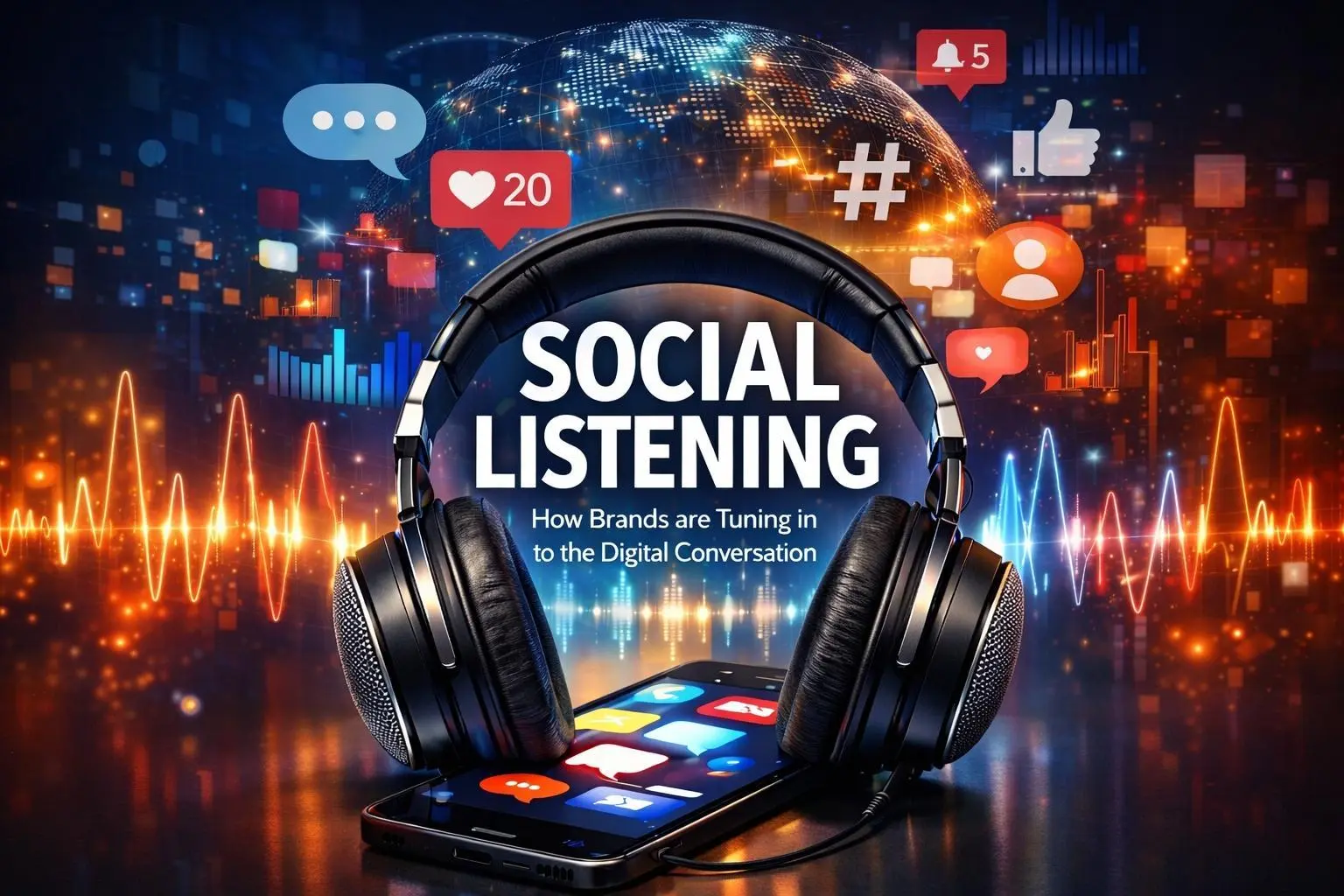
In the Philippine digital landscape, public sentiment is a volatile force. For government agencies and political figures, online conversations are no longer just “feedback”—they are the front lines of governance and reputation.
In an environment characterized by coordinated narrative shifts, misinformation, and high-stakes accountability, social listening in the Philippines has evolved. It is no longer about monitoring “likes”; it is about defending the truth and maintaining institutional stability.
Learn more about our comprehensive community management services and how we help organizations maintain authentic digital engagement.
1. The High-Stakes Reality of Public-Sector Discourse
In 2026, the digital space for Philippine leaders is defined by three distinct pressures:
Narrative Weaponization: Detractors and political opponents often use coordinated amplification to distort policy rollouts. The May 2025 “Bayan Muna Red-Tagging” incident demonstrated how false claims about party-list disqualification could spread faster than official COMELEC clarifications, utilizing coordinated social media “shouting” to drown out the truth.
The Misinformation Epidemic: False claims can go viral in minutes, causing public panic or eroding trust in government institutions. The May 2024 Marcos deepfake incident—where sophisticated audio fabrication portrayed the President ordering aggressive military action—required immediate multi-agency mobilization to prevent international diplomatic escalation. In a country where 90.8 million active social media users represent 78% of the total population, a single piece of manufactured content can reach critical mass within hours.
The Demand for Transparency: Citizens expect real-time responsiveness and absolute accountability. Yet 98.9% of Filipinos use chat and messenger services monthly—”dark social” channels where disinformation spreads invisibly to basic monitoring tools. Government agencies face the impossible task of maintaining transparency across platforms they cannot even see without enterprise-grade intelligence infrastructure.
At LeapOut, we believe that for government agencies, intelligence must precede communication. You cannot lead a conversation you do not fully understand. And in 2026, understanding requires capabilities that match the sophistication of those seeking to manipulate public opinion.
2. LeapOut & Meltwater: The Gold Standard for Public Intelligence
The threat landscape facing Philippine government institutions is no longer theoretical. It is documented, quantified, and escalating:
Foreign Interference Operations: Recent investigations have uncovered multi-million peso operations managing massive networks of fake accounts posing as teachers, laborers, and government employees to manufacture grassroots authenticity for foreign propaganda. In April 2025, the National Security Council flagged the use of local proxies to amplify divisive narratives and undermine the administration’s national security positions.
Industrial-Scale Coordinated Inauthentic Behavior: Meta’s May 2025 pre-election takedown removed thousands of fake accounts and pages days before the May 12 midterm polls—part of what researchers termed an “intensified firehose of falsehoods” designed to manipulate voter behavior at scale.
AI-Powered Disinformation: Deepfake technology has moved from experimental to operational. Hyper-partisan vlogger networks have deployed coordinated campaigns spreading fabricated allegations against high-ranking officials, requiring immediate institutional response to contain damage.
Our content marketing strategies help organizations develop authentic narratives that build trust and counter misinformation effectively.
Managing public perception in this environment requires enterprise-grade tools. LeapOut partners with Meltwater to provide government units and political leaders with a secure, robust intelligence ecosystem capable of matching these sophisticated threats.
Audit-Ready Data: Every insight is backed by a transparent data trail, essential for government compliance and reporting. When the Philippine National Police requested removal of 1,372 malicious posts in August 2025 alone, agencies needed documentation that could withstand legal scrutiny.
Hyper-Local Depth: Monitoring across Facebook, TikTok, X, Viber, WhatsApp, Telegram, and localized forums where regional political discourse actually happens. Basic tools miss the 98.9% of Filipinos using messenger services—precisely where coordinated campaigns operate beneath public visibility.
Explore our TikTok marketing expertise to understand how we navigate emerging social platforms where misinformation spreads rapidly.
Predictive Alerting: Advanced Boolean monitoring that flags potential PR crises or security threats before they breach the mainstream. The difference between containing a deepfake within niche channels versus managing international diplomatic fallout is measured in minutes, not hours.
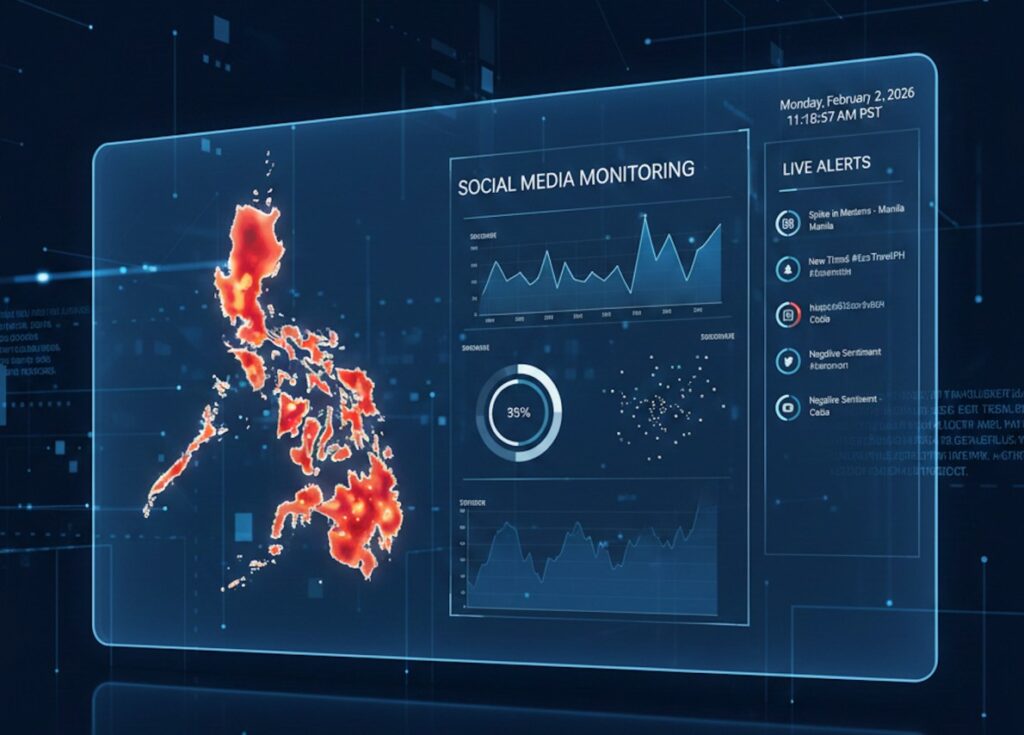
3. Critical Focus Areas for Government Agencies
Narrative Defense & Crisis Mitigation
We identify the “Patient Zero” of a misinformation campaign. By tracking how a false narrative spreads—whether it’s a multi-million peso foreign interference operation or a coordinated red-tagging campaign—we help agencies intervene at the exact point of escalation. When thousands of fake accounts activated days before the 2025 midterm elections, agencies with structured intelligence capabilities could distinguish between genuine voter discourse and manufactured amplification.
Citizen Sentiment & Policy Impact
How do Filipinos really feel about a new department order or legislative bill? With 90.8 million active social media users generating content across dozens of platforms and dialects, separating signal from noise requires more than keyword tracking. We filter out the “loud minority”—including the coordinated networks posing as “working-class Filipinos”—to provide leaders with an accurate pulse of genuine public sentiment.
Our social media advertising services leverage similar intelligence frameworks to reach authentic audiences and maximize campaign effectiveness.
Identifying Coordinated Inauthentic Behavior (CIB)
Distinguishing between genuine citizen grievances and “troll farm” activity is crucial. When hyper-partisan vlogger networks deploy coordinated campaigns, or when foreign proxy operations invest millions in manufacturing grassroots authenticity, leaders need intelligence systems that recognize behavioral patterns, timing anomalies, and network structures that reveal coordination. We help leaders ignore artificial noise and focus on real constituent needs.
Foreign Interference Detection
The National Security Council’s April 2025 identification of local proxies amplifying divisive narratives demonstrates that foreign interference is not abstract—it is operational and targeted. LeapOut’s monitoring frameworks are specifically designed to detect the linguistic patterns, funding indicators, and coordination signatures that distinguish foreign influence operations from domestic political discourse.
4. The LeapOut Workflow: Protecting the Mandate
Step | Focus for Leaders | Outcome | Real-World Application |
1. Architecture | Mapping Political Opponents & Key Issues | A tailored “early warning system” | Identifying multi-million peso networks before they achieve narrative dominance |
2. Monitoring | Real-time CIB & Misinformation Detection | Separation of real feedback from bots | Flagging coordinated activity across 90.8M users before Meta’s takedown |
3. Analysis | Risk Categorization (High/Medium/Low) | Prioritized response for leadership | Assessing deepfake threat level requiring multi-agency mobilization |
4. Activation | Strategic Narrative Counter-measures | Reclaiming the truth through PR/Social | PCO’s rapid response preventing diplomatic escalation |
5. Briefing | Executive Summaries for Decision Makers | Clear, actionable data for the “War Room” | NSC briefings on foreign proxy operations |
Discover how our SEO services in the Philippines can amplify your positive narratives and ensure your official messaging ranks prominently in search results.
5. Operating Under Public Scrutiny
We understand that government procurement and operations require a higher level of rigor. When the Philippine National Police documents 1,372 malicious posts requiring removal in a single month, the intelligence supporting those decisions must be defensible under legal and public scrutiny.
LeapOut’s processes are built for high-accountability environments:
Rigorous Documentation: Structured workflows that stand up to institutional audits, COMELEC complaints, and Freedom of Information requests. Every flagged account, narrative assessment, and response recommendation is backed by verifiable methodology.
Ethical Intelligence: Adhering to strict data privacy standards while maintaining comprehensive oversight. Our frameworks comply with the Data Privacy Act while providing the depth of monitoring necessary to detect sophisticated threats.
Defensible Strategy: Ensuring every public statement or policy adjustment is backed by verifiable data. When a deepfake threatens international relations or coordinated campaigns target electoral integrity, agencies need intelligence they can defend publicly.

6. Why Tools Alone Aren’t Enough for Politicians
A dashboard can show you that 1,372 posts were flagged, but it cannot tell you why a narrative is shifting in a specific province, whether a multi-million peso foreign operation is targeting your administration, or how to distinguish between genuine criticism and coordinated inauthentic behavior.
LeapOut provides the Human Intelligence layer that transforms data into strategic advantage:
Contextual Interpretation: Understanding local nuances, dialects, and political history. Recognizing that accounts posing as “teachers and laborers” require different analytical approaches than obvious bot networks.
Threat Attribution: Distinguishing between domestic opposition, foreign interference, commercial competitors, and genuine public concern. Foreign proxy networks and deepfake incidents require fundamentally different response strategies.
Decision Frameworks: Helping leaders decide when to engage, when to ignore, and when to proactively shift the narrative. With 98.9% of Filipinos using messenger services where conversations are invisible to basic tools, knowing where to engage is as important as knowing whether to engage.
Crisis Escalation Assessment: Determining whether a developing narrative will remain contained or explode into mainstream discourse requiring multi-agency coordination. The difference between routine monitoring and preventing diplomatic incidents depends on this judgment.
Our graphic design services support rapid response communications by creating compelling visual content that counters misinformation effectively.
The Critical Imperative: Nationwide and Localized Social Conversation Monitoring
The Philippines is not a monolith. What dominates Manila discourse may be completely irrelevant in Mindanao. What trends on national Twitter may contradict ground sentiment in the Visayas. For government agencies and political leaders operating across this archipelago of 7,641 islands, understanding the full spectrum of public sentiment requires both nationwide visibility and hyper-local granularity.
Why National Monitoring Alone Is Insufficient
Metro Manila-centric monitoring creates dangerous blind spots. National narratives often obscure regional grievances, local resistance to policies, or province-specific misinformation campaigns designed to exploit cultural and linguistic differences. A coordinated attack may test messaging in Davao before scaling to Luzon. A foreign interference operation may target specific ethnic communities or regional political rivalries invisible to English-language monitoring.
When the National Security Council flagged local proxy operations in 2025, these weren’t operating uniformly—they were tailored to regional contexts, exploiting local issues, personalities, and historical tensions. Generic national monitoring would miss entirely the nuanced ways these campaigns adapt to different audiences across the archipelago.
The LeapOut Approach: Layered Geographic Intelligence
Regional Dialect Monitoring: The Philippines has over 180 languages and dialects. Cebuano, Ilocano, Hiligaynon, Waray, and Tagalog conversations contain different sentiment patterns, cultural references, and political contexts. LeapOut’s monitoring frameworks account for linguistic diversity, ensuring that provincial conversations in vernacular languages receive the same analytical rigor as Manila’s English-language discourse.
Provincial Threat Mapping: Coordinated campaigns don’t always launch nationally—they often test and refine in specific regions before scaling. By maintaining granular monitoring across all regions, LeapOut detects emerging threats in their formative stages, whether it’s misinformation about agricultural policy spreading in Nueva Ecija or manufactured outrage about infrastructure projects targeting Cebu constituents.
Local Influencer Networks: National celebrities and politicians may dominate headline metrics, but provincial influencers, local radio commentators, barangay-level opinion leaders, and regional Facebook groups often drive actual behavior and sentiment in their communities. LeapOut maps these hyper-local influence networks, identifying the voices that genuinely shape opinion in specific geographic areas.
Learn about our influencer marketing services and how we identify and engage authentic voices that drive genuine community impact.
Sentiment Divergence Analysis: Understanding when and why regional sentiment diverges from national trends provides critical intelligence. Is opposition to a policy genuine and widespread, or concentrated in specific areas due to local factors? Are regional narratives being amplified artificially, or do they reflect authentic community concerns requiring tailored response?
Why This Matters for Government Strategy
Targeted Resource Allocation: When you know that misinformation is concentrated in Region XI while genuine concern exists in Region III, you can deploy communications resources effectively rather than broadcasting generic messaging that resonates nowhere.
Early Warning for Regional Escalation: Social unrest rarely begins nationally—it starts locally and either spreads or remains contained based on response. Provincial monitoring provides the lead time to address grievances before they become movements.
Electoral Intelligence: Political campaigns live and die by provincial dynamics. Understanding that your messaging works in Pampanga but fails in Bohol, or that coordinated attacks are targeting your barangay-level support in specific municipalities, makes the difference between strategic response and wasted resources.
Policy Impact Assessment: National rollouts of government programs produce varied reactions across regions. Real-time provincial monitoring reveals implementation challenges, local resistance points, and regional success stories that inform adjustment and scaling decisions.
Cultural Competence: Responding to Tausug-speaking communities in BARMM requires different cultural awareness than engaging Ilocano voters in the Ilocos Region. Localized monitoring ensures that response strategies respect regional identity, history, and communication norms.
The Infrastructure Required
Executing nationwide and localized monitoring at this scale requires more than adding “province” as a filter in a basic social listening tool. It demands:
- Multi-lingual Boolean frameworks calibrated to regional dialects and colloquialisms
- Geographically distributed data collection that captures provincial social platforms and forums ignored by Manila-centric tools
- Regional analyst expertise who understand local political history, cultural context, and community dynamics
- Scalable reporting architecture that can deliver both national executive summaries and granular provincial intelligence briefs
- Cross-regional pattern detection that identifies when localized campaigns are part of larger coordinated operations
This is the infrastructure LeapOut and Meltwater provide. When 90.8 million Filipinos are distributed across thousands of communities speaking hundreds of languages, national monitoring without local depth is simply intelligence theater—the appearance of awareness without actual understanding.
7. The Result: A Resilient Reputation
By integrating Meltwater’s technology with LeapOut’s strategic expertise, government agencies can:
- Neutralize black propaganda before it gains traction: Detecting the “firehose of falsehoods” before thousands of fake accounts achieve their objective—not after Meta’s post-election takedown.
- Counter foreign interference operations: Identifying the multi-million peso networks and local proxy operations that the National Security Council has flagged as active threats to institutional stability.
- Protect against AI-weaponized disinformation: Establishing deepfake detection and rapid response protocols that prevent audio fabrications from escalating into international incidents.
- Humanize public figures by identifying and amplifying positive organic sentiment buried beneath coordinated noise.
- Stabilize public trust through data-driven, transparent communication backed by intelligence that can withstand public scrutiny.
- Understand the archipelago, not just the capital: Gaining visibility into regional sentiment, provincial threats, and local opportunities that generic national monitoring completely misses.

8. Closing: Intelligence as Infrastructure
For the modern Philippine leader, structured listening is not a campaign luxury—it is governance infrastructure.
When 90.8 million Filipinos are actively engaged across platforms you cannot monitor manually, when foreign operations invest millions in manufactured narratives, when AI-generated deepfakes can trigger diplomatic crises, and when thousands of coordinated accounts activate days before critical elections—basic monitoring is not protection.
It is the shield that protects your mandate from the 1,372 malicious posts flagged in a single month. It is the early warning system that detects multi-million peso foreign interference operations before they achieve their objectives. It is the difference between managing a deepfake within your communications team versus mobilizing multi-agency diplomatic containment.
It is the capability that reveals what citizens in Zamboanga think about your policy while understanding how Baguio residents respond differently—intelligence that recognizes the Philippines as an archipelago of diverse communities, not a monolithic audience.
Protect your mandate with intelligence that matches the threat.
Is your agency equipped to detect a narrative threat before it becomes a crisis? Can you distinguish between the 90.8 million genuine voices and the coordinated networks designed to drown them out? Do you understand what’s happening in the provinces, or only what’s trending in Manila? Let LeapOut show you how to turn digital noise into institutional intelligence.
The question is no longer whether your institution needs enterprise-grade social listening. The question is whether you can afford to operate without it.
Ready to protect your mandate? Contact us to schedule a confidential consultation about your organization’s intelligence needs.
View our pricing packages to find a solution tailored to your agency’s requirements and budget.
LeapOut: Strategic intelligence for leaders who understand that in 2026, reputation is defended with data, not declarations.

Marv Ortiz is a leading growth strategist, recognized for driving transformative results for businesses across a variety of industries. As co-founder of LeapOut, Marv has worked with global enterprises and government organizations, helping them achieve measurable outcomes in revenue growth, digital transformation, and market expansion.
With over 16 years of experience, Marv has partnered with a wide range of companies, from fast-growing startups to Fortune Global 500 brands, guiding them through the complexities of digital initiatives and operational enhancements. His strategic insight has helped businesses expand their market presence and optimize performance, positioning them for long-term success.
Known for his ability to deliver tangible, lasting results, Marv is a trusted advisor to business owners and executive teams. His true passion lies in helping both enterprises and SMEs grow, innovate, and achieve sustainable success in competitive environments.