GEO in the Philippines:
Why Most Filipino Businesses—Especially E-Commerce—Are Already Behind

GEO in the Philippines:
Why Most Filipino Businesses—Especially E-Commerce—Are Already Behind

Marv  │  Managing Partner, LeapOut Digital  │  Former Head of Search, Major US Retail E-commerce  │  April 2026

I lead a team of search specialists—SEO and SEM—for one of the largest US retail e-commerce operations before moving back to build LeapOut Digital. I’ve managed search strategy across millions of SKUs, watched consumer intent data at scale, and seen firsthand how a single infrastructure decision can either surface or bury an entire product catalog.

When I say most Philippine businesses are not ready for Generative Engine Optimization—I’m not guessing. I’m pattern-matching against what I watched happen in US retail five years ago. We had the same debates. The same hesitations. The same tendency to wait until the problem was undeniable.

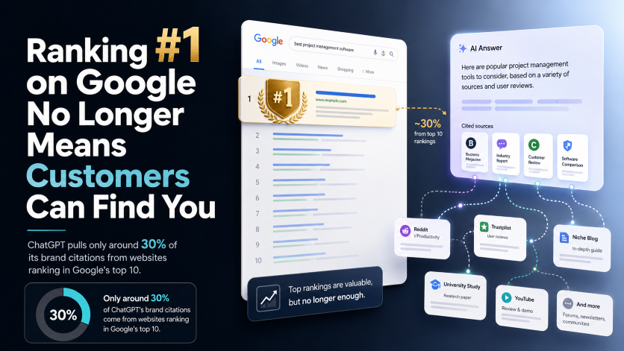
GEO is the practice of optimizing your content and brand presence so that AI platforms—ChatGPT, Google AI Overviews, Perplexity, Gemini, Claude—cite, mention, or recommend you when users ask questions. Not ranking at position #1. Being part of the answer itself.

This article covers GEO for all businesses. But I’m going to spend significant time on e-commerce specifically—because the e-commerce challenge is more structural, more urgent, and more misunderstood than most GEO content acknowledges.

🇵🇭  The Philippine context in one sentence: Filipinos are high-volume, high-trust searchers—and AI search is now inheriting that trust. When ChatGPT or Gemini gives a confident answer in the Philippines, users act on it. Being cited is no longer just a visibility play. It’s a trust play.


1. AI Is Already Deciding What Gets Bought

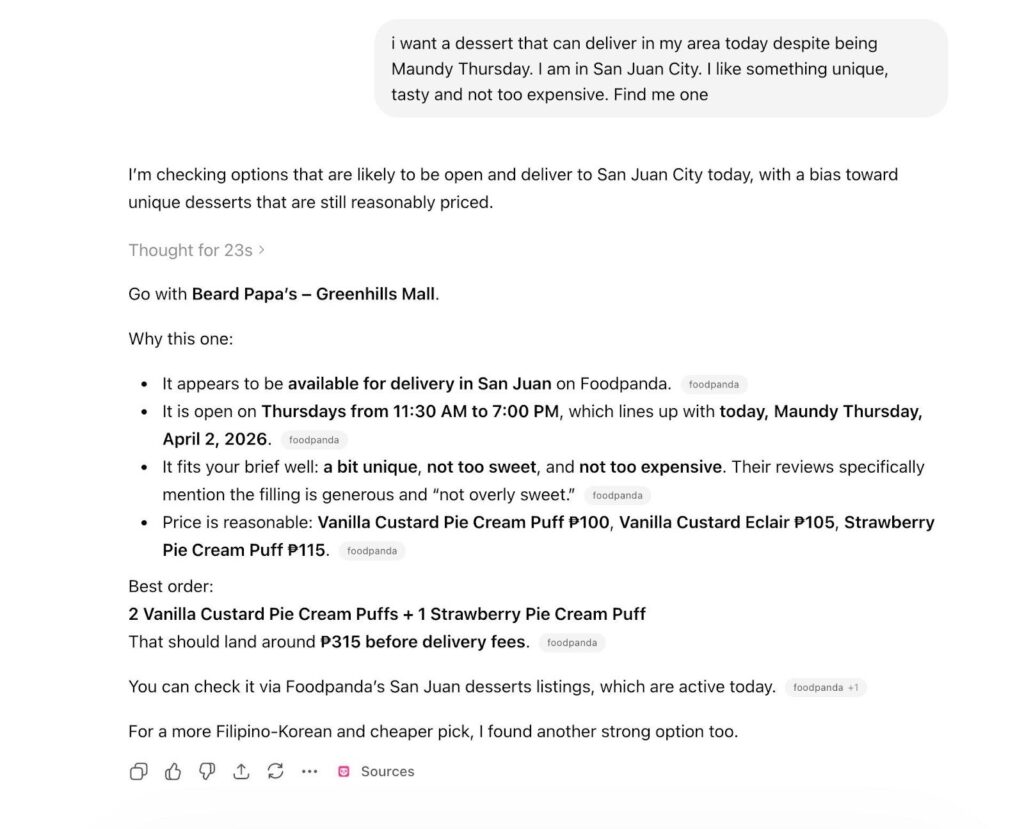
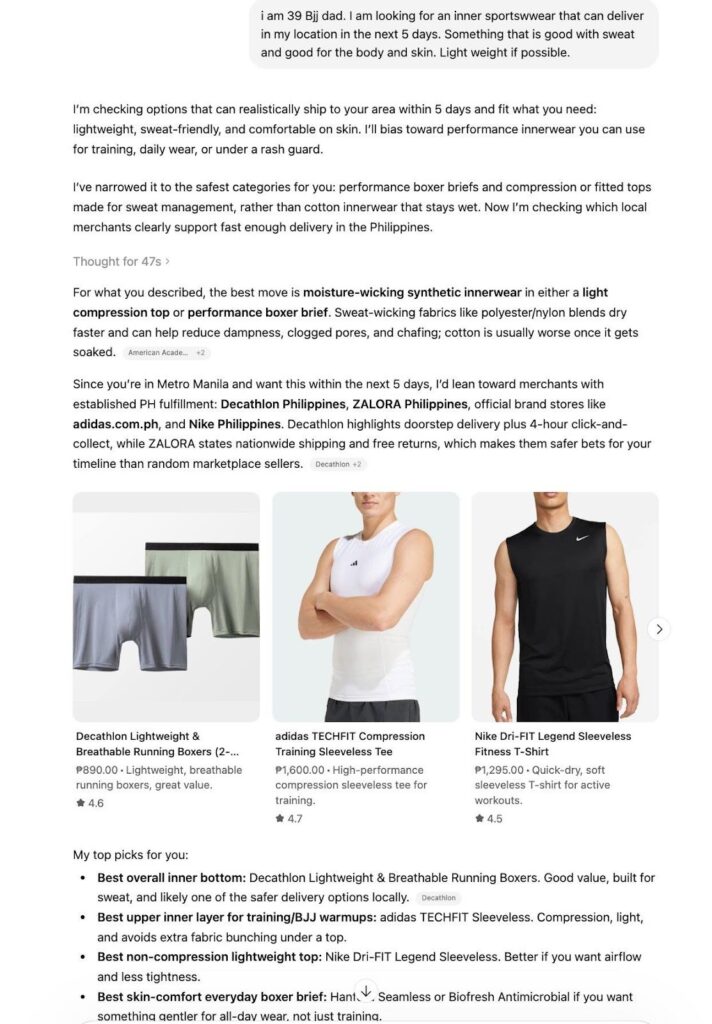
Before we talk strategy, look at what’s already happening. These two screenshots are from real AI conversations in the Philippines on April 2, 2026.

SCENARIO 1: “I WANT A DESSERT THAT CAN DELIVER TODAY IN SAN JUAN CITY”

AI recommends a specific store, explains why it fits, and suggests an exact order. Beard Papa’s Greenhills won—not because they ran ads, but because their data was accessible.

SCENARIO 2: “I AM A BJJ DAD LOOKING FOR INNER SPORTSWEAR THAT CAN DELIVER IN 5 DAYS”

AI reads the buyer’s context, filters by delivery reliability, and surfaces specific SKUs with prices and ratings. Decathlon, ZALORA, adidas.com.ph, Nike Philippines won the citation. No ad was served.

What these screenshots are telling you:

AI is not just answering questions. It is making purchasing recommendations with specific products, specific prices, specific stores, and specific delivery windows.

If your brand, product, or store didn’t appear in those answers—it’s not because the AI couldn’t find you. It’s because your data wasn’t structured well enough for the AI to trust you with a recommendation.

2. GEO vs. SEO: The Key Differences

Understanding GEO starts with knowing how it differs from—and builds on—traditional SEO services in the Philippines. The table below captures the key distinctions.


3. The E-Commerce Problem Nobody’s Talking About

Here’s the conversation I keep having with e-commerce clients: “We have 10,000 SKUs. Our site is on Shopify. We’re running Google Shopping. We’re doing SEO. Why aren’t we showing up in AI answers?”

The answer is structural—and it has nothing to do with how much content you have.

The Deep Catalog Problem

A traditional search engine indexes your pages and ranks them. A generative AI does something fundamentally different: it reads your product data, evaluates whether it can confidently recommend a specific product for a specific user need, and makes a judgment call.

For a business with 10,000 SKUs, that judgment call fails for most of your catalog because:

  • Product descriptions are written for humans, not machines. “Premium quality, stylish design, perfect for any occasion.” This tells an AI nothing. It cannot answer “is this good for sweat management?” from that description.
  • Attributes are incomplete or inconsistent. Size, color, material, use case, compatibility—these need to be machine-readable structured fields, not prose buried in a paragraph.
  • Inventory data is stale or siloed. AI agents need real-time stock levels per location. If your inventory system doesn’t sync with your product pages, the AI cannot confidently recommend a product with a specific delivery window.
  • Schema markup is missing or shallow. Most PH e-commerce stores implement basic product schema at best. The full picture—availability by variant, shipping estimates, return policy, aggregate ratings—is rarely structured correctly.
 

What AI needs vs. what most PH e-commerce stores provide

Source: LeapOut assessment framework, industry benchmarks (Mirakl, Creatuity 2026). PH estimates based on client audits.


The Merchandising Disconnect

Here’s what makes this worse for Philippine e-commerce specifically: most local brands separate their merchandising team from their SEO team. The people who decide how products are described are not the same people optimizing for search. With traditional SEO, that gap was manageable. With GEO, it’s a structural failure.

AI systems make recommendations by synthesizing product attributes, reviews, delivery capabilities, and brand credibility. If your merchandising data doesn’t feed correctly into a machine-readable format, the AI simply skips you—not out of preference, but out of insufficient confidence.

💡 The merchandising fix:

GEO forces a conversation that should have happened at the start of every e-commerce build: “How will a machine understand this product?” Every SKU needs structured, attribute-level data that answers the questions a customer would ask an expert:

What is it made of? What is it best used for? What size/color/variant is in stock? How fast can it deliver to this location? What do verified buyers say about it?

If your product page can’t answer those questions in a machine-readable format, you are invisible to AI agents regardless of your SEO rankings.

4. Can AI Actually Recommend a Specific Product From 10,000 SKUs Based on Color, Stock, and Delivery?

This is the question I get most from e-commerce operators—and it’s the right question to ask. The honest answer: yes, but only if your infrastructure supports it. And most stores’ infrastructure does not.

Let me break down what has to be true for an AI agent to answer: “I want a navy blue compression top in large, in stock, that can deliver to Quezon City within 5 days.”


What Actually Happens When You Ask AI to Shop for You

The two screenshots at the start of this article are not magic. They show something very specific: AI agents pulling from Foodpanda’s live delivery index (Screenshot 1) and from Decathlon’s structured product catalog and delivery SLA (Screenshot 2).

Foodpanda won the dessert recommendation because:

  • Their merchant data includes structured operating hours by day
  • Their delivery radius and availability is mapped in real-time
  • Reviews and flavor descriptions are structured and crawlable

Decathlon won the sportswear recommendation because:

  • Their product attributes (lightweight, breathable, moisture-wicking) are structured
  • Their delivery SLA (“doorstep delivery”) is explicit and machine-readable
  • Their catalog is indexed and accessible to AI crawlers with complete schema

🔍 The technical enabler: Model Context Protocol (MCP)

The technology making this possible at scale is MCP—Model Context Protocol. It creates a real-time “pipe” between an AI agent and your inventory system.

With MCP, an AI agent can query your live stock levels, check variant availability (color, size), pull delivery estimates by warehouse location, and verify pricing before making a recommendation—all in real time.

Without MCP or equivalent real-time data access, the AI is working from stale indexed information. That’s when it hallucinates: recommending a product that’s out of stock, quoting a price that changed, or suggesting a delivery window that doesn’t match logistics reality.

The Reality Check for Philippine E-Commerce

Question

Possible Today?

What’s Required

Can AI recommend a specific color/size that’s in stock?

✅ Yes—if infrastructure is ready

Real-time inventory sync + variant-level product schema + MCP or feed integration

Can AI filter by 5-day delivery to a specific city?

⚠️ Partial—depends on logistics data

Delivery SLA data must be machine-readable and location-mapped (Decathlon does this; most PH SMEs don’t)

Can AI surface a product from 10,000 SKUs by use case?

✅ Yes—if attributes are structured

Semantic product attributes (use case, material, performance specs)—not just name and price

Can AI complete the purchase autonomously?

🔄 Emerging—not mainstream in PH yet

ACP (Agent Commerce Protocol by OpenAI/Stripe) or Shopify’s ChatGPT checkout integration required

Can a store with Facebook-only presence win GEO?

❌ No

Facebook is not crawlable by most AI agents. A structured product catalog on an indexable domain is the prerequisite.

The bottom line: AI can absolutely do this—and it’s already doing it for the stores that are ready. The gap isn’t technology. The gap is data infrastructure. Most Philippine e-commerce businesses are still optimizing their product pages for human eyes. AI needs them optimized for machine comprehension.

5. What Triggers GEO? (And What’s Different From SEO)

GEO and SEO share the same foundation. But GEO adds layers that SEO doesn’t require.

Trigger Layer

What It Means

SEO Overlap?

Retrievability

Can AI crawlers find and access your content?

High. Same technical hygiene: crawlability, clean HTML, robots.txt, sitemaps. ChatGPT Search uses Bing’s index—Bing Webmaster Tools is not optional.

Extractability

Can AI pull a standalone passage and use it accurately?

Partial. SEO rewards depth. GEO rewards self-contained, front-loaded answers. Every paragraph should work as a standalone citation.

Entity clarity

Does AI know exactly who you are, what you sell, and why you’re credible?

Diverges. SEO focuses on your own site. GEO requires consistent brand identity across LinkedIn, GBP, Wikidata, directories, and review platforms.

Real-time data (E-com)

Can AI trust your inventory, pricing, and logistics data?

New for GEO. Traditional SEO has no real-time data requirement. GEO agents need live feeds. Stale data = hallucinations = AI deprioritizes you.

Cross-web credibility

Is your brand mentioned and validated across trusted platforms?

Diverges. SEO values backlinks. GEO values earned brand mentions in reviews, forums, publications—even unlinked mentions carry weight in AI models.

6. If You Did SEO Before, Does It Help?

Yes—and for e-commerce brands with established organic presence, the advantage is significant. Here’s the precise transfer:

Your SEO Work

GEO Transfer Value

High-quality product content

AI extracts attribute-rich descriptions. Depth and accuracy matter more than keyword density.

Backlink authority

Cross-web credibility signal. AI cross-references your brand across sources it already trusts.

Technical SEO (speed, crawlability)

Same requirements for AI crawlers. Clean, fast, server-side rendered sites perform better.

Schema markup (even basic)

Head start on machine-readability. Extend it with variant-level product, offer, and review schema.

Google Business Profile

Core local GEO signal. AI scrapes operating hours, reviews, services, and Q&As from GBP directly.

Topical authority / content clusters

AI recognizes domain-level expertise. Owning a category area transfers directly into citation preference.

Google Merchant Center feed

If your feed is accurate and updated frequently, it feeds AI Overviews’ product recommendation layer.

The compounding advantage I see at LeapOut:

E-commerce clients who invested in SEO consistently for 12+ months have a much faster GEO path. Their structured product data is cleaner, their authority signals are established, and the remaining work is extending schema depth and ensuring real-time data integrity.

Clients who treated SEO as a short-term project? They’re starting much closer to zero than they think.

7. No SEO Yet? Here’s Your Path

GEO without SEO is harder—but the path depends on your business type.

For E-Commerce Businesses (No SEO Foundation)

Your priority sequence:

  1. Get your product catalog on an indexable domain. Facebook is not sufficient. You need a website—Shopify, WooCommerce, or any platform where product schema can be implemented.
  2. Implement product schema on day one. Every SKU: name, brand, SKU, price, availability, images, and AggregateRating. This is not optional.
  3. Sync your inventory to Google Merchant Center. This feeds AI Overviews’ shopping layer. Set up hourly sync minimum.
  4. Submit sitemaps to both Google Search Console and Bing Webmaster Tools. ChatGPT Search uses Bing’s index.
  5. Optimize your Google Business Profile completely. Hours, services, categories, Q&As, photos. AI scrapes this for local product queries.
  6. Start accumulating structured reviews on Google and Trustpilot. Star ratings, recency, and review volume are explicit GEO signals.

For Service Businesses and Non-E-Commerce (No SEO Foundation)

You have two parallel paths:

  • Build SEO + GEO simultaneously: Write content that is answer-structured from day one. Use conversational headings, front-loaded answers, FAQ sections, and schema markup as you build.
  • Build off-site presence first: YouTube, LinkedIn, Reddit Philippines communities, and business directories are all sources AI actively indexes. Build brand presence there while your site matures.

8. Which Philippine Industries Win at GEO First?

GEO Opportunity by Industry — Philippine Market (LeapOut Assessment)

E-commerce earns “Very High” when it’s niche-specific. A store selling BJJ gear, maternal health products, or specialty coffee has significantly higher GEO win probability than a general merchandise store—because AI can confidently categorize and recommend from a focused catalog. The broader your assortment without niche authority, the harder GEO becomes.

9. The Forecast: Where Is GEO Heading?

25%

Search Volume Drop

Gartner predicts by 2026

37%+

Organic Traffic Loss

some sites, due to AI Overviews absorbing clicks

4,700%

AI-Driven Retail Traffic Growth

YoY by mid-2025 (Adobe)

Horizon

What to Expect in PH

2025–2026Now

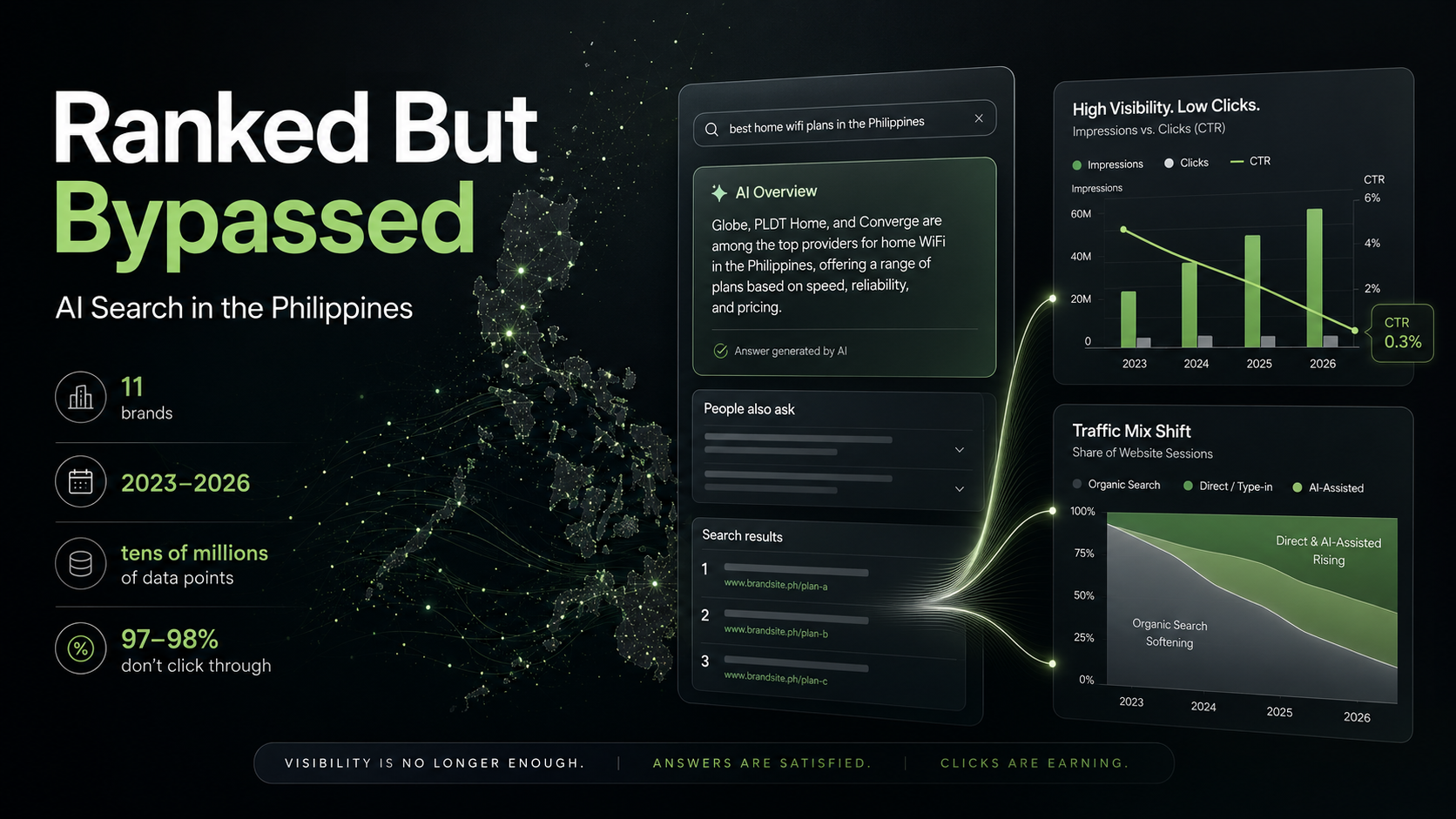
Traditional SEO and GEO run in parallel. Google AI Overviews appear on the SERPs Filipinos already use—no ChatGPT switch required. Impressions rising, clicks falling. The ‘jaw graph’ is real and accelerating.

2027–2029Medium term

AI-native search goes mainstream among urban Filipinos. Metro Manila first, then cascading outward. Brands that build GEO credibility now compound that advantage as AI systems reinforce trusted sources. Agentic commerce—AI completing purchases autonomously—starts entering Philippine consumer behavior.

2030+Long term

SEO and GEO distinction becomes academic. Entity clarity—consistent, accurate, authoritative presence across every platform—is the only durable strategy. The brands that built this foundation early become the defaults AI reaches for. Late entrants pay a premium to compete for positions early movers already own.

My forecast for Philippine e-commerce specifically:

The stores that win AI citations in the next 12–18 months will build sustainable, compounding advantages that are genuinely difficult to displace. AI systems develop preferred sources over time. Early citation patterns influence future recommendations.

The same window existed in Philippine e-commerce SEO circa 2013–2015. The stores that invested then dominated organically for years. The ones that waited spent the next decade paying to compete for ground they could have owned.

GEO is running on the same timeline. The window is open. It will not stay open.

10. The Pattern That Will Repeat Itself

I’ve been in this industry long enough to have watched the same mistake made twice.

When SEO was gaining traction in the Philippines, the businesses that fell behind weren’t the ones who tried and failed. They were the ones who chased shortcuts. Bought links. Stuffed keywords. Hired cheap content farms. Wanted to look like an authority without doing the work of building one.

GEO will follow the exact same arc. The shortcuts are already appearing:

  • Agencies promising to “make your brand rank in ChatGPT” with AI-generated content volume
  • Businesses stuffing brand mentions into low-quality posts hoping AI picks them up
  • E-commerce stores adding schema markup to five products and calling it done

These will not work. AI systems are built to detect authority and trust patterns. Manufactured signals get filtered, the same way Google learned to filter manipulative backlinks.

And then there’s the other pattern: the 30-day mentality. GEO compounds over time. The businesses that want results in 30 days and move on when they don’t see them will always underperform—not because the strategy is wrong, but because they didn’t give the compounding enough time to work.

The honest advice:

GEO—especially for e-commerce—is not a sprint. It is infrastructure. The brands that treat it that way will look back in 24 months and wonder why their competitors are scrambling to catch up.

The brands that treat it like a campaign will be among those competitors.

11. To SEO Specialists: Your Moment Is Here

I want to address the practitioners reading this directly.

You’ve heard “SEO is dead” so many times it’s almost comedic. Panda. Penguin. Featured snippets. Voice search. Every time, someone declared the end. Every time, the practitioners who understood that search is fundamentally about serving user needs—they adapted and kept building.

GEO is not the end of SEO. GEO is SEO’s next form. The core discipline transfers directly: understanding intent, building authority, technical architecture, earning credible citations, measuring and iterating.

What I see in the Philippine market is that the SEO practitioners who treated the craft as a set of tricks are struggling with this transition. The ones who treated it as a discipline built on genuine helpfulness? They’re adapting faster than they expected.

The industry has been quiet and stable for a while. GEO is your moment to speak louder. The skills you’ve built are exactly what businesses—especially e-commerce businesses—need right now. The bridge between SEO and GEO is the most valuable position in Philippine digital marketing today.

12. E-Commerce GEO Checklist: Where to Start

Immediate (This Week)

  1. Audit your AI presence. Search “tell me about [your brand]” and “what is the best [your category] in [your city]?” in ChatGPT and Gemini. Document exactly what comes back. This is your GEO baseline.
  2. Check robots.txt. Ensure GPTBot, OAI-SearchBot, PerplexityBot, and Bingbot are not blocked at yourdomain.com/robots.txt.
  3. Submit to Bing Webmaster Tools. ChatGPT Search uses Bing’s index. If you haven’t submitted a sitemap to Bing, do it today.
  4. Audit one product category. Pick your top-selling category. For each product: Does it have structured attributes? Is inventory synced in real-time? Is delivery information machine-readable?
  5. Verify Google Business Profile. Complete, accurate hours, categories, services, and photos. AI scrapes this for every local query involving your brand or category.

30 Days

  • Implement full Product schema on your top 100 SKUs: name, brand, SKU, price, availability, AggregateRating, and Offers with priceCurrency
  • Connect Google Merchant Center feed to your platform with minimum hourly sync
  • Rewrite your top 20 product descriptions to be attribute-first, not marketing-first: material, use case, performance specs, compatibility
  • Add FAQ schema to your top category pages targeting real buyer questions from your support tickets
  • Request 10–15 new Google reviews from satisfied customers asking for specific product details in the review

60–90 Days: Build Cross-Web Credibility

  • Get listed in at least two industry listicles relevant to your niche—even small regional publications build entity signals
  • Create YouTube product demos or comparison videos—long-form platform content AI actively indexes
  • Ensure brand name, address, category, and key positioning are identical across GBP, LinkedIn, Trustpilot, and any directory listing
  • Begin tracking AI visibility monthly using Semrush AI Toolkit, Surfer AI Tracker, or manual ChatGPT/Gemini prompt audits
  • Evaluate Product Information Management (PIM) system if catalog exceeds 5,000 SKUs—manual attribute management at that scale is not sustainable for GEO

If You’re Not Doing This, You’re Losing Ground

That’s not rhetoric. It’s the same statement that was true about SEO in 2012 and about mobile optimization in 2015.

The businesses appearing in AI answers today are not there by accident. They built structured catalogs. They earned real reviews. They maintained consistent brand presence across every platform AI trusts. They gave AI enough confidence to recommend them by name, with specific products, specific prices, and specific delivery windows.

The screenshots at the start of this article prove it’s already happening in the Philippines. The question is whether your brand is in those answers—or watching competitors get cited while you’re not.

The window is open. Build now.

Picture of Marvin Ortiz
Marvin Ortiz

Marv Ortiz is a leading growth strategist, recognized for driving transformative results for businesses across a variety of industries. As co-founder of LeapOut, Marv has worked with global enterprises and government organizations, helping them achieve measurable outcomes in revenue growth, digital transformation, and market expansion.

With over 16 years of experience, Marv has partnered with a wide range of companies, from fast-growing startups to Fortune Global 500 brands, guiding them through the complexities of digital initiatives and operational enhancements. His strategic insight has helped businesses expand their market presence and optimize performance, positioning them for long-term success.

Known for his ability to deliver tangible, lasting results, Marv is a trusted advisor to business owners and executive teams. His true passion lies in helping both enterprises and SMEs grow, innovate, and achieve sustainable success in competitive environments.

RECENT BLOGS

Shopify B2B Is Now Available on Every Plan: What It Means for Merchants (and the Playbook to Launch It)

On April 2, 2026, Shopify extended its native B2B features to merchants on Basic, Grow, and Advanced plans — ending nearly four years of Plus-only access. Here’s why the announcement matters, what it unlocks for Southeast Asian merchants, and a step-by-step playbook for getting your first wholesale buyer live. The news, in one line Shopify B2B — company profiles, custom catalogs, volume discounts, quantity rules, vaulted credit cards, and payment terms — is now available at no extra cost on Basic, Grow, and Advanced plans. Previously, these features were exclusive to Shopify Plus.  For nearly four years, native B2B lived behind the Plus paywall. That paywall was the single biggest structural reason DTC-first brands didn’t touch wholesale. It wasn’t that the demand wasn’t there — it was that doing it properly meant either replatforming or stitching together third-party apps. Both were expensive. Both killed momentum.  That reason is now gone. What replaces it is a harder problem most merchants aren’t ready to face: designing a B2B offer worth buying.  Why Shopify opening B2B to every plan matters The global B2B ecommerce market is worth roughly $36 trillion — an order of magnitude larger than DTC. Most brand founders don’t feel the gap because their entire operating stack (ads, funnels, attribution, CRM) is built for the consumer. Procurement lives in a different universe.  But the signals are almost always there. A retailer DMs asking for wholesale pricing. A clinic chain places five identical orders in a month. A corporate gifting buyer asks for an invoice with payment terms. Most merchants treat these as edge cases. They’re not edge cases. They’re the opening of a second business inside the first one.  Shopify’s own data on merchants already running B2B is hard to ignore:  Up to 4.1x reorder frequency versus DTC  Up to 33% increase in self-serve orders within six months  40% higher average customer spend (Snyder Performance Engineering case)  25% reduction in back-office time  Those numbers don’t come from a new acquisition channel. They come from unlocking revenue that was already trying to happen.  What’s now included on Basic, Grow, and Advanced plans Shopify merchants on non-Plus plans now have access to:  Company profiles for wholesale buyers (separate identity from DTC customers)  Up to three custom catalogs with tailored pricing per buyer group  Volume discounts and quantity rules (tiered pricing, minimum order quantities)  Vaulted credit cards for repeat-order convenience  Payment terms — Net 15, Net 30, Net 60, and custom arrangements  Native integration with Shopify Payments, Shopify Flow, and Shopify Markets  Everything runs from one admin. One source of truth for both DTC and B2B. No plugins required.  What’s still exclusive to Shopify Plus For brands with complex wholesale operations, Plus retains meaningful advantages:  Unlimited custom catalogs (vs. the three-catalog cap on lower tiers)  Direct catalog assignment to specific companies and company locations  Partial payments and deposits  Advanced B2B checkout customization  The full suite of enterprise B2B workflows  The takeaway: Plus remains the right home for brands with dozens of wholesale accounts across multi-location buyers. For everyone else — the 90% whose B2B ambition starts with “a handful of clinics,” “twenty boutique resellers,” or “a growing list of cafes” — three catalogs is more than enough to test, prove, and scale before replatforming becomes a real question.  What this unlocks for Southeast Asian merchants Most SEA-based Shopify brands are on Basic, Grow, or Advanced. Plus adoption in the region remains concentrated among enterprise merchants. Which means native B2B, until this rollout, was effectively out of reach for the majority of brands who would benefit from it most — DTC-first operators with growing trade demand they didn’t know how to serve.  Here’s what that looks like on the ground.  The skincare brand getting DMs from clinics. A Manila-based skincare label notices aesthetic clinics and spas ordering in bulk through regular checkout, then asking for invoices and wholesale pricing after the fact. Instead of building a messy workaround, they spin up a B2B catalog with per-unit pricing tiers and Net 30 terms. Each clinic gets a company profile. Orders now self-serve, invoices go out automatically, and the founder stops being the accounts receivable department.  The coffee roaster selling to cafes. A specialty roaster outside Metro Manila has fifteen cafes on a Viber order list, each messaging their weekly orders to one sales coordinator. They move that list onto a B2B catalog with per-kilo pricing, a 5kg minimum, and vaulted card payment. Cafes log in, reorder their usual, and get dispatched the same day. The sales coordinator stops managing spreadsheets and starts calling prospects.  The apparel brand selling to boutiques. A streetwear label building a reseller network creates a tiered catalog — Tier 1 at 40% off RRP with a 50-unit quarterly commitment, Tier 2 at 30%. Each boutique logs in, sees only their pricing, and places orders without renegotiating every season. Sell-through data starts flowing in, and the brand finally learns which retailers are actually moving product versus sitting on inventory.  The wellness brand doing corporate gifting. A supplements brand gets a Q4 inquiry from a corporate wellness program for 500 curated bundles. Instead of handling it over email with a spreadsheet, they create a company profile for the client, a private catalog with the negotiated bundle price, and invoice-based payment terms. Next year, the same client reorders themselves. A new revenue line exists inside the same store.  None of these require replatforming. None require an agency to build a custom portal. All of them require the brand to decide what its B2B offer actually is. The trap: the tech is easy. The commercial design isn’t. This is the part most merchants will miss.  Turning on native B2B takes an afternoon. Designing a B2B offer that’s actually worth buying takes real thinking. What’s your MOQ? What’s your wholesale margin structure? Who qualifies for Net 30 and who pays upfront? What does pricing look like for a boutique committing to a quarterly order versus one reordering ad hoc? Do you ship to multi-location companies, and how do you handle split invoicing and taxes?  These are commercial questions, not technical ones. Shopify just removed the technical excuse. The brands

Continue Reading

GEO in the Philippines:
Why Most Filipino Businesses—Especially E-Commerce—Are Already Behind

Marv  │  Managing Partner, LeapOut Digital  │  Former Head of Search, Major US Retail E-commerce  │  April 2026 I lead a team of search specialists—SEO and SEM—for one of the largest US retail e-commerce operations before moving back to build LeapOut Digital. I’ve managed search strategy across millions of SKUs, watched consumer intent data at scale, and seen firsthand how a single infrastructure decision can either surface or bury an entire product catalog. When I say most Philippine businesses are not ready for Generative Engine Optimization—I’m not guessing. I’m pattern-matching against what I watched happen in US retail five years ago. We had the same debates. The same hesitations. The same tendency to wait until the problem was undeniable. GEO is the practice of optimizing your content and brand presence so that AI platforms—ChatGPT, Google AI Overviews, Perplexity, Gemini, Claude—cite, mention, or recommend you when users ask questions. Not ranking at position #1. Being part of the answer itself. This article covers GEO for all businesses. But I’m going to spend significant time on e-commerce specifically—because the e-commerce challenge is more structural, more urgent, and more misunderstood than most GEO content acknowledges. 🇵🇭  The Philippine context in one sentence: Filipinos are high-volume, high-trust searchers—and AI search is now inheriting that trust. When ChatGPT or Gemini gives a confident answer in the Philippines, users act on it. Being cited is no longer just a visibility play. It’s a trust play.   1. AI Is Already Deciding What Gets Bought Before we talk strategy, look at what’s already happening. These two screenshots are from real AI conversations in the Philippines on April 2, 2026. SCENARIO 1: “I WANT A DESSERT THAT CAN DELIVER TODAY IN SAN JUAN CITY” AI recommends a specific store, explains why it fits, and suggests an exact order. Beard Papa’s Greenhills won—not because they ran ads, but because their data was accessible. SCENARIO 2: “I AM A BJJ DAD LOOKING FOR INNER SPORTSWEAR THAT CAN DELIVER IN 5 DAYS” AI reads the buyer’s context, filters by delivery reliability, and surfaces specific SKUs with prices and ratings. Decathlon, ZALORA, adidas.com.ph, Nike Philippines won the citation. No ad was served. What these screenshots are telling you: AI is not just answering questions. It is making purchasing recommendations with specific products, specific prices, specific stores, and specific delivery windows. If your brand, product, or store didn’t appear in those answers—it’s not because the AI couldn’t find you. It’s because your data wasn’t structured well enough for the AI to trust you with a recommendation. 2. GEO vs. SEO: The Key Differences Understanding GEO starts with knowing how it differs from—and builds on—traditional SEO services in the Philippines. The table below captures the key distinctions.   3. The E-Commerce Problem Nobody’s Talking About Here’s the conversation I keep having with e-commerce clients: “We have 10,000 SKUs. Our site is on Shopify. We’re running Google Shopping. We’re doing SEO. Why aren’t we showing up in AI answers?” The answer is structural—and it has nothing to do with how much content you have. The Deep Catalog Problem A traditional search engine indexes your pages and ranks them. A generative AI does something fundamentally different: it reads your product data, evaluates whether it can confidently recommend a specific product for a specific user need, and makes a judgment call. For a business with 10,000 SKUs, that judgment call fails for most of your catalog because: Product descriptions are written for humans, not machines. “Premium quality, stylish design, perfect for any occasion.” This tells an AI nothing. It cannot answer “is this good for sweat management?” from that description. Attributes are incomplete or inconsistent. Size, color, material, use case, compatibility—these need to be machine-readable structured fields, not prose buried in a paragraph. Inventory data is stale or siloed. AI agents need real-time stock levels per location. If your inventory system doesn’t sync with your product pages, the AI cannot confidently recommend a product with a specific delivery window. Schema markup is missing or shallow. Most PH e-commerce stores implement basic product schema at best. The full picture—availability by variant, shipping estimates, return policy, aggregate ratings—is rarely structured correctly.   What AI needs vs. what most PH e-commerce stores provide Source: LeapOut assessment framework, industry benchmarks (Mirakl, Creatuity 2026). PH estimates based on client audits.   The Merchandising Disconnect Here’s what makes this worse for Philippine e-commerce specifically: most local brands separate their merchandising team from their SEO team. The people who decide how products are described are not the same people optimizing for search. With traditional SEO, that gap was manageable. With GEO, it’s a structural failure. AI systems make recommendations by synthesizing product attributes, reviews, delivery capabilities, and brand credibility. If your merchandising data doesn’t feed correctly into a machine-readable format, the AI simply skips you—not out of preference, but out of insufficient confidence. The merchandising fix: GEO forces a conversation that should have happened at the start of every e-commerce build: “How will a machine understand this product?” Every SKU needs structured, attribute-level data that answers the questions a customer would ask an expert: What is it made of? What is it best used for? What size/color/variant is in stock? How fast can it deliver to this location? What do verified buyers say about it? If your product page can’t answer those questions in a machine-readable format, you are invisible to AI agents regardless of your SEO rankings. 4. Can AI Actually Recommend a Specific Product From 10,000 SKUs Based on Color, Stock, and Delivery? This is the question I get most from e-commerce operators—and it’s the right question to ask. The honest answer: yes, but only if your infrastructure supports it. And most stores’ infrastructure does not. Let me break down what has to be true for an AI agent to answer: “I want a navy blue compression top in large, in stock, that can deliver to Quezon City within 5 days.”   What Actually Happens When You Ask AI to Shop for

Continue Reading

From Noise to Intelligence: How LeapOut and Meltwater Safeguard Public Trust for Government and Political Leaders

In the Philippine digital landscape, public sentiment is a volatile force. For government agencies and political figures, online conversations are no longer just “feedback”—they are the front lines of governance and reputation. In an environment characterized by coordinated narrative shifts, misinformation, and high-stakes accountability, social listening in the Philippines has evolved. It is no longer about monitoring “likes”; it is about defending the truth and maintaining institutional stability. Learn more about our comprehensive community management services and how we help organizations maintain authentic digital engagement. 1. The High-Stakes Reality of Public-Sector Discourse In 2026, the digital space for Philippine leaders is defined by three distinct pressures: Narrative Weaponization: Detractors and political opponents often use coordinated amplification to distort policy rollouts. The May 2025 “Bayan Muna Red-Tagging” incident demonstrated how false claims about party-list disqualification could spread faster than official COMELEC clarifications, utilizing coordinated social media “shouting” to drown out the truth. The Misinformation Epidemic: False claims can go viral in minutes, causing public panic or eroding trust in government institutions. The May 2024 Marcos deepfake incident—where sophisticated audio fabrication portrayed the President ordering aggressive military action—required immediate multi-agency mobilization to prevent international diplomatic escalation. In a country where 90.8 million active social media users represent 78% of the total population, a single piece of manufactured content can reach critical mass within hours. The Demand for Transparency: Citizens expect real-time responsiveness and absolute accountability. Yet 98.9% of Filipinos use chat and messenger services monthly—”dark social” channels where disinformation spreads invisibly to basic monitoring tools. Government agencies face the impossible task of maintaining transparency across platforms they cannot even see without enterprise-grade intelligence infrastructure. At LeapOut, we believe that for government agencies, intelligence must precede communication. You cannot lead a conversation you do not fully understand. And in 2026, understanding requires capabilities that match the sophistication of those seeking to manipulate public opinion. 2. LeapOut & Meltwater: The Gold Standard for Public Intelligence The threat landscape facing Philippine government institutions is no longer theoretical. It is documented, quantified, and escalating: Foreign Interference Operations: Recent investigations have uncovered multi-million peso operations managing massive networks of fake accounts posing as teachers, laborers, and government employees to manufacture grassroots authenticity for foreign propaganda. In April 2025, the National Security Council flagged the use of local proxies to amplify divisive narratives and undermine the administration’s national security positions. Industrial-Scale Coordinated Inauthentic Behavior: Meta’s May 2025 pre-election takedown removed thousands of fake accounts and pages days before the May 12 midterm polls—part of what researchers termed an “intensified firehose of falsehoods” designed to manipulate voter behavior at scale. AI-Powered Disinformation: Deepfake technology has moved from experimental to operational. Hyper-partisan vlogger networks have deployed coordinated campaigns spreading fabricated allegations against high-ranking officials, requiring immediate institutional response to contain damage. Our content marketing strategies help organizations develop authentic narratives that build trust and counter misinformation effectively. Managing public perception in this environment requires enterprise-grade tools. LeapOut partners with Meltwater to provide government units and political leaders with a secure, robust intelligence ecosystem capable of matching these sophisticated threats. Audit-Ready Data: Every insight is backed by a transparent data trail, essential for government compliance and reporting. When the Philippine National Police requested removal of 1,372 malicious posts in August 2025 alone, agencies needed documentation that could withstand legal scrutiny. Hyper-Local Depth: Monitoring across Facebook, TikTok, X, Viber, WhatsApp, Telegram, and localized forums where regional political discourse actually happens. Basic tools miss the 98.9% of Filipinos using messenger services—precisely where coordinated campaigns operate beneath public visibility. Explore our TikTok marketing expertise to understand how we navigate emerging social platforms where misinformation spreads rapidly. Predictive Alerting: Advanced Boolean monitoring that flags potential PR crises or security threats before they breach the mainstream. The difference between containing a deepfake within niche channels versus managing international diplomatic fallout is measured in minutes, not hours. 3. Critical Focus Areas for Government Agencies Narrative Defense & Crisis Mitigation We identify the “Patient Zero” of a misinformation campaign. By tracking how a false narrative spreads—whether it’s a multi-million peso foreign interference operation or a coordinated red-tagging campaign—we help agencies intervene at the exact point of escalation. When thousands of fake accounts activated days before the 2025 midterm elections, agencies with structured intelligence capabilities could distinguish between genuine voter discourse and manufactured amplification. Citizen Sentiment & Policy Impact How do Filipinos really feel about a new department order or legislative bill? With 90.8 million active social media users generating content across dozens of platforms and dialects, separating signal from noise requires more than keyword tracking. We filter out the “loud minority”—including the coordinated networks posing as “working-class Filipinos”—to provide leaders with an accurate pulse of genuine public sentiment. Our social media advertising services leverage similar intelligence frameworks to reach authentic audiences and maximize campaign effectiveness. Identifying Coordinated Inauthentic Behavior (CIB) Distinguishing between genuine citizen grievances and “troll farm” activity is crucial. When hyper-partisan vlogger networks deploy coordinated campaigns, or when foreign proxy operations invest millions in manufacturing grassroots authenticity, leaders need intelligence systems that recognize behavioral patterns, timing anomalies, and network structures that reveal coordination. We help leaders ignore artificial noise and focus on real constituent needs. Foreign Interference Detection The National Security Council’s April 2025 identification of local proxies amplifying divisive narratives demonstrates that foreign interference is not abstract—it is operational and targeted. LeapOut’s monitoring frameworks are specifically designed to detect the linguistic patterns, funding indicators, and coordination signatures that distinguish foreign influence operations from domestic political discourse. 4. The LeapOut Workflow: Protecting the Mandate Step Focus for Leaders Outcome Real-World Application 1. Architecture Mapping Political Opponents & Key Issues A tailored “early warning system” Identifying multi-million peso networks before they achieve narrative dominance 2. Monitoring Real-time CIB & Misinformation Detection Separation of real feedback from bots Flagging coordinated activity across 90.8M users before Meta’s takedown 3. Analysis Risk Categorization (High/Medium/Low) Prioritized response for leadership Assessing deepfake threat level requiring multi-agency mobilization 4. Activation Strategic Narrative Counter-measures Reclaiming the truth through PR/Social PCO’s rapid response preventing

Continue Reading