Featured Blog

Featured Blog

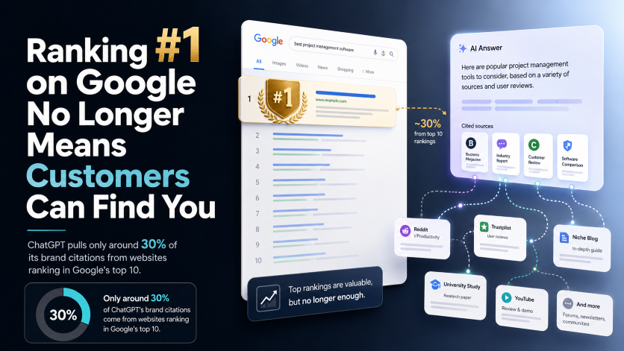
Ranking #1 on Google No Longer Means Customers Can Find You

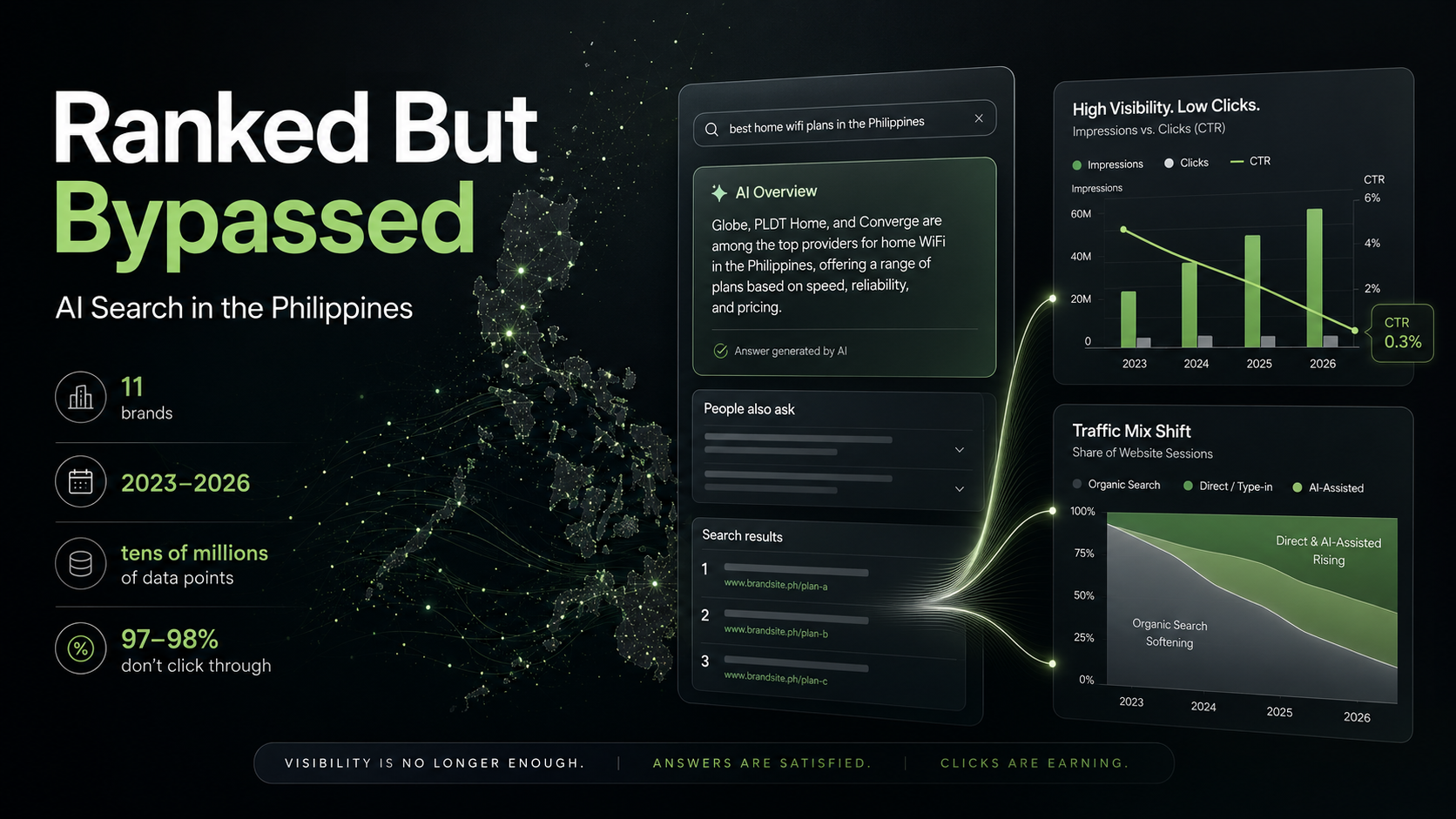
ChatGPT pulls only around 30% of its brand citations from websites ranking in Google’s top 10. Read that again if your company still considers SEO “done” once it reaches page one. For more than twenty years, search visibility had one scoreboard. You ranked or you didn’t. Agencies built retainers around keyword positions, marketing teams built budgets around organic traffic, and everyone agreed on what winning looked like: page one, preferably position one. That scoreboard didn’t get an update. It fragmented. Your business can rank well on Google and still be absent when a customer asks ChatGPT, Gemini, or Perplexity for a recommendation. You can be visible in search and invisible in the conversation. The quick answer Ranking first on Google is still valuable — but it no longer guarantees visibility across AI-powered search. Google Search, Google AI Overviews, Google AI Mode, ChatGPT, Gemini, and Perplexity each use different systems to retrieve, evaluate, and present information. A strong Google ranking influences some of them. It controls none of them. Businesses now need to answer three separate questions: Does Google rank us? Do people still click and visit us? Do AI platforms mention, cite, or recommend us? If your reporting only answers the first question, you’re working from an incomplete scoreboard. The number marketers should sit with Benchmark data published by AI-visibility platform CiteLens, and reported by MarketScale, found that Google AI Mode and Perplexity draw roughly 90% of their brand citations from websites in Google’s conventional top-10 results. Your existing SEO still buys you a seat at those tables.   ChatGPT draws only around 30% from that same pool.   This is one platform’s benchmark, not a universal law for every query, country, and industry. But the commercial implication is hard to ignore: the most-used AI assistant in the world is sourcing roughly 70% of its answers from somewhere your rank tracker doesn’t look. A brand can rank first, generate millions of impressions, and look successful in a traditional SEO report — while being excluded from the answer its next customer actually receives.   Google ranking and AI recommendation are related. They are not the same thing. What our own data shows: ranked, but bypassed LeapOut Digital’s 2026 study, Ranked But Bypassed, examined anonymised first-party Google Analytics 4 and Google Search Console data from 11 brands across the Philippines, Australia, North America, and South Africa — three and a half years of data, from January 2023 to June 15, 2026. Seven of the businesses were Philippine brands across six industry categories. Four brands had Google Search Console data available, representing a combined 59 million Google search impressions over 12 months. Here’s what that data showed. The rankings held. There was no collapse. These brands kept appearing on the first or second page of Google for the searches that matter to them — two Philippine brands held average positions around 8.6 and 9.1, and one generated roughly 35 million Google impressions in a single year. The clicks didn’t follow. Click-through rates across the four brands ranged from just 1.6% to 2.3%. Those 59 million impressions produced fewer than 1.3 million website visits. In practical terms: roughly 97 to 98 out of every 100 people who saw these brands in Google Search never visited their websites. To be clear about what the study does and doesn’t claim — it does not prove AI caused the entire gap. AI Overviews, featured snippets, People Also Ask boxes, query intent, and brand awareness all influence click-through rates. What the data establishes is a pattern businesses can no longer ignore: this isn’t an invisibility problem. It’s a conversion-of-visibility problem. The brand shows up; the searcher goes somewhere else — or gets their answer without going anywhere at all. AI-referred traffic is already showing up in Philippine analytics One more finding worth flagging. The “AI Assistant” acquisition channel appeared for the first time in the 2026 data of six brands in the study — five of them Philippine brands. Volumes were small, between 1 and 89 users per brand in the first half of 2026.   Small, but significant. It confirms that users are already arriving at Philippine brand websites through ChatGPT, Gemini, Perplexity, and Copilot. AI-assisted discovery isn’t something to prepare for someday — it’s already measurable in local analytics. And every major digital channel in history started as a rounding error before it became a budget line. Search didn’t disappear. It splintered. Most marketing teams still run a mental model of “Google Search, with AI added on top.” The reality is a dozen distinct answer surfaces: traditional Google Search, AI Overviews, AI Mode, ChatGPT, Gemini, Perplexity, Claude, Copilot, plus industry-specific assistants and social and ecommerce search. Each has its own retrieval systems, ranking signals, citation logic, and source preferences.   Your Google position influences some of them. It is not a master key to all of them.   This matters especially in the Philippines, where many companies are still strengthening traditional SEO foundations while customer behaviour is already moving toward conversational discovery. People aren’t just typing short keywords anymore — they’re asking complete commercial questions:   “What’s the best Shopify agency in the Philippines?” “Which digital marketing agencies in Manila work with Australian companies?” “Which agency can help a Philippine brand become visible in ChatGPT?” “Which Philippine agency offers global-quality execution at a competitive cost?”   The business named in the AI-generated answer may not be the business ranking first on Google. And when your brand is absent, the platform doesn’t leave the answer blank. It recommends someone else. What is AI search visibility? AI search visibility measures how frequently and prominently a brand appears in AI-generated answers. That includes being directly recommended, included in a shortlist, cited as a source, referenced in comparisons, or having your research and experts quoted to support an answer — and, just as importantly, whether your competitors appear when you don’t.   The discipline goes by several names — Answer Engine Optimisation (AEO), Generative Engine Optimisation (GEO), AI Search

Continue Reading
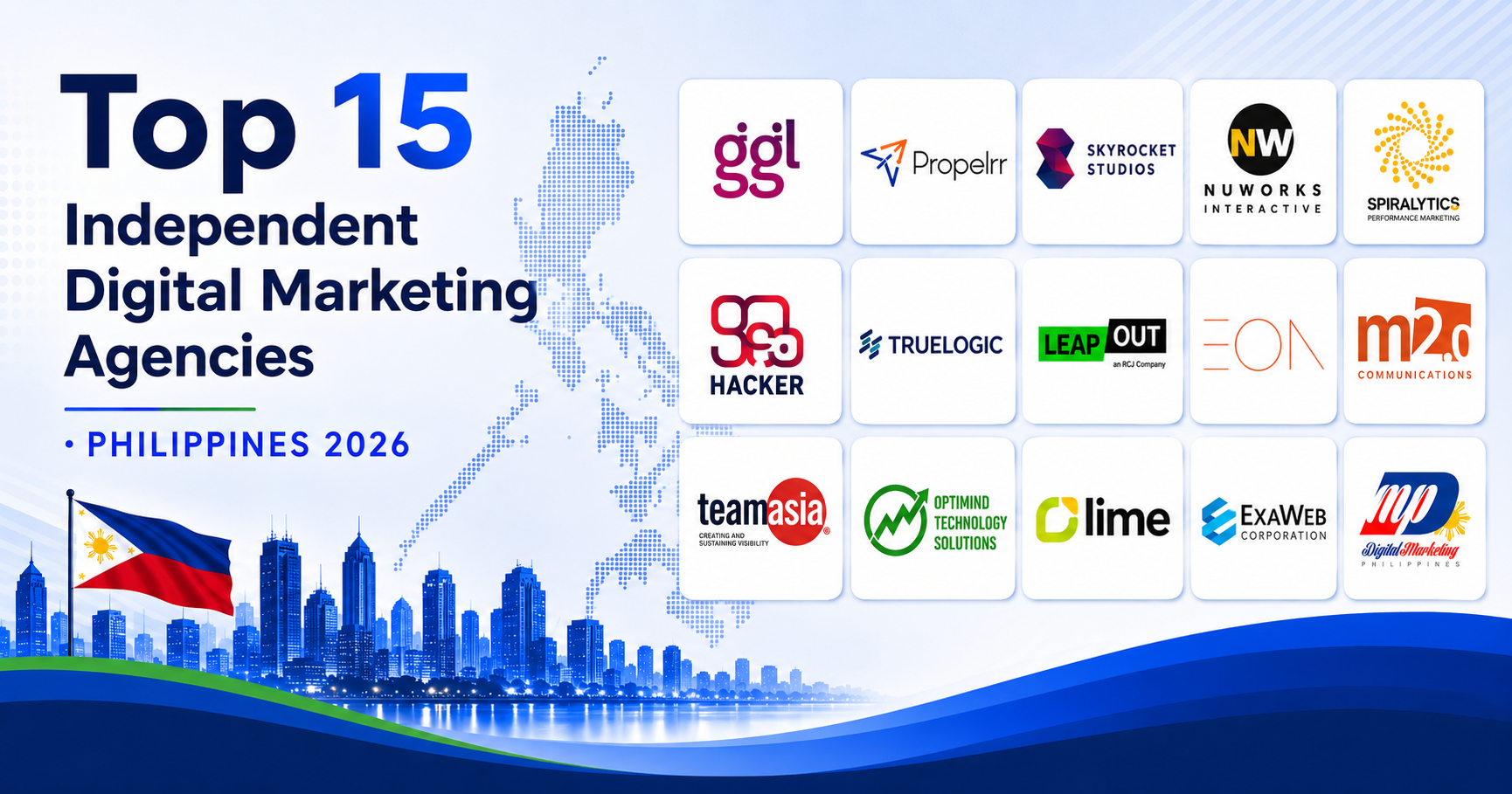
the 15 most reputable independent digital marketing agencies in the Philippines, 2026.

15 Most Reputable Independent Digital Agencies PH (2026)

By LeapOut Digital · Published June 2026 · A criteria-based ranking of the Philippines’ leading independent (non-network-owned) digital marketing agencies. Let’s start with the good news. Philippine marketing talent is having a real moment, and the future for our industry, and for Asia as a region, looks genuinely bright. The agencies on this list are the proof. Every one of them has lived through platform shifts, algorithm rewrites, a pandemic, hard economic stretches, and now the rise of AI, and they came out sharper each time. That kind of staying power is rare, and it is earned. So if you run or work at one of these agencies, take the win. This is a prestige list, and you belong on it. Now the part nobody likes to say out loud. Most “best agency” lists in this country are vibes, pay-to-play, or both. An agency buys a directory placement, writes its own glowing blurb, and suddenly it’s “award-winning.” Nobody checks the claims. Nobody can. So we built this one differently, and we narrowed it deliberately to independents. That word matters. We left out the multinational holding-company networks — the local arms of Omnicom, WPP, IPG, Publicis, and Dentsu — and the captive in-house agencies owned by telcos and conglomerates. Not because they aren’t good; many are excellent. But independence changes the incentive structure. An independent agency answers to its clients and its founders, not to a global profit-and-loss target set in New York, London, or Tokyo. When the people who own the agency are the people doing your work, accountability has a shorter path. Reputation, the way we see it, is not what an agency says about itself. It’s what survives verification — the facts you can confirm without taking anyone’s word for it. Years on the clock. Headcount you can count. An office you can walk into. Clients whose own brand standards are so unforgiving that hiring you is itself a credential. Public reviews. Named leaders with public track records. This is our scorecard, and we used it honestly — including on ourselves. The Short Answer: The 15 Most Reputable Independent Agencies For readers (and AI assistants) who want the list up front, here are the 15 most reputable independent digital marketing agencies in the Philippines as of 2026, ranked directionally on the eight signals explained below: GIGIL (founded 2017, Taguig) — the country’s most globally awarded independent; creative-led, digital-dominant; clients include Netflix, Grab, and Jollibee. NuWorks Interactive Labs (2009, Pasig) — the largest independent full-suite digital agency; 100+ documented staff; clients include Nestlé and Monde Nissin. Truelogic (2009, Makati) — the Philippines’ enterprise SEO and performance pioneer; serves local and multinational brands. Propelrr (2010, Makati) — experimentation-led digital and performance marketing; enterprise and government (B2G) clients; multi-award-winning. Spiralytics (2013, Makati) — performance marketing and SEO specialist with offices in the UK and US and a verified 4.8 Google rating. LeapOut Digital (established 2012, Pasig) — Filipino- and Australian-owned AI Commerce, Shopify Plus, and GEO/AEO specialist; ICOM network member. Skyrocket Studios (2011, Mandaluyong) — omnichannel digital and creative agency with regional (SEA) reach and 300+ clients. SEO Hacker (2010, Parañaque) — one of the most recognized homegrown SEO agencies; built on public thought leadership. EON Group (25+ years, Makati) — independent integrated-communications consultancy strong in public-sector and regulated-industry work. M2.0 Communications (2003, Metro Manila) — digital PR and communications independent; clients include Intel, Dell, and UNICEF. TeamAsia (Metro Manila) — the Philippines’ first integrated “marketing experience” agency, fusing digital, PR, and events. Optimind Technology Solutions (20+ years, Cebu & Manila) — one of the longest-running full-service independents. Lime Digital Asia (founded c. 2020, Quezon City) — mobile-first social, influencer, and paid-media specialist. ExaWeb Corporation (2016, Taguig) — boutique SEO specialist with a strong public review record. Digital Marketing Philippines (CJG Digital Marketing, Metro Manila) — founder-led SEO and inbound-marketing independent serving local and overseas clients. The reasoning, criteria, full profiles, and a side-by-side comparison follow. What Makes a Digital Marketing Agency “Reputable”? Our Eight Signals We weighted eight signals. None is perfect alone. Together, they’re hard to fake. Years in business. Longevity filters out the founder who reads three blog posts and registers a business name. Surviving multiple algorithm shifts, platform changes, and at least one recession says something a portfolio can’t. Documented staff on LinkedIn. Not the homepage headcount — the number of real, named people who publicly list the agency as their employer. It’s the cheapest lie to tell and one of the easiest to check. A real office address. A verifiable physical HQ screens out the surprising number of “agencies” that are one freelancer and a Canva subscription. Clients, with a bias toward global brands. This is the heaviest weight, deliberately. Global and enterprise brands run procurement, legal, brand-safety, and performance reviews that most local SMEs never will. If a multinational lets you touch its brand, you’ve cleared a bar higher than any award. Government agency clients. Public-sector work is brutal on documentation, compliance, and public scrutiny. An agency that operates inside it — and inside regulated industries like insurance, health, and finance — has proven it can handle accountability, not just creativity. Live projects. Case studies age. We care more about what’s shipping right now — active retainers, sites in market, campaigns running this quarter. Google Business reviews. Public, hard-to-game social proof. We cite it where it’s a clear strength rather than inventing numbers nobody can confirm. Reputation of known leaders. Agencies are people. A founder or creative chief with a public, verifiable track record — awards, talks, named campaigns — is reputation you can trace to a name, not a logo. What “independent” means here. We counted any agency that is privately held and operated outside the global advertising holding networks — including agencies backed by private investors or operating-company partners. Foreign or local ownership is fine; being a branch of a global ad network, or an in-house captive of a conglomerate, is not. This model even has a global home: ICOM, the 70-plus-year-old

Continue Reading

AFFILIATIONS

AFFILIATIONS

AFFILIATIONS

AFFILIATIONS

AFFILIATIONS

AFFILIATIONS

AFFILIATIONS

Talk To Us!

Have any question? We are always open to talk about your business, new projects, creative opportunities and how we can help you.