On April 2, 2026, Shopify extended its native B2B features to merchants on Basic, Grow, and Advanced plans — ending nearly four years of Plus-only access. Here’s why the announcement matters, what it unlocks for Southeast Asian merchants, and a step-by-step playbook for getting your first wholesale buyer live.
The news, in one line
Shopify B2B — company profiles, custom catalogs, volume discounts, quantity rules, vaulted credit cards, and payment terms — is now available at no extra cost on Basic, Grow, and Advanced plans. Previously, these features were exclusive to Shopify Plus.
For nearly four years, native B2B lived behind the Plus paywall. That paywall was the single biggest structural reason DTC-first brands didn’t touch wholesale. It wasn’t that the demand wasn’t there — it was that doing it properly meant either replatforming or stitching together third-party apps. Both were expensive. Both killed momentum.
That reason is now gone. What replaces it is a harder problem most merchants aren’t ready to face: designing a B2B offer worth buying.
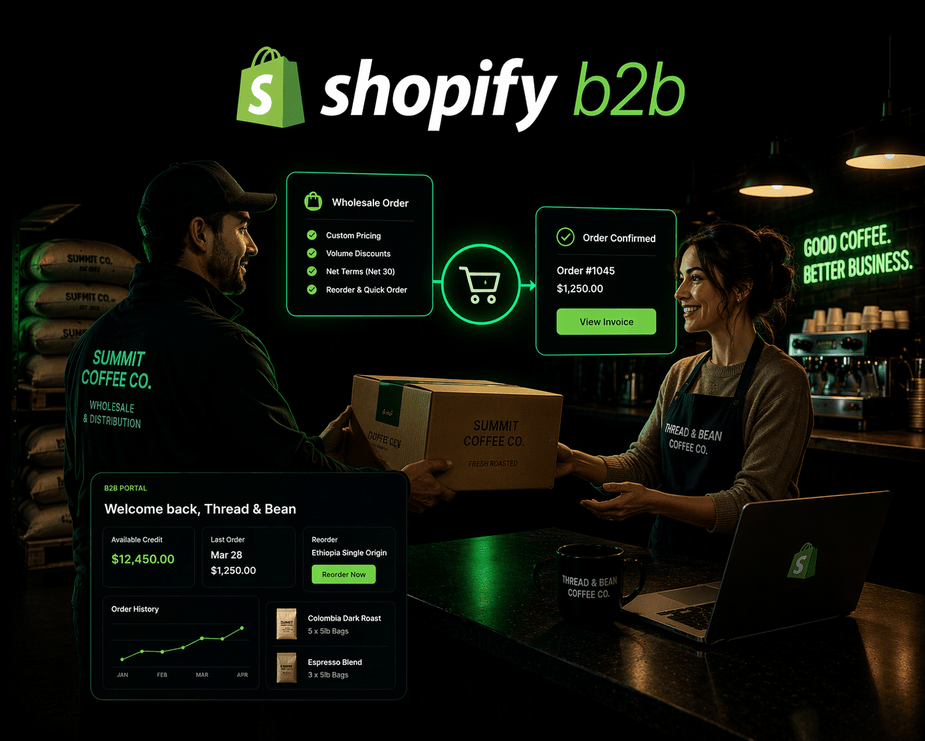
Why Shopify opening B2B to every plan matters
The global B2B ecommerce market is worth roughly $36 trillion — an order of magnitude larger than DTC. Most brand founders don’t feel the gap because their entire operating stack (ads, funnels, attribution, CRM) is built for the consumer. Procurement lives in a different universe.
But the signals are almost always there. A retailer DMs asking for wholesale pricing. A clinic chain places five identical orders in a month. A corporate gifting buyer asks for an invoice with payment terms. Most merchants treat these as edge cases. They’re not edge cases. They’re the opening of a second business inside the first one.
Shopify’s own data on merchants already running B2B is hard to ignore:
- Up to 4.1x reorder frequency versus DTC
- Up to 33% increase in self-serve orders within six months
- 40% higher average customer spend (Snyder Performance Engineering case)
- 25% reduction in back-office time
Those numbers don’t come from a new acquisition channel. They come from unlocking revenue that was already trying to happen.
What's now included on Basic, Grow, and Advanced plans
Shopify merchants on non-Plus plans now have access to:
- Company profiles for wholesale buyers (separate identity from DTC customers)
- Up to three custom catalogs with tailored pricing per buyer group
- Volume discounts and quantity rules (tiered pricing, minimum order quantities)
- Vaulted credit cards for repeat-order convenience
- Payment terms — Net 15, Net 30, Net 60, and custom arrangements
- Native integration with Shopify Payments, Shopify Flow, and Shopify Markets
Everything runs from one admin. One source of truth for both DTC and B2B. No plugins required.
What's still exclusive to Shopify Plus
For brands with complex wholesale operations, Plus retains meaningful advantages:
- Unlimited custom catalogs (vs. the three-catalog cap on lower tiers)
- Direct catalog assignment to specific companies and company locations
- Partial payments and deposits
- Advanced B2B checkout customization
- The full suite of enterprise B2B workflows
The takeaway: Plus remains the right home for brands with dozens of wholesale accounts across multi-location buyers. For everyone else — the 90% whose B2B ambition starts with “a handful of clinics,” “twenty boutique resellers,” or “a growing list of cafes” — three catalogs is more than enough to test, prove, and scale before replatforming becomes a real question.
What this unlocks for Southeast Asian merchants
Most SEA-based Shopify brands are on Basic, Grow, or Advanced. Plus adoption in the region remains concentrated among enterprise merchants. Which means native B2B, until this rollout, was effectively out of reach for the majority of brands who would benefit from it most — DTC-first operators with growing trade demand they didn’t know how to serve.

Here’s what that looks like on the ground.
The skincare brand getting DMs from clinics. A Manila-based skincare label notices aesthetic clinics and spas ordering in bulk through regular checkout, then asking for invoices and wholesale pricing after the fact. Instead of building a messy workaround, they spin up a B2B catalog with per-unit pricing tiers and Net 30 terms. Each clinic gets a company profile. Orders now self-serve, invoices go out automatically, and the founder stops being the accounts receivable department.
The coffee roaster selling to cafes. A specialty roaster outside Metro Manila has fifteen cafes on a Viber order list, each messaging their weekly orders to one sales coordinator. They move that list onto a B2B catalog with per-kilo pricing, a 5kg minimum, and vaulted card payment. Cafes log in, reorder their usual, and get dispatched the same day. The sales coordinator stops managing spreadsheets and starts calling prospects.
The apparel brand selling to boutiques. A streetwear label building a reseller network creates a tiered catalog — Tier 1 at 40% off RRP with a 50-unit quarterly commitment, Tier 2 at 30%. Each boutique logs in, sees only their pricing, and places orders without renegotiating every season. Sell-through data starts flowing in, and the brand finally learns which retailers are actually moving product versus sitting on inventory.
The wellness brand doing corporate gifting. A supplements brand gets a Q4 inquiry from a corporate wellness program for 500 curated bundles. Instead of handling it over email with a spreadsheet, they create a company profile for the client, a private catalog with the negotiated bundle price, and invoice-based payment terms. Next year, the same client reorders themselves. A new revenue line exists inside the same store.
None of these require replatforming. None require an agency to build a custom portal. All of them require the brand to decide what its B2B offer actually is.
The trap: the tech is easy. The commercial design isn't.
This is the part most merchants will miss.
Turning on native B2B takes an afternoon. Designing a B2B offer that’s actually worth buying takes real thinking. What’s your MOQ? What’s your wholesale margin structure? Who qualifies for Net 30 and who pays upfront? What does pricing look like for a boutique committing to a quarterly order versus one reordering ad hoc? Do you ship to multi-location companies, and how do you handle split invoicing and taxes?
These are commercial questions, not technical ones. Shopify just removed the technical excuse. The brands that win the next 24 months in Southeast Asian commerce will be the ones who treat B2B as a product, not a feature.
If you’d rather skip the DIY on the commercial design, LeapOut runs an AI Commerce Readiness Audit that covers exactly this — pricing tiers, payment terms, buyer qualification, catalog architecture, and how to set it up inside Shopify without tripping over edge cases. Typical engagement: 2–3 weeks, ₱80K–₱150K fixed fee.
The B2B Launch Playbook: From Zero to First Wholesale Buyer on Shopify
If you’re reading this and recognizing your business in the scenarios above, here’s the practical sequence. It’s written to be done by a founder or ops lead in roughly 2–4 weeks of focused work.
Phase 1 — Design the commercial offer (before you touch Shopify)
Every B2B failure on Shopify traces back to skipping this phase. The technical setup is worthless without these decisions.
Step 1: Audit your existing signals. Pull the last 90 days of orders. Flag anything with:
- Business email domains (non-gmail/yahoo/etc.)
- Unusually large quantities for a single customer
- Repeat bulk buys from the same address
- Manual requests for invoices, POs, or payment terms
- Shipping to commercial addresses (clinics, offices, stores)
Your B2B pipeline already exists. You just haven’t been reading it.
Step 2: Define your wholesale offer on one page. If you can’t fit it on a page, you don’t have an offer yet. At minimum, decide:
- Which SKUs are available wholesale (not always the full catalog)
- Your margin structure (typical starting point: 40–50% off RRP for wholesale)
- Minimum order quantity (per SKU? per order value? both?)
- Payment terms by buyer tier (new accounts usually pay upfront; established accounts earn Net 30)
- Shipping terms (do you ship freight-collect, or is freight built in?)
Step 3: Decide who qualifies. Not every customer should get wholesale pricing. Common qualification gates:
- Valid business registration (BIR certificate in PH, ABN in Australia, etc.)
- Minimum first-order value
- Reseller certificate or trade license where applicable
- Industry fit (e.g., only licensed aesthetic clinics for skincare)
Write the qualification rule down. You’ll need it during buyer approval.
Phase 2 — Technical setup in Shopify
Once Phase 1 is decided, this phase is mostly execution.
Step 4: Enable B2B in your Shopify admin. In Settings → Customer accounts, confirm new customer accounts are enabled (B2B requires them). Then navigate to the B2B section and activate it. On Basic, Grow, and Advanced, you’ll see company-related settings unlock automatically.
Step 5: Create your custom catalog(s). You have up to three. A sensible starting allocation:
- Catalog 1 — Standard Wholesale: default tier, 40% off RRP, Net 15 on approval
- Catalog 2 — Volume Wholesale: larger commitments, 45–50% off RRP, Net 30
- Catalog 3 — Strategic / Key Accounts: custom-negotiated pricing per account
If you only need one catalog to start, start with one. Don’t build complexity you won’t use.
Step 6: Configure quantity rules and volume discounts. Set minimums at the product level (e.g., “sold in cases of 12”), and configure volume breaks (e.g., “5% off at 50 units, 10% off at 200 units”). Quantity rules prevent buyers from ordering sub-case amounts. Volume discounts reward scale.
Step 7: Set payment terms. Create templates: “Upfront” (default for new accounts), “Net 15,” “Net 30.” Attach them per company profile. Use vaulted credit cards for recurring reorder buyers who want one-click checkout.
Step 8: Set up tax and shipping for B2B. B2B often has different tax treatment (exempt, reverse-charged, or VAT-registered). Shopify’s tax engine handles most scenarios, but for regulated product categories (supplements, alcohol, cosmetics), verify manually. Shipping rates for B2B are usually per-kilogram or per-pallet, not per-order — configure a B2B-specific shipping profile.
Phase 3 — Onboard your first buyers
Step 9: Invite manually first. Open self-serve second. For the first 10–20 accounts, invite them manually. Send a short email with login instructions and a one-page summary of their terms. Manual onboarding lets you catch edge cases before opening the floodgates.
Step 10: Add a wholesale application form. Once manual is working, add a “Wholesale / Trade” page to your site with an application form capturing: business name, registration number, industry, intended order volume, and contact details. Route applications to an admin who approves or rejects within 48 hours.
Step 11: First-week QA checklist. Before you tell anyone publicly:
- Place a test order as a logged-in B2B buyer on each catalog
- Confirm pricing displays correctly (no retail leak)
- Confirm the invoice generates with the right payment terms
- Confirm the order syncs to your fulfillment and accounting systems
- Confirm shipping rates and tax are correct
Phase 4 — Measure and iterate
Step 12: Track the right metrics. Ignore pageviews. Track:
- B2B reorder frequency (target: 2x+ your DTC baseline)
- B2B AOV (target: 3–5x DTC AOV)
- Self-serve completion rate (% of B2B orders placed without rep intervention)
- Payment terms performance (days sales outstanding, default rate)
- Gross margin on wholesale revenue (factoring discount, freight, and payment risk)
Step 13: Know when you’ve outgrown the three-catalog cap. You’re ready to upgrade to Plus when:
- You have 20+ wholesale accounts with meaningfully different pricing
- You need per-location catalog assignment (e.g., different pricing by branch)
- You need partial payments or deposits for high-ticket wholesale SKUs
- Your B2B revenue exceeds 25–30% of total revenue
The path from Basic/Advanced to Plus is seamless — no replatforming required.
Need help benchmarking your B2B readiness or running the playbook? Our team specializes in this exact build. See our work on what we build for enterprise commerce or review case studies from brands we’ve taken through similar launches.
Frequently asked questions
What Shopify plans now include native B2B features?
As of April 2, 2026, native B2B features are available on Basic, Grow, Advanced, and Plus plans. Previously, they were exclusive to Shopify Plus.
Does Shopify B2B cost extra on Basic, Grow, or Advanced plans?
No. Native B2B is included at no additional cost on all eligible plans. There are no per-transaction B2B fees beyond your standard Shopify transaction costs.
What’s the difference between Shopify B2B on Advanced and Plus?
Non-Plus plans (Basic, Grow, Advanced) include company profiles, up to three custom catalogs, volume discounts, quantity rules, vaulted credit cards, and payment terms. Shopify Plus adds unlimited catalogs, direct catalog-to-location assignment, partial payments, deposits, and advanced B2B checkout customization.
Can I run both DTC and B2B from the same Shopify store?
Yes. B2B is built natively into the core Shopify admin, which means one storefront, one inventory pool, one admin, and one source of truth for both DTC and B2B operations. Buyers see either retail or wholesale pricing based on whether they’re logged into a company profile.
How many B2B catalogs can I have without Shopify Plus?
Up to three custom catalogs on Basic, Grow, and Advanced plans. Each catalog can have its own pricing, assigned to specific company profiles.
Do I still need a B2B app for Shopify after this update?
For most merchants on Basic, Grow, or Advanced, no. The native feature set now covers the majority of standard wholesale use cases — tiered pricing, volume discounts, MOQs, payment terms, and self-serve ordering. Third-party apps remain useful for edge cases: complex approval workflows, multi-step quote-to-order processes, or ERP integrations.
How long does it take to launch B2B on Shopify?
A focused founder or ops lead can complete commercial design (Phase 1) and technical setup (Phase 2) in 2–4 weeks. Onboarding the first 10–20 wholesale accounts typically adds another 2–3 weeks.
Who should stay on Shopify Plus for B2B?
Merchants with 20+ active wholesale accounts, multi-location B2B buyers requiring location-specific pricing, high-ticket products needing partial payments or deposits, or B2B revenue exceeding ~25% of total revenue. Plus remains the better commercial fit at that scale.
The bigger picture
Shopify’s framing in the April 2 announcement was telling: “If B2B and DTC are part of the same business, the software should work that way too.”
That’s not a feature message. It’s a platform message. Shopify is saying the artificial line between B2B and DTC — the one that forced merchants to pick a side, a platform, or a price tier — is closing. And it’s closing at exactly the moment agentic commerce is rewriting how buyers (including B2B buyers) discover, evaluate, and transact.
For agencies, this changes what “Shopify implementation“ means. For merchants, it turns a second growth engine into a weekend project. For the regional commerce ecosystem in Southeast Asia, it quietly rewrites what a 7-figure brand can look like — one built not on ad spend, but on trade.
The brands that see this clearly will move on it this quarter. The ones that treat it as “a B2B feature announcement” will be reading about it in a competitor’s case study next year.
LeapOut Digital is Southeast Asia’s Agentic Commerce Agency and a Shopify Plus Premium Plus Partner. We help enterprise brands launch and scale commerce systems that are built for how buyers actually shop now — AI-mediated, multi-channel, and increasingly B2B + DTC unified.

Marv Ortiz is a leading growth strategist, recognized for driving transformative results for businesses across a variety of industries. As co-founder of LeapOut, Marv has worked with global enterprises and government organizations, helping them achieve measurable outcomes in revenue growth, digital transformation, and market expansion.
With over 16 years of experience, Marv has partnered with a wide range of companies, from fast-growing startups to Fortune Global 500 brands, guiding them through the complexities of digital initiatives and operational enhancements. His strategic insight has helped businesses expand their market presence and optimize performance, positioning them for long-term success.
Known for his ability to deliver tangible, lasting results, Marv is a trusted advisor to business owners and executive teams. His true passion lies in helping both enterprises and SMEs grow, innovate, and achieve sustainable success in competitive environments.