An original observational study tracking GA4 and Google Search Console data across Philippine, Australian, North American, and South African brands from January 2023 to June 2026.
Search visibility and website visits
may be beginning to separate.
97-98%
>80%
of the searchers who see these brands in google don’t click through
6
20-30x
~18mo
of the searchers who see these brands in google don’t click through
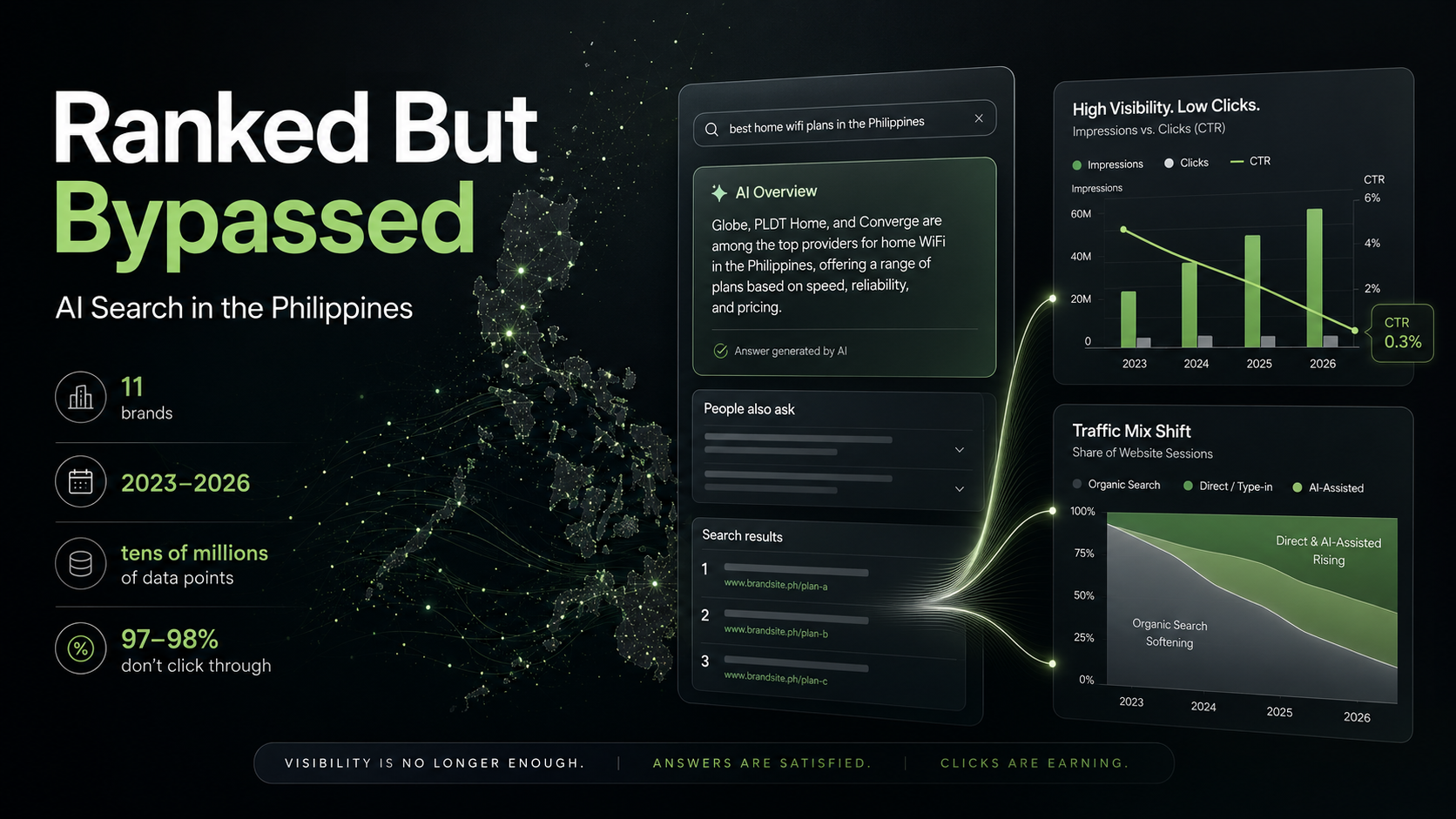
The short version: Philippine brands still rank on Google. Google is still showing them at scale — tens of millions of impressions annually. But 97 to 98 percent of people who see them in search don’t click through. A new traffic source called “AI Assistant” appeared in their analytics for the first time in 2026. And in Western markets operating 18 to 24 months ahead of us on the AI adoption curve, organic search — once a primary channel — has contracted by as much as 80 percent. The shift is not coming. For some brands and markets, it has already arrived.
What This Study Measured — and What It Cannot Claim
This is an observational study, not a controlled academic experiment. It uses anonymized first-party analytics data from 11 brands that LeapOut Digital has managed, supported, or analyzed. No brand names are disclosed. Brands are referenced by market and industry type only. This research reflects direct access to first-party analytics — not external, synthetic, or modeled data.
11
7
3.5 yrs
Important limitations before you proceed
This study does not control for changes in paid media spend, campaign activity, app launches, platform migrations, seasonality, or brand events that may independently shift channel mix. Several brands showed Direct traffic spikes of 83–96% in 2026 H1 consistent with platform migration events rather than AI behavior — these are disclosed and excluded from relevant analysis. All findings are directional signals requiring further brand-level investigation, not definitive causal claims.
Key Terms — A Plain-Language Glossary
For CEOs, CMOs, and brand leaders who are not digital analytics specialists, here is a plain-language explanation of the eight most important terms in this study.
Glossary of Terms Used in This Report
AI Assistant (GA4 channel)
A channel classification Google Analytics 4 began using in 2026 to identify sessions where the first referral came from an AI tool such as ChatGPT, Gemini, Perplexity, or Copilot.
Direct Traffic
Sessions where no referral source is detected in GA4. Includes typed URLs, bookmarks, saved links, dark social, app traffic, and AI-assisted navigation — but cannot be attributed to AI alone without additional data.
Organic Search Share
The percentage of total users whose first interaction came through an unpaid search engine result. This study tracks share (%) rather than absolute numbers to allow fair comparison across brands of different sizes.
AEO — Answer Engine Optimization
The practice of structuring content to be surfaced and cited by AI-powered answer systems — including Google AI Overviews, ChatGPT, and Perplexity — not just indexed by traditional search engines.
AI Overview
A Google feature that displays an AI-generated summary at the top of search results. When triggered, it may satisfy a user’s query before they scroll to organic listings — potentially reducing click-through.
Unassigned Traffic
Sessions GA4 cannot attribute to any standard channel group. Growth in Unassigned traffic is not proof of AI referral, but when it rises alongside AI Assistant traffic, Direct growth, and CTR compression, it becomes a signal worth investigating.
CTR Gap
The difference between a site’s actual click-through rate from search and the expected rate for its average ranking position. A brand ranking at position 9 with a 2% CTR when benchmarks suggest 6–8% indicates something above the listing may be satisfying the query.
GEO — Generative Engine Optimization
A related term referring to optimization for large language model-based search tools and generative AI interfaces. GEO and AEO are often used interchangeably, with AEO focused on factual Q&A retrieval and GEO on broader generative outputs.
The Central Finding: Visibility and Visits May Be Separating
The core observation of this study is not that search is dying. It is that the reliable relationship between appearing in search and receiving a website visit shows early signs of weakening.
Across all four brands with Google Search Console access, click-through rates sit between 1.6% and 2.3%. These brands appear in search. They rank. Google is surfacing their pages. But across a combined 59 million search impressions over 12 months, fewer than 1.3 million visits resulted. Roughly 97 to 98 out of every 100 people who saw these brands in Google search did not visit the website.
| User has a question |
| ↓ |
| Goes to Google |
| ↓ |
| Sees organic listing |
| ↓ |
| Clicks → visits website |
| ↓ |
| GA4 records: Organic Search |
| User asks an AI tool first |
| ↓ |
| Gets answer — brand mentioned or not |
| ↓ |
| May open Google — sees AI Overview |
| ↓ |
| No click — or navigates directly to brand |
| ↓ |
| GA4 records: Direct · Unassigned · AI Assistant |
The Western Control Group: A Directional Warning
The offshore brands in this study are not presented as a forecast for the Philippines. They are included as a directional reference: a longer time series of the same channel-mix signals now appearing at early stages in Philippine data.
The Western Control Group: A Directional Warning
The inverse relationship between declining organic share and rising Direct traffic. The Canadian brand (solid lines) shows the more pronounced pattern. Observe how the two lines cross as AI adoption accelerated.
* 2026 data covers January 1–June 15, 2026 only. Direct traffic growth may reflect AI-informed discovery, brand campaigns, dark social, or other factors — not AI alone. The inverse correlation is observational, not causal proof.
The most pronounced pattern belongs to a Canadian online retailer. In 2023, organic search was its primary channel at 55.14% of user acquisitions. By mid-2026, that share had contracted to 10.51% — a relative reduction of more than 80%. Over the same period, Direct traffic grew from 21.48% to 75.97%. The brand’s total user base grew throughout. This is not a brand in decline. It reflects a fundamental shift in how users arrive.
A US activewear brand showed organic search share declining from 20.73% in 2023 to 10.38% in 2025, with Direct traffic rising from 25.81% to 57.94% over the same period.
The Western Control Group: A Directional Warning
Five Philippine brands with clean channel data. The picture is more stable than Western markets — but shows variation by industry and early softening in 2026 H1 for some brands.
Brands with anomalous 2026 H1 Direct traffic spikes consistent with app launches or platform events are excluded. Null values indicate a data gap. The food/FMCG brand's dominance reflects an informational content model distinct from retail or transactional brands.
What the data does show is a pattern of early-warning signals that appeared in Western brands 18 to 24 months before meaningful organic compression began. If that pattern holds in the Philippine context — and it may not — brands that monitor these signals now will have more options than those that wait.
What is holding strong
What is beginning to soften
The early-warning signals appearing now
Direct traffic growth across five brands where anomalous platform events have been excluded. Growth may reflect AI-influenced discovery, brand campaigns, dark social, or other factors — attribution to AI alone requires further investigation.
* Excludes brands with Direct spikes consistent with app launches or platform migrations. 2026 data is Jan 1–Jun 15, 2026 only.
What the Search Console Data Says: Rankings Are Holding, Clicks May Not Be
2.3%
1.9%
1.6%
Published benchmark studies suggest that organic listings at positions 8–10 typically generate CTRs in the range of 6 to 9%. The brands in this dataset at those positions are generating 1.9% to 2.3%. That gap — if not explained by brand, vertical, or query mix alone — is consistent with something above the organic listing satisfying a meaningful proportion of queries.
All four brands rank well. The gap between actual CTR and benchmark expectations is consistent with zero-click behavior or AI Overview interception — but requires query-level validation to confirm causation.
Benchmark CTR figures are estimates based on published industry position-CTR studies and are illustrative only. [Citation needed: Backlinko / Advanced Web Ranking]. Actual CTR from GSC over the 12 months ending June 2026.
Impressions remain relatively stable while clicks decline over 12 months — a pattern consistent with AI Overview interception. Query-level data would be needed to confirm this interpretation.
Data indexed to 100 at June 2025 for comparative clarity. Chart is representative of the observed trend, not exact daily values. The widening gap between lines indicates declining click yield per impression.
GA4's Confirmation: The AI Assistant Channel Now Exists
GA4 created this classification when AI-referred traffic crossed a threshold its systems could categorize. These are users who clicked a link within ChatGPT, Gemini, Perplexity, or Copilot. Volume is early-stage; the classification itself is the significant finding.
The AI Assistant channel was not present in any brand's 2023 or 2024 GA4 data. Its first appearance in 2026 H1 — across 6 brands including 5 Philippine brands — marks a measurable threshold, not a peak.
Unassigned traffic grew 20–30× from 2023 baselines across three Philippine brands. This is not proof of AI referral. When it rises in parallel with AI Assistant traffic, Direct growth, and CTR compression, it becomes a signal that warrants investigation.
Absolute percentages remain small (under 3.5%). The growth multiple — not the absolute level — is the notable signal. Possible explanations include AI-referred visits, tracking gaps, unrecognized referral sources, and GA4 attribution changes.
Why Some Brands Are More Resilient — The Branded Content Principle
Both brands share a specific characteristic: their users predominantly arrive via informational and branded content intent. People search for content associated specifically with those brands — recipes, usage guides, product specifications — rather than for a category or competitor comparison.
Even so, these more resilient brands are not showing zero signal. One shows Direct traffic growing from 5.18% in 2023 to 9.03% in 2026 H1. Another shows AI Assistant traffic appearing for the first time in 2026 H1 and Unassigned traffic growing five-fold over two years. The resilience is real and present. The signals suggest that monitoring — not complacency — is the appropriate response.
The AI Search Vulnerability Matrix
Type 1 · Lowest Current Pressure
The Content-Dominant Brand
Type 2 · Moderate, Mixed Signals
The Transitional Brand
Watch for: Unassigned traffic accelerating. AI Assistant emerging. Total organic volumes declining even as share holds. Act now.
Type 3 · Higher Exposure
The Paid-Dependent Brand
Type 4 · Significant Compression (Offshore)
The Western-Market Reference
Type 5 · Requires Audit First
The Anomalous Signal Brand
Target State · Build Toward This
The AI-Visible Brand
Answering the Questions This Data Raises
Is Google ending?
Not in any timeframe this data suggests. Google’s impression volumes for brands in this study remain large — 15 million and 35 million impressions annually for the two Philippine brands with GSC access. What this data suggests is that the reliable conversion from Google impression to website visit may be weakening for certain query types, not that Google’s role as the primary discovery engine is disappearing. Google may still satisfy the search. The brand may no longer receive the visit.
Should Philippine brands pay attention to ChatGPT and Perplexity?
Is the Philippines headed where Western markets are?
What Philippine Brands Should Do — Ranked by Urgency
The response is not to abandon SEO. It is to expand it. SEO asked: does Google rank us? The question now expanding alongside it is: does AI recommend us? These are not the same question — and for some query types and some brands, the gap between them is already measurable.
Type 5 · Immediate · Next 30 Days
Establish your current signal baseline
- Add AI Assistant, Unassigned, and Direct as monitored weekly metrics in GA4
- Pull 12 months of GSC data and compare Impressions vs. Clicks trends — is the gap widening?
- Test your top 20 organic queries in ChatGPT, Gemini, and Perplexity — does your brand appear?
- Check whether your primary commercial queries now trigger AI Overviews in Google PH
Short-Term · 90 Days
Start optimizing for the answer, not just the rank
- For every query triggering an AI Overview, ask whether your brand is cited — and what content change would make it so
- Audit key pages for structured data markup — FAQ, HowTo, Product schema
- Add author credentials and publication dates to primary content pages — basic AEO hygiene
- Identify which content only you can produce and own — invest there first
Medium-Term · 6 Months
Build AI visibility alongside search visibility
- Create content structured to be retrieved by AI systems — clear, factual, specific, with explicit source signals
- Build brand mentions and citations across trusted external sources AI tools reference
- Diversify traffic before organic compression arrives — email, community, direct relationships
- Set a quarterly AI brand audit: ask five AI tools your customers' questions and record results
Strategic · Ongoing
Reframe the success metric
- Stop measuring only rankings. Start measuring AI citation frequency alongside organic position
- Treat rising Direct traffic as a signal requiring investigation, not just a reporting line
- Brief leadership on the impressions-to-clicks gap — one of the most commercially important metrics in 2026
- Build content that only your brand can own and only AI can cite you for
Research Integrity: What This Study Can and Cannot Claim
| Finding | Confidence | Basis and Caveat |
|---|---|---|
| GA4 now classifies "AI Assistant" as a distinct traffic channel | High | Directly observable in GA4 data across 6 brands. Reproducible by any analyst with account access. |
| Philippine brands are receiving early AI-referred visits | Medium | AI Assistant channel is confirmed. Volume is early-stage (1–89 users per brand in H1 2026). |
| CTR is lower than pre-AI benchmarks for ranking positions observed | Externally Supported | Observed in GSC across 4 brands. Benchmark comparison depends on third-party CTR studies with inherent variance. |
| Unassigned traffic may include AI-influenced visits | Directional | Correlates with other AI signals in this dataset. Not causal proof. Multiple alternative explanations exist. |
| Direct traffic growth is partially AI-influenced | Directional | Inverse correlation with organic observed consistently. Direct growth has multiple causes — cannot be attributed to AI alone. |
| AI Overviews are contributing to CTR compression in PH | Externally Supported | April–May 2026 GSC cliff aligns with AI Overview expansion timing. Query-level analysis needed to confirm. |
| PH brands are 18–24 months behind Western markets | Hypothesis | Based on pattern similarity only. Not a controlled comparison. Market differences may produce different outcomes. |
What This Study Does Not Claim
- That AI is the sole or confirmed cause of organic search decline in any brand in this dataset
- That Direct traffic growth is caused by AI behavior alone — platform migrations, campaigns, app launches, and dark social all contribute
- That Unassigned traffic is AI-referred traffic — it is a signal, not a confirmed attribution
- That the Philippine market will follow Western markets on the same timeline or to the same degree
- That the 11 brands in this study are representative of the Philippine market as a whole
- That organic search investment should be reduced — the data does not support that conclusion
- That the CTR gap is caused exclusively by AI Overviews rather than featured snippets, PAA boxes, or other zero-click SERP features
Full Methodology and Data Disclosure
What We Are Tracking in Edition 02