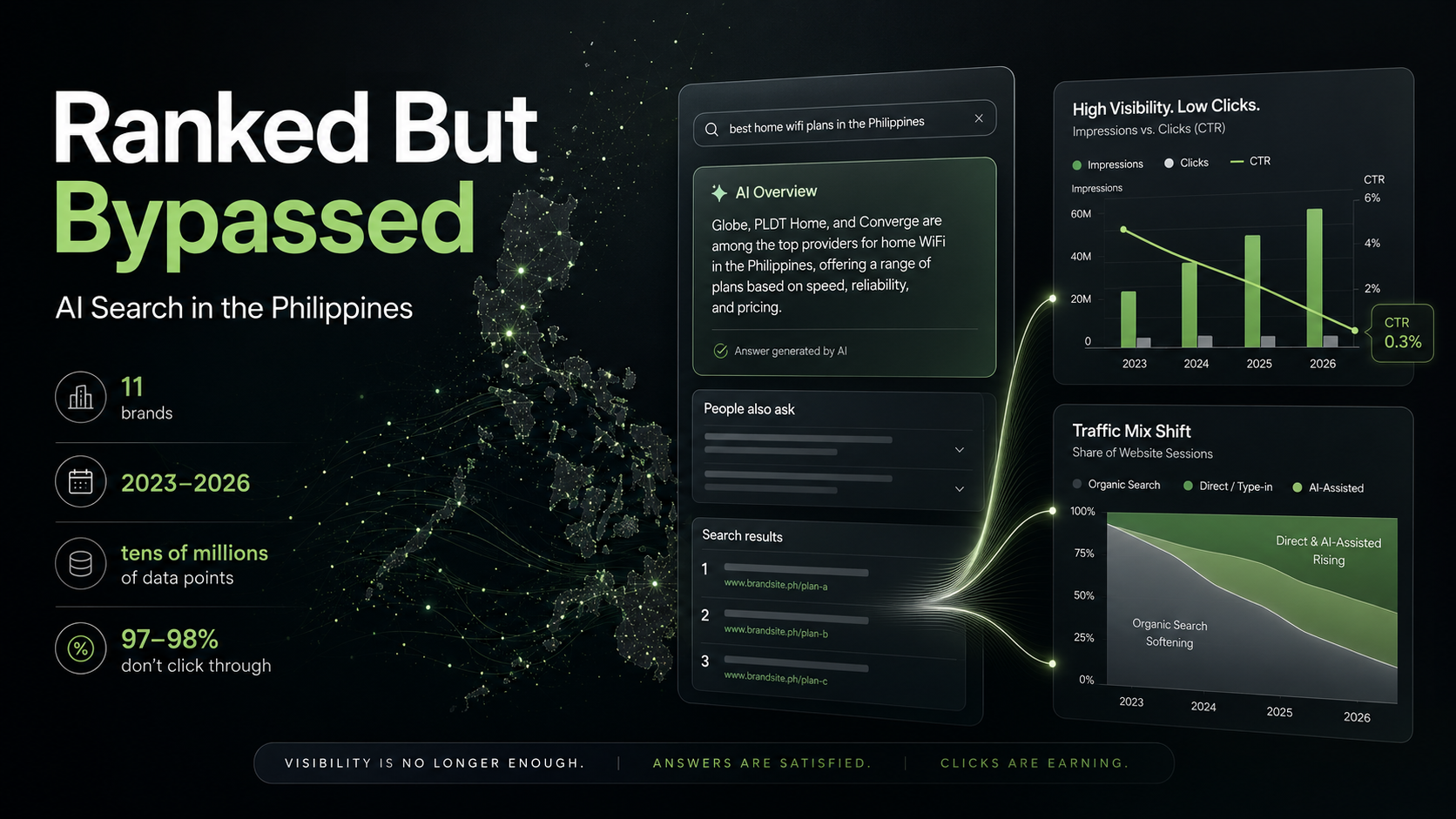
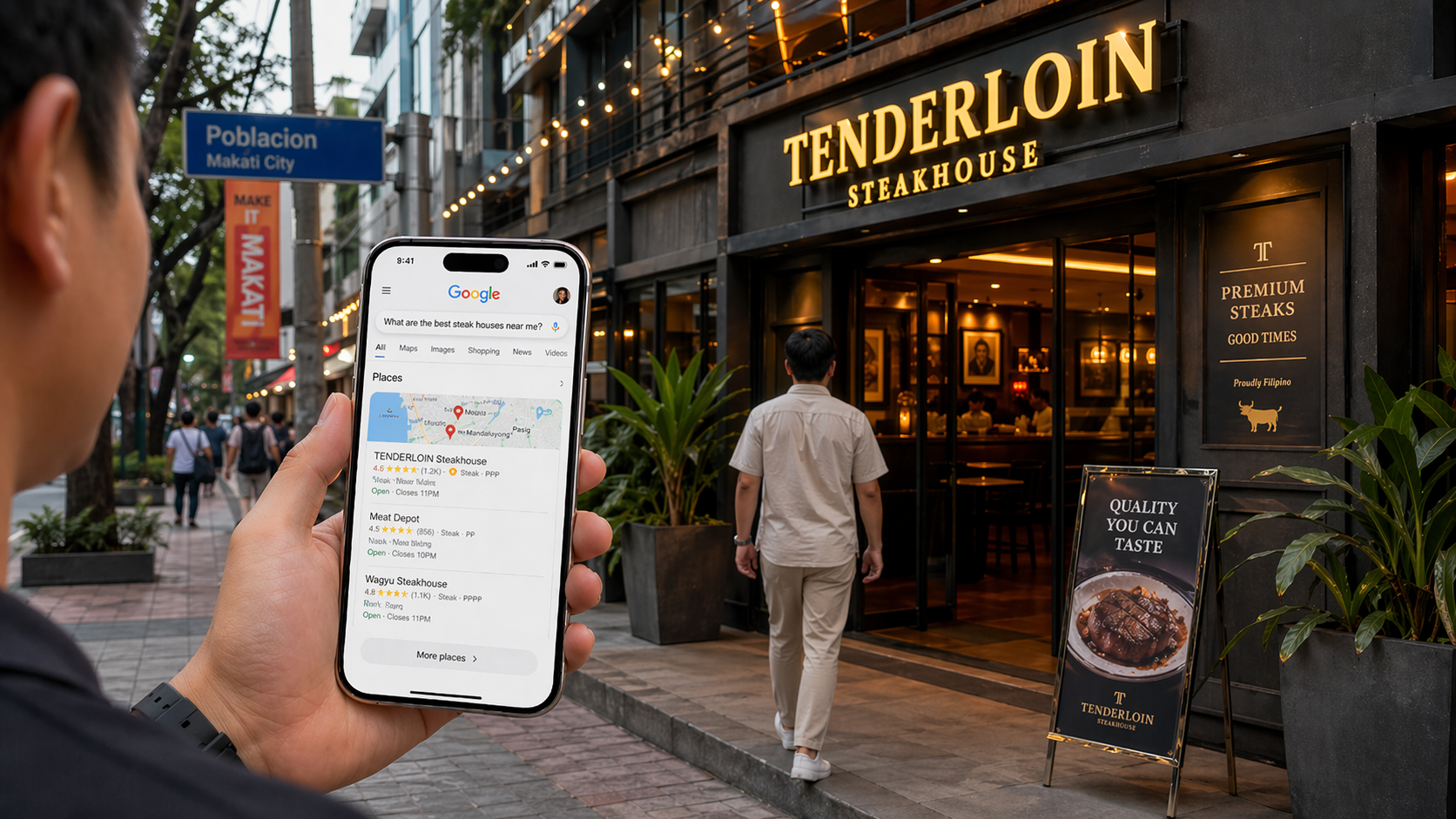
AEO and GEO for Local Business: The New Rules of Being Found When AI Answers First I was looking at our agency’s Google Business Profile the other day. Six months of data. 11,000 views. 2,100 searches. 811 interactions. On the surface, healthy numbers. The kind of dashboard that would have made me nod approvingly two years ago. Then a question landed that I couldn’t shake: how many potential customers searched for an agency like ours in that same window and never showed up in my dashboard at all — because an AI tool answered for them? That number is unknowable. And that’s exactly the point. A year ago, a customer searching “best steak near me” got a familiar result: a map with pins, a list of nearby businesses, a stack of reviews. The job of a local business was simple on paper — climb the list, get the click, win the customer. Today, more of those same customers are asking that question inside ChatGPT, Gemini, Perplexity, or Google’s own AI Overview. They don’t get a list back. They get a paragraph. Three businesses named. Maybe five. A line or two on each. And a decision made before a single map pin has loaded. If your business isn’t in that paragraph, you don’t exist for that search. And the search never appears in your analytics. That’s the whole shift. Everything else flows from it. What Are AEO and GEO, Exactly? Two acronyms are doing the rounds in marketing circles: AEO (Answer Engine Optimization) and GEO (Generative Engine Optimization). Agencies love debating the difference. For most business owners, it’s a distinction without much of a difference. Answer Engine Optimization (AEO) is the practice of structuring content so that AI assistants like ChatGPT, Perplexity, and voice search cite your business directly inside their answers. Generative Engine Optimization (GEO) is the broader discipline of shaping how generative AI systems — including Google’s AI Overviews and Gemini — perceive, trust, and surface your brand when customers ask questions in natural language. Different surfaces. Same game. You’re optimizing to be the named answer, not the clicked link. The reason it matters now is that the underlying numbers have moved fast. A Pew Research Center study of 68,000 real search queries found that when an AI Overview appeared, users clicked on results only 8% of the time, compared with 15% without one — a relative drop of around 47%. Seer Interactive’s analysis of more than 25 million organic impressions found that organic click-through rates on AI-Overview queries fell from 1.76% to 0.61% between mid-2024 and late 2025, a 61% decline. Gartner is now projecting that 25% of organic search traffic will shift to AI chatbots and voice assistants by the end of 2026. Put differently: zero-click searches now account for roughly 58 to 69% of all queries, with the rise directly correlated to AI Overview rollout. The link economy that powered local SEO for fifteen years is being replaced by an answer economy. The currency has changed. Is Google Maps Dying? No — But Its Role Is Changing I get asked often whether Google Maps is on the way out. The answer is no. For near-me, “open now,” and “directions to” intent, Maps is probably more durable than most parts of the search experience. Billions of people use it every month. What’s changing is the role Google Maps — and your Google Business Profile inside it — plays in the broader search ecosystem. For the last decade, your GBP was a destination. A customer found it, read it, and called. You optimized it so that final page view converted. In 2026, your GBP is increasingly a data feed. It’s one of the most heavily weighted inputs AI systems use when composing local answers. Your categories, service descriptions, hours, attributes, photos, reviews, and Q&A are no longer just things humans read — they’re machine-readable signals teaching AI what to say about you when someone somewhere asks. Three implications most local business owners miss: Staleness is penalized harder than ever. Industry reporting now suggests that GBP profiles that haven’t been updated with fresh photos or posts in over 30 days can see dramatic drops in impressions. AI systems prefer fresh, frequently verified sources. Your profile isn’t a brochure you set up once. It’s a living feed. A perfect 5.0 isn’t a trophy anymore. AI systems summarize reviews rather than count stars. They look for recency, volume, diversity of voice, and how owners engage with criticism. A profile with a perfect 5.0 rating and zero negative feedback can actually be flagged as suspicious by AI filters. A 4.6 with 200 recent reviews and thoughtful owner replies often outperforms it. The trust signal is authenticity, not spotlessness. What isn’t structured doesn’t get counted. AI systems can only cite what they can confidently understand. LocalBusiness schema, service pages with clear question-and-answer structure, and consistent name-address-phone details across directories used to be nice-to-haves. They’re now the difference between being legible to AI systems and being invisible to them. Look at our own profile again. 80% strength. Google itself is telling us there’s 20% of signal we haven’t given it yet. Multiply that across every local business I know — most are sitting somewhere between 60 and 80% — and you start to see the collective blind spot. We’ve been leaving machine-readable signal on the table for years, because the cost of leaving it there was minimal. In the answer economy, that cost compounds. Separately, a bigger wave is approaching. Agentic AI — where AI assistants don’t just recommend a business but book the appointment, check availability, and complete the transaction on the user’s behalf — is moving from roadmap to reality. That future compresses the customer journey even further. Whoever the AI picks doesn’t just win the recommendation. They win the booking. How Can Local Businesses Optimize for AEO and GEO? You don’t need to become technical overnight. But you do need to change what you’re playing for. Stop chasing rank. Start earning citations. Five moves matter more than the rest. Treat your GBP like a product, not a profile. Publish