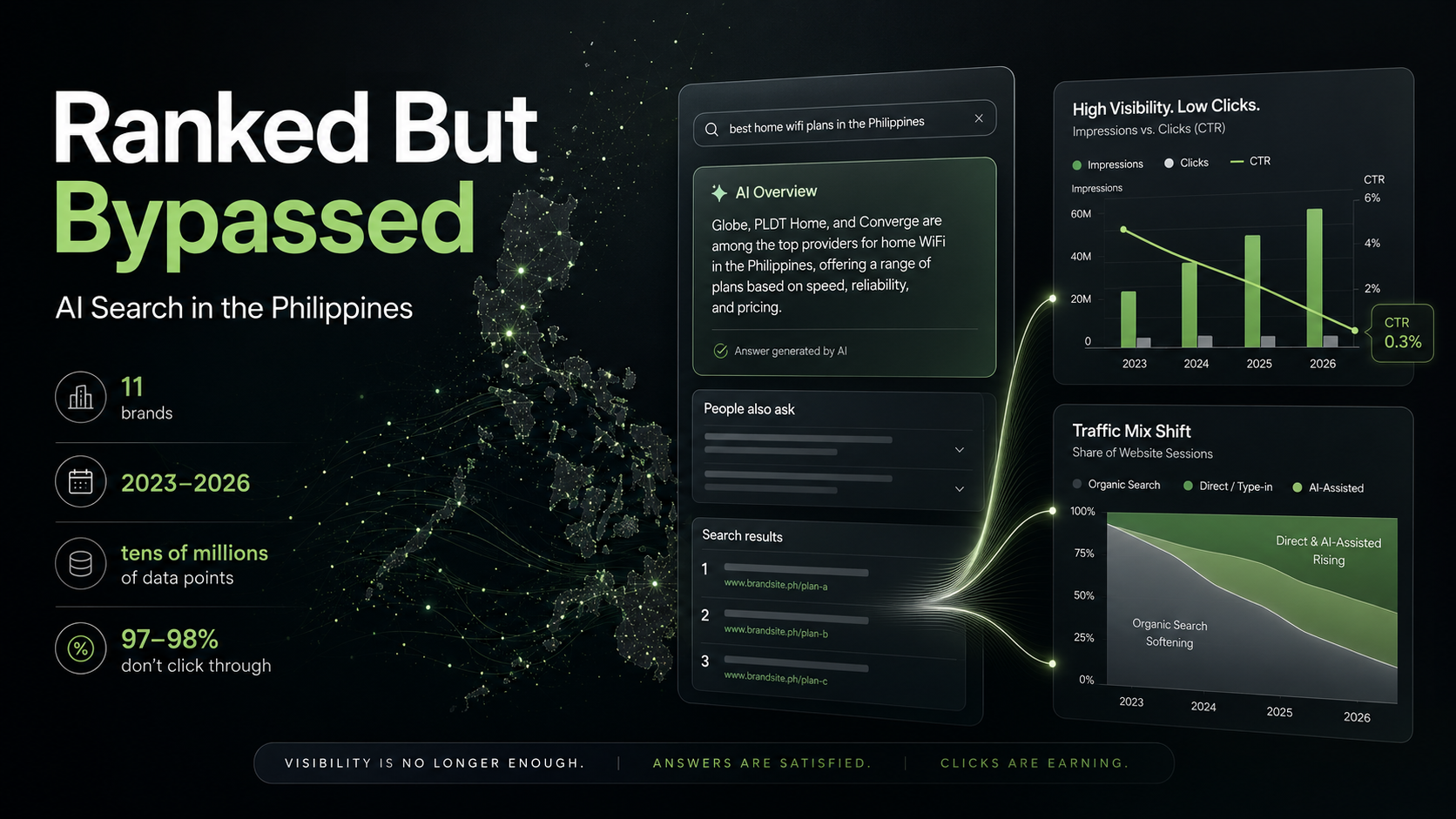
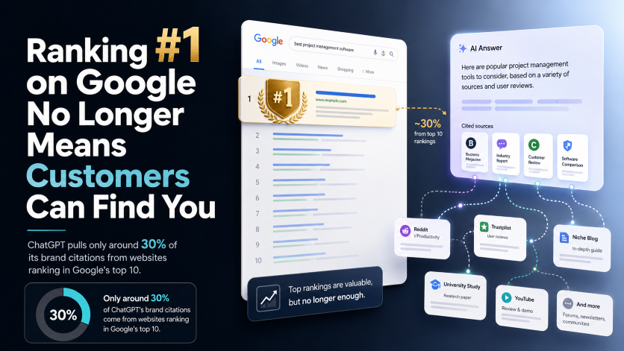
ChatGPT pulls only around 30% of its brand citations from websites ranking in Google’s top 10. Read that again if your company still considers SEO “done” once it reaches page one. For more than twenty years, search visibility had one scoreboard. You ranked or you didn’t. Agencies built retainers around keyword positions, marketing teams built budgets around organic traffic, and everyone agreed on what winning looked like: page one, preferably position one. That scoreboard didn’t get an update. It fragmented. Your business can rank well on Google and still be absent when a customer asks ChatGPT, Gemini, or Perplexity for a recommendation. You can be visible in search and invisible in the conversation. The quick answer Ranking first on Google is still valuable — but it no longer guarantees visibility across AI-powered search. Google Search, Google AI Overviews, Google AI Mode, ChatGPT, Gemini, and Perplexity each use different systems to retrieve, evaluate, and present information. A strong Google ranking influences some of them. It controls none of them. Businesses now need to answer three separate questions: Does Google rank us? Do people still click and visit us? Do AI platforms mention, cite, or recommend us? If your reporting only answers the first question, you’re working from an incomplete scoreboard. The number marketers should sit with Benchmark data published by AI-visibility platform CiteLens, and reported by MarketScale, found that Google AI Mode and Perplexity draw roughly 90% of their brand citations from websites in Google’s conventional top-10 results. Your existing SEO still buys you a seat at those tables. ChatGPT draws only around 30% from that same pool. This is one platform’s benchmark, not a universal law for every query, country, and industry. But the commercial implication is hard to ignore: the most-used AI assistant in the world is sourcing roughly 70% of its answers from somewhere your rank tracker doesn’t look. A brand can rank first, generate millions of impressions, and look successful in a traditional SEO report — while being excluded from the answer its next customer actually receives. Google ranking and AI recommendation are related. They are not the same thing. What our own data shows: ranked, but bypassed LeapOut Digital’s 2026 study, Ranked But Bypassed, examined anonymised first-party Google Analytics 4 and Google Search Console data from 11 brands across the Philippines, Australia, North America, and South Africa — three and a half years of data, from January 2023 to June 15, 2026. Seven of the businesses were Philippine brands across six industry categories. Four brands had Google Search Console data available, representing a combined 59 million Google search impressions over 12 months. Here’s what that data showed. The rankings held. There was no collapse. These brands kept appearing on the first or second page of Google for the searches that matter to them — two Philippine brands held average positions around 8.6 and 9.1, and one generated roughly 35 million Google impressions in a single year. The clicks didn’t follow. Click-through rates across the four brands ranged from just 1.6% to 2.3%. Those 59 million impressions produced fewer than 1.3 million website visits. In practical terms: roughly 97 to 98 out of every 100 people who saw these brands in Google Search never visited their websites. To be clear about what the study does and doesn’t claim — it does not prove AI caused the entire gap. AI Overviews, featured snippets, People Also Ask boxes, query intent, and brand awareness all influence click-through rates. What the data establishes is a pattern businesses can no longer ignore: this isn’t an invisibility problem. It’s a conversion-of-visibility problem. The brand shows up; the searcher goes somewhere else — or gets their answer without going anywhere at all. AI-referred traffic is already showing up in Philippine analytics One more finding worth flagging. The “AI Assistant” acquisition channel appeared for the first time in the 2026 data of six brands in the study — five of them Philippine brands. Volumes were small, between 1 and 89 users per brand in the first half of 2026. Small, but significant. It confirms that users are already arriving at Philippine brand websites through ChatGPT, Gemini, Perplexity, and Copilot. AI-assisted discovery isn’t something to prepare for someday — it’s already measurable in local analytics. And every major digital channel in history started as a rounding error before it became a budget line. Search didn’t disappear. It splintered. Most marketing teams still run a mental model of “Google Search, with AI added on top.” The reality is a dozen distinct answer surfaces: traditional Google Search, AI Overviews, AI Mode, ChatGPT, Gemini, Perplexity, Claude, Copilot, plus industry-specific assistants and social and ecommerce search. Each has its own retrieval systems, ranking signals, citation logic, and source preferences. Your Google position influences some of them. It is not a master key to all of them. This matters especially in the Philippines, where many companies are still strengthening traditional SEO foundations while customer behaviour is already moving toward conversational discovery. People aren’t just typing short keywords anymore — they’re asking complete commercial questions: “What’s the best Shopify agency in the Philippines?” “Which digital marketing agencies in Manila work with Australian companies?” “Which agency can help a Philippine brand become visible in ChatGPT?” “Which Philippine agency offers global-quality execution at a competitive cost?” The business named in the AI-generated answer may not be the business ranking first on Google. And when your brand is absent, the platform doesn’t leave the answer blank. It recommends someone else. What is AI search visibility? AI search visibility measures how frequently and prominently a brand appears in AI-generated answers. That includes being directly recommended, included in a shortlist, cited as a source, referenced in comparisons, or having your research and experts quoted to support an answer — and, just as importantly, whether your competitors appear when you don’t. The discipline goes by several names — Answer Engine Optimisation (AEO), Generative Engine Optimisation (GEO), AI Search