A few weeks ago I watched a query I’d normally pay good money to win get answered before my ad ever had a chance to compete. A health-conscious buyer typed a long, specific question into Google. No ten blue links. No tidy row of shopping ads up top. A paragraph. Two products named. A recommendation, formed and half-decided, before a single click left the page.
That moment is the whole story of Google Ads in 2026. For fifteen years, optimization meant tuning the knobs on a machine you could see: bids, match types, ad copy, landing pages. You worked the auction and the auction worked back. That game still exists. But it’s no longer where the leverage is.
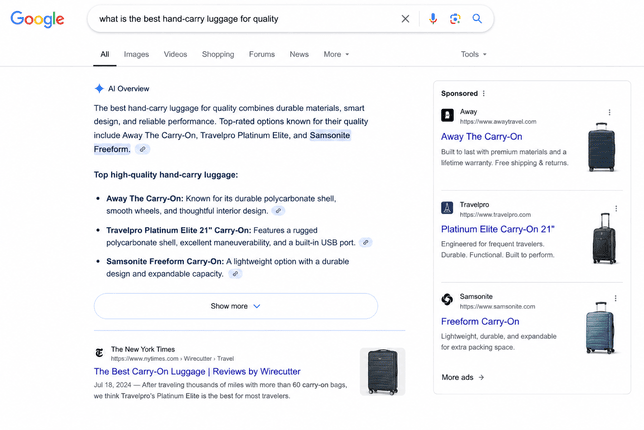
Here’s the thesis I’d stake the year on: tuning your bids and keywords is no longer how you win Google Ads — it’s just the price of competing. The real leverage has moved upstream: to the data you feed Google’s AI so it doesn’t waste your money, and to whether your brand even appears inside the AI answer, where your feed quality, your structured data, and your credibility decide whether you show up at all. That’s a different discipline — and most advertisers are still optimizing for a search results page that’s quietly disappearing.
Let me show you what changed, what still matters, and what to actually do about it.
The 2026 contradiction: better clicks, worse conversions
Start with the numbers, because they tell a stranger story than “CPCs are rising.”
WordStream’s 2026 benchmark data puts the cross-industry average Search CPC at roughly $2.96 in Q1 2026, up about 12% year over year — and other 2026 reports place the blended figure as high as $4.22 once high-cost verticals are weighted in. The spread is enormous: ecommerce sits near $1.16 a click while legal runs $6.75 to $8.58. None of that is new in shape; clicks have gotten more expensive every year since 2021.
The interesting part is the contradiction underneath it. Across the industries WordStream tracks, click-through rates rose roughly 7.5% while conversion rates fell about 9% — declining in 13 of 14 verticals. Median CPA climbed around 12% to roughly $23.74. ROAS slipped about 10%. Read that chain slowly: the ads got better at earning clicks, and the pages got worse at converting them.
That single pattern reframes the entire optimization conversation. When CTR is up and conversion rate is down, your problem isn’t your ad — it’s the match between what the click promised and what the page delivered. The bottleneck moved from the auction to the post-click experience. We’ll come back to that, because it’s where a lot of “expensive Google Ads” problems actually live.
Why CPCs keep climbing — and why AI Overviews are part of it
The auction mechanic hasn’t changed: Ad Rank is still bid × Quality Score × context. More advertisers, higher bids, simple. But there’s a newer pressure most analyses miss.
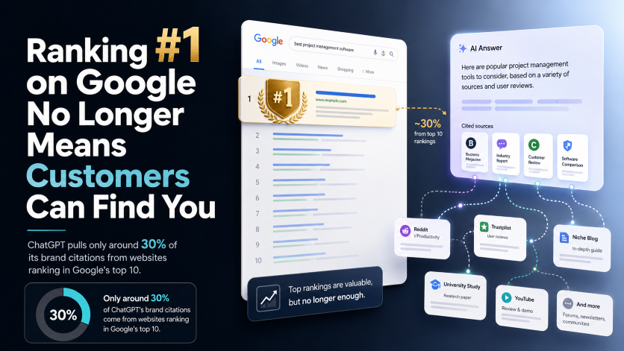
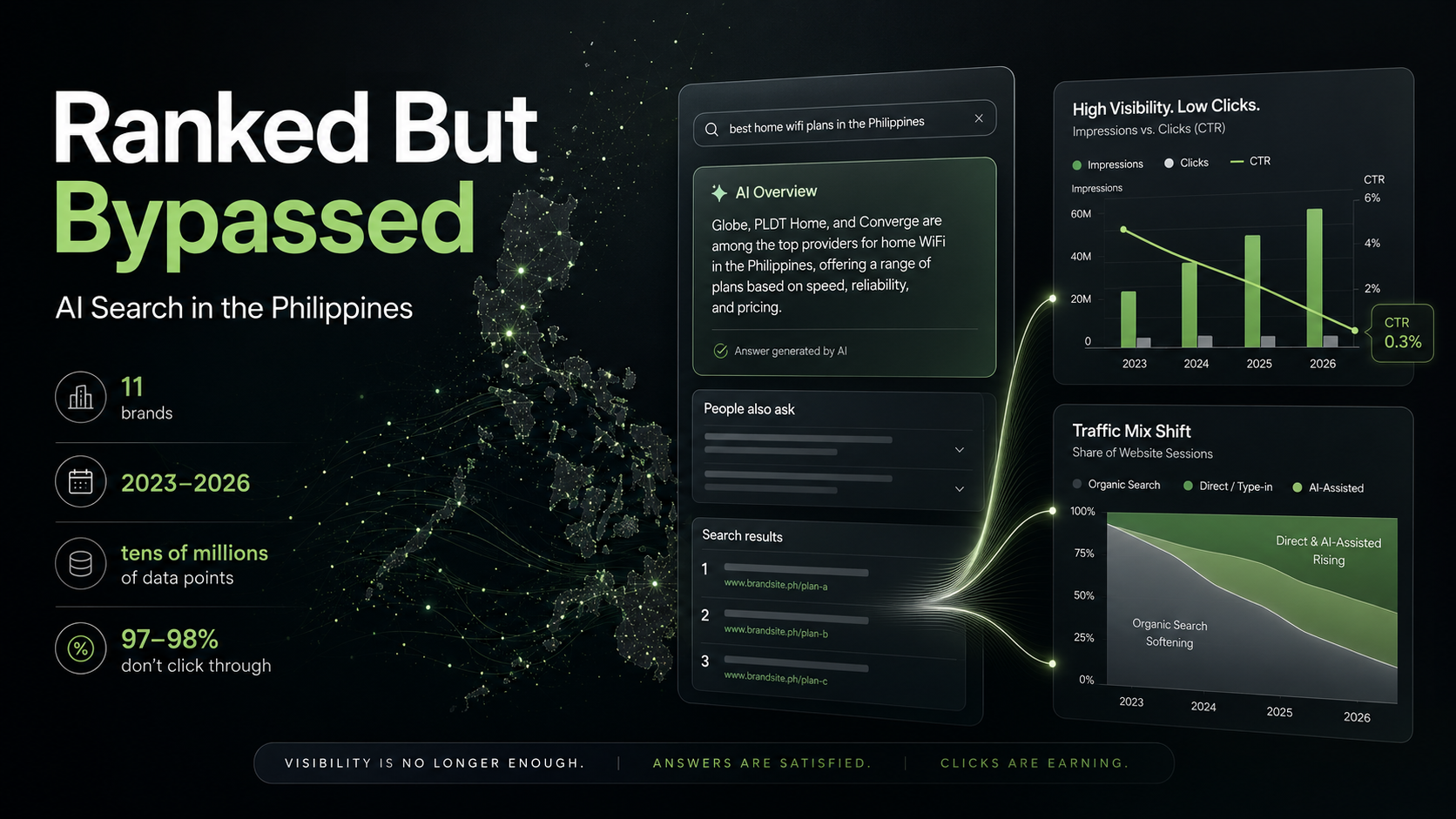
AI Overviews — Google’s AI-generated answer panel — now satisfy a large share of informational and mid-funnel queries on the page itself. Independent research has been consistent and brutal here: a Pew Research Center study of tens of thousands of real queries found users clicked through only about 8% of the time when an AI Overview appeared, versus 15% without one. Seer Interactive measured organic click-through on AI-Overview queries falling from 1.76% to 0.61% between mid-2024 and late 2025.
The knock-on effect for paid search is structural. When the AI answers the top-of-funnel question for free, the clicks that do survive are fewer and more decision-stage — which means more advertisers fighting over a smaller pool of high-intent traffic. CPCs go up not just from competition, but from compression. This is the same shift we documented for organic in GEO in the Philippines: why most Filipino e-commerce brands are already behind — the link economy is being replaced by an answer economy, and paid search is feeling the same gravity.
So yes, optimize the auction. But understand that the auction is now playing on a smaller field.
Quality Score still matters — but think of it as feeding the machine
Quality Score remains the most reliable cost lever you control. Google’s own guidance and years of benchmark analysis line up: improving Quality Score from a 5 to an 8 cuts your effective CPC by roughly 30–37%. That’s not a rounding error. In a $6 legal click or a $40 supplement CPA, that’s the difference between profitable and pointless.
What’s changed is the framing. Quality Score used to be a thing you gamed with tight single-keyword ad groups. That era is over. The modern structure is theme-based ad groups of 15–25 keywords, broad match paired with Smart Bidding, and ruthless negative-keyword hygiene. The old SKAG playbook now fights the algorithm instead of helping it.
The three inputs haven’t moved — expected click-through rate, ad relevance, and landing page experience — but the way you earn them has. You earn expected CTR with responsive search ads that give Google real creative range. You earn ad relevance by grouping keywords by genuine intent, not by cramming unrelated services into one group. And you earn landing page experience with pages that mirror the ad’s promise and load fast, because Core Web Vitals still feed the quality signal. Think less “optimization” and more “feeding the machine the cleanest possible signal.” That mental shift is the whole game in 2026.
The structural change you can't ignore: AI Max is replacing Dynamic Search Ads
If you take one operational action from this article, take this one.
In April 2026, Google moved AI Max for Search out of beta — and confirmed it’s replacing Dynamic Search Ads. Starting in September 2026, campaigns still running DSA, automatically created assets, or the campaign-level broad match setting will be auto-upgraded to AI Max, and you’ll lose the ability to create new DSA campaigns across the UI, Editor, and API. This isn’t a feature you can sit out.
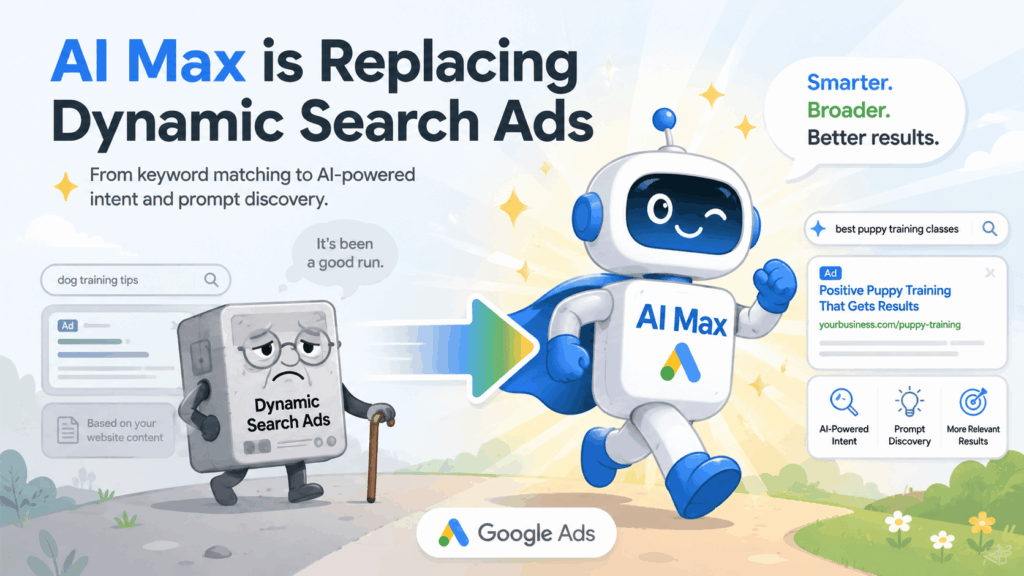
AI Max is Google’s most aggressive automation push in Search: it broadens keyword matching, generates headlines and descriptions, and dynamically adjusts landing-page targeting based on intent signals. Google’s own data claims campaigns using the full suite — search term matching, text customization, and final URL expansion — see about 7% more conversions or conversion value at a similar CPA or ROAS.
Here’s the operator’s read, and it’s the same lesson I wrote about years ago in automated vs. manual bidding: automation amplifies whatever you feed it. “Garbage in, garbage out” didn’t stop being true; the stakes just went up. AI Max with weak landing pages, sloppy negatives, and broken tracking will spend your budget faster and more confidently than any human ever could. Before September, three moves matter: get your conversion tracking airtight, build proper negative-keyword lists so final URL expansion doesn’t chase junk queries, and use the new brand controls and text customization to keep AI Max on-message. Don’t let the auto-upgrade catch you flat.
Smart Bidding: the lever is your conversion data, not your bid
Automated bidding now drives roughly 78% of all Google Ads spend in 2026. Manual CPC accounts are being out-competed on auction dynamics, and the gap widens every quarter the model improves. For most accounts, the question isn’t whether to use Smart Bidding — it’s whether you’ve earned the right to.
Smart Bidding needs fuel. Target CPA and Target ROAS stabilize around 30–50 conversions per month per campaign. Below that, you’re asking a machine-learning model to optimize on noise. This is where so many smaller accounts quietly bleed: a $3,000 budget split across ten thin campaigns gives the algorithm nothing to learn from. Consolidating that spend into your highest-intent services or product lines does more for CPA than any bid tweak — accounts that fold underperforming segments into stronger primary campaigns often see CPA fall 10–25% over a 60–90 day window.
But the real lever isn’t the bid strategy at all. It’s the data underneath it. Smart Bidding is only as smart as your conversion tracking. In 2026 that means GA4 events imported cleanly as conversions, Enhanced Conversions firing (non-negotiable for recovering signal lost to privacy restrictions), offline conversion imports for lead-gen so the model optimizes toward closed deals and not just form fills, and server-side tagging for any account spending past ~$10k/month. The single most expensive mistake we find in audits isn’t a bad keyword — it’s conversion tracking that counts the wrong thing, so the algorithm spends a quarter optimizing toward garbage with total confidence.
Performance Max: discipline, not a black box
Performance Max drives a large and growing share of ecommerce conversions, and it isn’t optional anymore — avoiding it leaves Shopping volume on the table. But it rewards discipline and punishes laziness.
Treat each asset group like its own mini-campaign, grouped by product theme or margin tier. Feed it everything: multiple headlines and long headlines, real images, and — this matters — real video, because the auto-generated video Google makes when you don’t supply one is usually weak. Use search themes as soft hints. Set brand exclusions at the account level so PMax doesn’t cannibalize your branded Search and then take credit for demand you already owned. And watch the Insights tab: when ROAS drops, it’s almost always garbage search categories or a feed-health problem, not a bidding problem.
For ecommerce specifically, your Merchant Center feed is your campaign. A clean, richly attributed feed — accurate availability, variants, pricing, GTINs — is what lets PMax (and increasingly the AI shopping surfaces) recommend you with confidence. If your feed and product data are thin, that’s a Shopify development problem upstream of your ad account, and no amount of bidding will fix it.
The big shift: your ads now live inside the AI answer
This is the part that turns a standard optimization article into a 2026 strategy. At Google Marketing Live 2026, Google made the direction unmistakable: ads are no longer beside the answer. They’re inside it.
Google has embedded ads directly into AI Overviews and AI Mode — the conversational search experiences more users now see first. These aren’t banners next to a result; they surface when relevant to both the user’s query and the AI-generated response itself. Your existing Search, Shopping, and Performance Max campaigns are already eligible to appear above, below, or within AI Overviews across the 200+ markets where they run — including here in the Philippines.
Then come the new formats: Conversational Discovery ads, Highlighted Answers, and AI-powered Shopping ads that explain why your product is the right choice for a high-consideration purchase. There’s a Business Agent for Leads — an ad a prospect can click to chat with an agent trained entirely on your website, replacing the static lead form. And the logical endpoint: agentic checkout, where the AI completes the purchase on the user’s behalf via Google Pay.
Sit with what that means. The traditional model — bid on a keyword, win an auction, get a click — is being layered over by an AI deciding when your brand is contextually relevant to a conversation. To even be eligible for these surfaces, Google’s own guidance is blunt: build your foundation on Performance Max and AI Max, and make your product data and content machine-legible.
This is exactly where paid media collides with what we call AI Commerce. Winning inside the answer isn’t a bidding skill — it’s a visibility skill. Clean feeds, rich schema, accurate availability, and a brand that AI systems can confidently cite become the new ad infrastructure. It’s the same discipline we lay out for organic in AEO and GEO for local business and across our SEO, GEO & AI Commerce work — now applied to paid. The brands that treated structured data as a nice-to-have are about to discover it was the entry fee.
The landing page is now the bottleneck — for service, health, and ecommerce alike
Remember the contradiction: CTR up, conversion rate down in 13 of 14 industries. The math is unforgiving. When clicks cost more and convert less, the cheapest CPA win available to most advertisers is sitting on the page, not in the account.
Improving conversion rate by a single point can drop effective CPA more than weeks of bid optimization. The fixes are unglamorous and they work: the page must mirror the ad’s exact promise the instant it loads, load fast, and make the next action obvious. Trust signals — reviews, certifications, guarantees — move the needle, and they move it differently for each of our audiences.
For service businesses (a law firm, an HVAC company), the conversion is a call or a form, and speed-to-lead plus credibility wins. For health and wellness brands — the regulated, Mercola-style end of ecommerce — trust is the conversion: clear sourcing, credentials, and policy-compliant claims do the heavy lifting, and Google’s ad policies on health make message-match even less optional. For ecommerce, it’s product-page clarity, real availability, and a checkout that doesn’t leak. If your conversion rate trails your industry benchmark, audit the page before you touch the bid. We built Shopify Care+ partly because this post-click layer — speed, message-match, page health — is where so much ad spend silently dies.
Privacy, first-party data, and the attribution you can actually trust
Privacy restrictions and signal loss have made first-party data the foundation of bidding accuracy, not a compliance afterthought. Without reliable conversion data flowing back, Smart Bidding and AI Max misallocate — confidently. Enhanced Conversions, consent-compliant tracking, CRM and offline imports, and server-side tagging aren’t “advanced” anymore; they’re the price of letting automation drive.
One operator’s habit worth keeping: blended is truth, platform is signal. Platforms over-attribute — especially branded and view-through conversions. Watch your blended return (total revenue ÷ total ad spend) alongside platform-reported ROAS, and subtract brand from the blended view so Performance Max and Demand Gen don’t take credit for demand you already had. The cleaner your first-party signal, the less you have to guess.
The LeapOut framework: what to actually do, on four clocks
Optimization in 2026 is systematic, not reactive. Here’s how we sequence it for clients, on the four time horizons we manage every account against.
This week (tactical): Pull your search terms report and build negatives. Confirm conversion tracking is firing once, not twice. Pause the obvious money-burners. Check Lost Impression Share to see whether your ceiling is budget or rank.
This month (operational): Consolidate thin campaigns into your highest-intent lines so Smart Bidding has data to learn from. Migrate from Maximize Conversions to Target CPA or Target ROAS once you clear 30–50 conversions. Run a landing-page sprint on your worst converters.
This quarter (strategic): Prepare for the AI Max auto-upgrade before September — tighten controls, brand settings, and URL expansion. Get your Merchant Center feed and product schema clean enough to be cited inside AI shopping surfaces. Rebuild attribution on first-party data.
This year (structural): Server-side tracking, full-funnel coverage layering YouTube and Demand Gen onto Search, and the visibility infrastructure — schema, feeds, brand corroboration — that decides whether you appear inside the answer at all. This is the compounding work.
Auction inflation is real. But disciplined optimization offsets it, and the brands that treat Google Ads as a continuously refined system — fed clean data, built to be legible to AI — hold steady CPA while everyone else watches costs escalate without proportional growth.
The deeper truth is the one I keep coming back to with clients: the machine is taking the knobs away. What it can’t replace is judgment — the strategy that decides what to feed it, and the guardrails that stop it from spending confidently in the wrong direction. That’s the human edge. It’s why our whole model is AI-accelerated, human-led.
If your CPA is climbing and you’re not sure whether the problem is your auction, your tracking, your page, or your visibility inside the AI answer — that’s exactly the diagnosis we run. Send us an inquiry and we’ll pressure-test your account, or see the work we’ve done for service, health, and ecommerce brands across the region. You can also explore how we approach Google Ads and search engine marketing directly.
Frequently Asked Questions
What is the biggest change to Google Ads optimization in 2026? Two things. First, ads now appear inside Google’s AI answers — AI Overviews and AI Mode — not just beside the search results, so visibility now depends on your feed quality, structured data, and brand credibility, not bids alone. Second, AI Max for Search has replaced Dynamic Search Ads, with legacy campaigns auto-upgrading from September 2026. Together they shift optimization from tuning the auction to feeding the algorithm clean signals and earning a place inside AI-generated answers.
Why is my Google Ads CPA going up even though my ads get more clicks? Because 2026 broke the link between clicks and conversions. Across most industries, click-through rates rose while conversion rates fell, median CPA climbed about 12%, and ROAS slipped around 10%. When clicks cost more and convert less, the problem is usually the landing page or your conversion tracking — not the ad. Audit message-match, page speed, and whether your tracking counts the right action before adjusting bids.
What is AI Max for Search and do I have to use it? AI Max is Google’s AI-powered Search campaign setting that broadens keyword matching, generates ad copy, and adjusts landing-page targeting using intent signals. It moved out of beta in April 2026 and is replacing Dynamic Search Ads. From September 2026, eligible legacy campaigns auto-upgrade to AI Max, and you won’t be able to create new DSA campaigns — so effectively, yes. Prepare by tightening conversion tracking, negatives, and brand controls first.
How many conversions does Smart Bidding need to work? Target CPA and Target ROAS stabilize around 30–50 conversions per campaign per month. Below that, the model is optimizing on noise. If your budget is split across many thin campaigns, consolidate spend into your highest-intent lines so the algorithm has enough data to learn from.
How do I get my ads to show inside Google’s AI Overviews and AI Mode? Existing Search, Shopping, and Performance Max campaigns are already eligible to appear above, below, or within AI Overviews where commercial intent is detected. To qualify for the newer in-answer formats, Google’s guidance is to build on Performance Max and AI Max and make your product data and content machine-legible — clean feeds, rich schema, accurate availability. This overlaps directly with GEO and AEO: you’re optimizing to be the recommended answer, not just the clicked link.
Is Google Ads still worth it for ecommerce and health brands with rising costs? Yes, when run as a system. Disciplined optimization — clean tracking, consolidated campaigns, strong landing pages, and visibility infrastructure for AI surfaces — keeps CPA stable even as auction costs rise. Health and other regulated verticals need extra care on policy compliance and trust signals, which also happen to be what lifts conversion rate.
Sources & further reading
- Google, We’re upgrading Dynamic Search Ads to AI Max (April 2026) and A new generation of ads for the AI era of Search, blog.google
- Marketing Dive, Google upgrades AI search ads: what marketers need to know (2026)
- WordStream / DigitalApplied, Google Ads Benchmarks 2026: CPC, CTR, CVR by Industry
- Foundry CRO, Google Ads Benchmarks by Industry 2026 (CTR up, CVR down analysis)
- Pew Research Center, study of search behavior with AI Overviews
- Seer Interactive, organic and paid CTR analysis on AI-Overview queries
- Google Ads Help, About ads and AI Overviews
Internal: Automated vs. Manual Bidding · GEO in the Philippines · AEO and GEO for Local Business · SEO, GEO & AI Commerce · Search Engine Marketing · Shopify Development · Shopify Care+