7 Proven Ways To Increase Your Website’s Organic Traffic

7 Proven Ways To Increase Your Website’s Organic Traffic

Apart from making your business a customer’s top of mind, it should also be at the top of their search. Whether you like it or not, the internet has become an integral part of life, making websites an effective business move. All it takes is one search and click, however, the question remains: are you searchable? 

Being a searchable website means you are visible on a search engine. Google, for instance, has over 5.6 billion searches per day. Take advantage of these numbers and increase your website’s organic traffic by doing the following fail-safe tips:

Resonate with your target audience

Determine your buyer personas and ensure that your content is made for them. By creating quality content that addresses their issues and pain points among others, you will be able to drive traffic and connect with the visitors of your website. However, keep in mind that it’s one thing to attract the attention of your market and another to make you their first choice. Your goal is to keep them coming back for more. Being a credible source of information for your target audience will help promote and drive traffic to you.

Create content regularly

One of the most effective ways to increase organic traffic in your site is to consistently create helpful content. Although you’re doing it frequently, be reminded to keep your postings of high quality as any inferior content can have a negative affect on your website. Come up with a content marketing strategy that can help you boost your standing in the industry and open doors of opportunities for you.

Promote your website 

There’s nothing wrong with promoting your website. In fact, it’s even a recommended effort. You can join online groups and communities which are relevant to your content as well as your buyer personas. Being part of an online group, however, doesn’t exactly scream immediate results. Instead, it’s advised to build rapport by being active, showing your expertise with helpful insights, and encouraging authentic interactions which can cultivate your relationship with your audience.

Choose long tail keywords

While we have said that your content must be able to address queries and concerns of your buyer personas, this doesn’t mean that you should push aside search engine optimization (SEO) efforts. One of the basic steps in being optimized is choosing specific long tail keywords that represent your product or service. Doing so can help search engines include your website as a landing page for the subject and keyword you have selected. This can also improve your ranking and, in turn, make you searchable for your targets.

Insert internal links and welcome external links

With these internal links, your website visitors are then directed to other relevant content of yours. This is usually done after reaching a reasonable amount of posts. Content efforts are then maximized by linking one content to another. Doing so will keep them your target audience on your site, boosting your ranking further to the top.

External links, especially those coming from established websites, have a greater effect on your ranking. This is because Google sees websites more credible and authoritative when externally linked with other trustworthy sites.

Connect via social media

Allow your business to connect with your audience personally. By being shareable and reachable, being on social media can definitely put your brand out there and get the traffic your website needs.

Base on insights to better optimize

Make use of tools that can help your track the performance of your site and the traction of your content. Being aware of your buyer persona’s behaviour can help you adjust and improve your content.

At LeapOut Digital, our expertise includes making clients searchable. Partner with us and let your website reach its fullest potential. Our team of digital experts can help turn your digital audiences into customers.

RECENT BLOGS

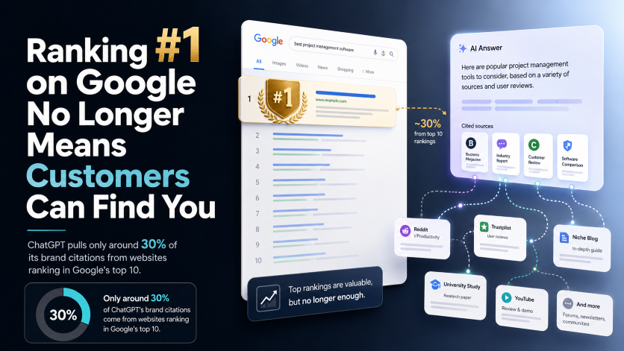
Ranking #1 on Google No Longer Means Customers Can Find You

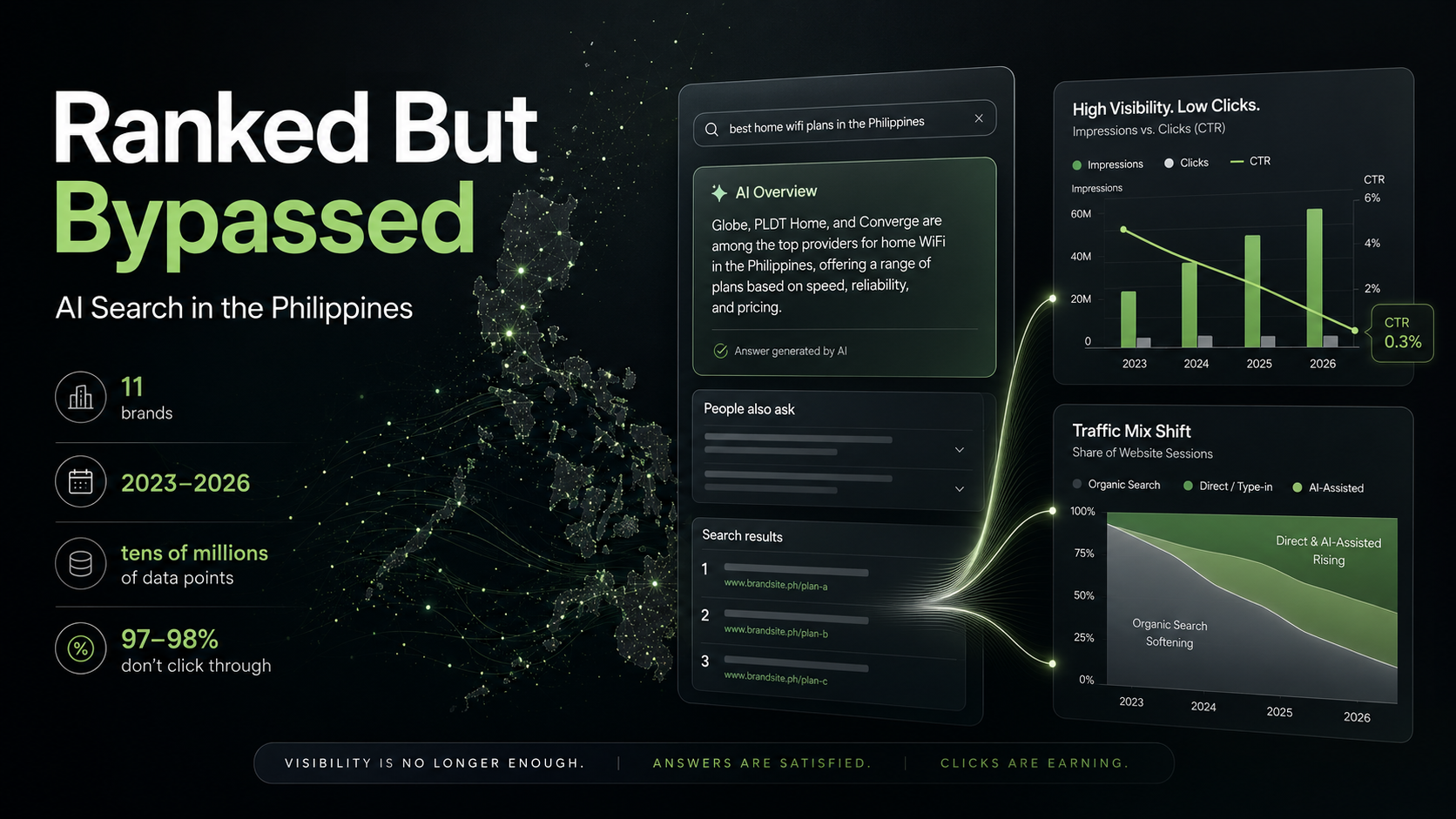
ChatGPT pulls only around 30% of its brand citations from websites ranking in Google’s top 10. Read that again if your company still considers SEO “done” once it reaches page one. For more than twenty years, search visibility had one scoreboard. You ranked or you didn’t. Agencies built retainers around keyword positions, marketing teams built budgets around organic traffic, and everyone agreed on what winning looked like: page one, preferably position one. That scoreboard didn’t get an update. It fragmented. Your business can rank well on Google and still be absent when a customer asks ChatGPT, Gemini, or Perplexity for a recommendation. You can be visible in search and invisible in the conversation. The quick answer Ranking first on Google is still valuable — but it no longer guarantees visibility across AI-powered search. Google Search, Google AI Overviews, Google AI Mode, ChatGPT, Gemini, and Perplexity each use different systems to retrieve, evaluate, and present information. A strong Google ranking influences some of them. It controls none of them. Businesses now need to answer three separate questions: Does Google rank us? Do people still click and visit us? Do AI platforms mention, cite, or recommend us? If your reporting only answers the first question, you’re working from an incomplete scoreboard. The number marketers should sit with Benchmark data published by AI-visibility platform CiteLens, and reported by MarketScale, found that Google AI Mode and Perplexity draw roughly 90% of their brand citations from websites in Google’s conventional top-10 results. Your existing SEO still buys you a seat at those tables.   ChatGPT draws only around 30% from that same pool.   This is one platform’s benchmark, not a universal law for every query, country, and industry. But the commercial implication is hard to ignore: the most-used AI assistant in the world is sourcing roughly 70% of its answers from somewhere your rank tracker doesn’t look. A brand can rank first, generate millions of impressions, and look successful in a traditional SEO report — while being excluded from the answer its next customer actually receives.   Google ranking and AI recommendation are related. They are not the same thing. What our own data shows: ranked, but bypassed LeapOut Digital’s 2026 study, Ranked But Bypassed, examined anonymised first-party Google Analytics 4 and Google Search Console data from 11 brands across the Philippines, Australia, North America, and South Africa — three and a half years of data, from January 2023 to June 15, 2026. Seven of the businesses were Philippine brands across six industry categories. Four brands had Google Search Console data available, representing a combined 59 million Google search impressions over 12 months. Here’s what that data showed. The rankings held. There was no collapse. These brands kept appearing on the first or second page of Google for the searches that matter to them — two Philippine brands held average positions around 8.6 and 9.1, and one generated roughly 35 million Google impressions in a single year. The clicks didn’t follow. Click-through rates across the four brands ranged from just 1.6% to 2.3%. Those 59 million impressions produced fewer than 1.3 million website visits. In practical terms: roughly 97 to 98 out of every 100 people who saw these brands in Google Search never visited their websites. To be clear about what the study does and doesn’t claim — it does not prove AI caused the entire gap. AI Overviews, featured snippets, People Also Ask boxes, query intent, and brand awareness all influence click-through rates. What the data establishes is a pattern businesses can no longer ignore: this isn’t an invisibility problem. It’s a conversion-of-visibility problem. The brand shows up; the searcher goes somewhere else — or gets their answer without going anywhere at all. AI-referred traffic is already showing up in Philippine analytics One more finding worth flagging. The “AI Assistant” acquisition channel appeared for the first time in the 2026 data of six brands in the study — five of them Philippine brands. Volumes were small, between 1 and 89 users per brand in the first half of 2026.   Small, but significant. It confirms that users are already arriving at Philippine brand websites through ChatGPT, Gemini, Perplexity, and Copilot. AI-assisted discovery isn’t something to prepare for someday — it’s already measurable in local analytics. And every major digital channel in history started as a rounding error before it became a budget line. Search didn’t disappear. It splintered. Most marketing teams still run a mental model of “Google Search, with AI added on top.” The reality is a dozen distinct answer surfaces: traditional Google Search, AI Overviews, AI Mode, ChatGPT, Gemini, Perplexity, Claude, Copilot, plus industry-specific assistants and social and ecommerce search. Each has its own retrieval systems, ranking signals, citation logic, and source preferences.   Your Google position influences some of them. It is not a master key to all of them.   This matters especially in the Philippines, where many companies are still strengthening traditional SEO foundations while customer behaviour is already moving toward conversational discovery. People aren’t just typing short keywords anymore — they’re asking complete commercial questions:   “What’s the best Shopify agency in the Philippines?” “Which digital marketing agencies in Manila work with Australian companies?” “Which agency can help a Philippine brand become visible in ChatGPT?” “Which Philippine agency offers global-quality execution at a competitive cost?”   The business named in the AI-generated answer may not be the business ranking first on Google. And when your brand is absent, the platform doesn’t leave the answer blank. It recommends someone else. What is AI search visibility? AI search visibility measures how frequently and prominently a brand appears in AI-generated answers. That includes being directly recommended, included in a shortlist, cited as a source, referenced in comparisons, or having your research and experts quoted to support an answer — and, just as importantly, whether your competitors appear when you don’t.   The discipline goes by several names — Answer Engine Optimisation (AEO), Generative Engine Optimisation (GEO), AI Search

Continue Reading
Headless Shopify development in the Philippines showcasing enterprise eCommerce solutions, custom integrations, and scalable storefronts by LeapOut Digital

Enterprise & Headless Shopify Builds in the Philippines | LeapOut 

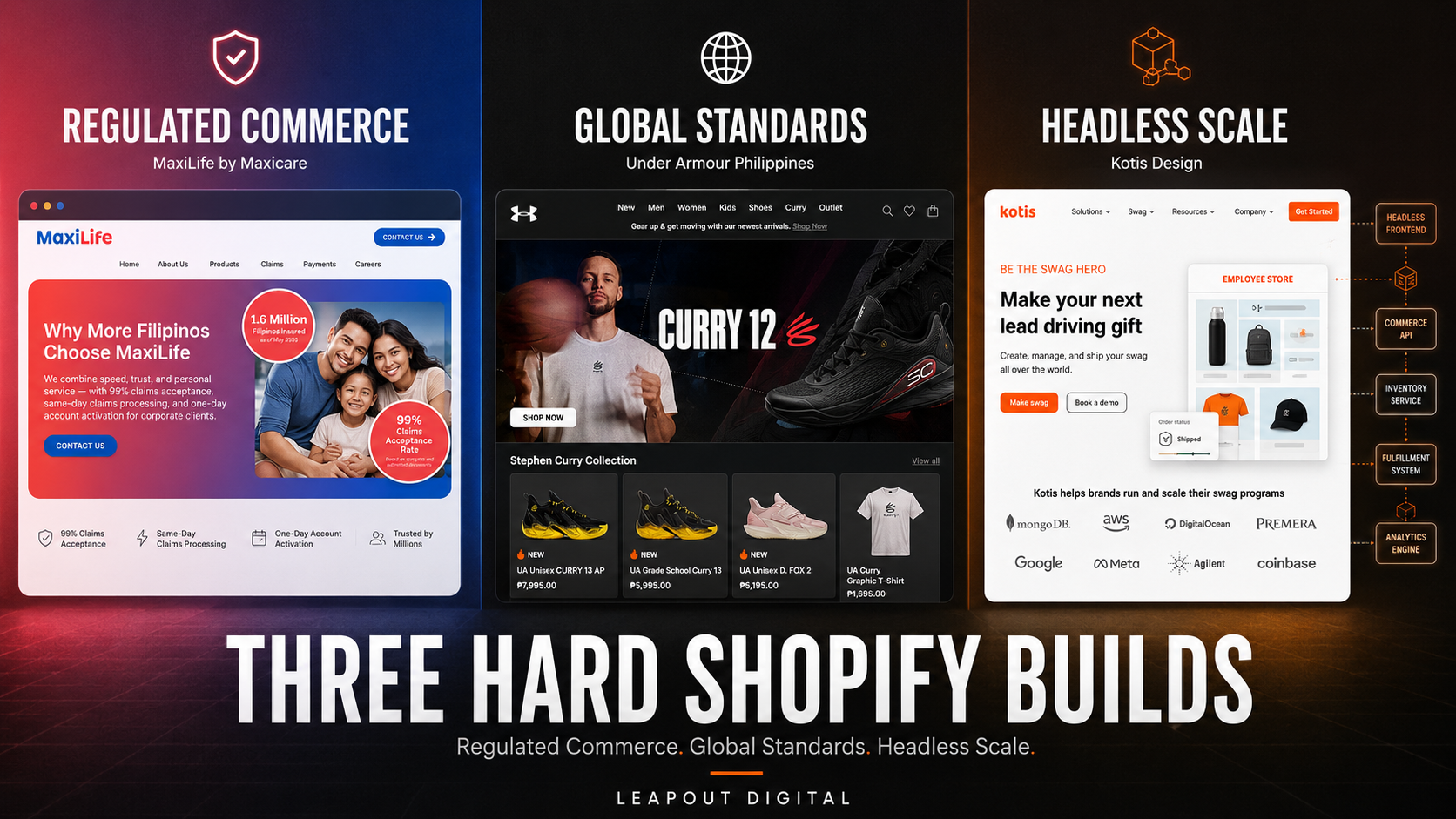
Inside LeapOut’s Hardest Shopify Plus Builds: Regulated Commerce, Enterprise Scale, and Going Headless By Marvin Ortiz, Co-Founder and Managing Partner, LeapOut Digital  The short version: Most agencies show you their prettiest work. We’d rather be judged by our hardest. This is a deep look at three Shopify and Shopify Plus builds that each solved one of the three hardest problems in enterprise ecommerce — selling a regulated product (MaxiLife by Maxicare), executing a global brand’s standards at scale (Under Armour Philippines), and extending Shopify Plus past its native limits into a headless build (Kotis Design, USA). We chose these three because difficulty is the one thing a portfolio can’t fake. If you want to know whether a team can actually build, look at what it does when the easy path runs out.   A portfolio full of beautiful storefronts proves almost nothing. Anyone with a good designer can produce a clean store on a forgiving brief. What separates a real engineering partner from a theme shop is what happens when the brief isn’t forgiving — when a regulator is involved, when a global brand sets a standard you can’t bend, or when the platform itself says “no.”  So instead of showing you everything we’ve built, I want to go deep on three. Not our prettiest work — our hardest. Each one represents a different way an ecommerce build can become genuinely difficult, and together they’re the closest thing we have to an honest answer to the question every serious client is really asking: can you handle the part that’s hard?  Here they are. Build One — MaxiLife by Maxicare: Selling a Regulated Product Online The problem most agencies won’t take. MaxiLife by Maxicare is a regulated, healthcare-adjacent insurance product from one of the country’s largest health-maintenance organizations — sold, for the first time, through ecommerce. That single fact changes everything about the build.  Why it was hard. Selling a regulated financial-and-health product isn’t like selling apparel. The build has to satisfy disclosure, compliance, and documentation requirements that a normal store never encounters — and it has to do that without turning the purchase into a punishing legal form. The entire challenge is a contradiction: make something heavily regulated feel light and human to the person buying it. Get the compliance wrong and you can’t launch. Get the experience wrong and no one buys. You have to win both.  What we did. We extended Shopify Plus with deep technical customization to meet the regulatory requirements while protecting the buying experience — building the compliance into the platform rather than bolting it on top, so the rules were satisfied structurally instead of being patched in. Precision wasn’t a preference here; it was the entire job.  What it proves. When we tell a prospect “we handle regulated commerce,” this is the build we point to — and it’s why brands in insurance, health, and finance take our calls. Regulated ecommerce is a specialist capability most agencies quietly avoid, and the avoidance is the opportunity.  “Your professionalism, dedication, and excellent service have been greatly appreciated… It’s been a pleasure collaborating with your team, and I truly value the strong relationship we’ve built. I will certainly recommend your services moving forward.” — Carlo Rodelas, MaxiLife, Digital Channels Manager Build Two — Under Armour Philippines: Executing a Global Standard, Flawlessly The problem you don’t hear discussed. Under Armour Philippines was one of the most demanding Shopify environments we’ve handled — and the difficulty was a specific, underrated kind: building to a standard we didn’t set.  Why it was hard. When you work with a global brand, the design language, the brand controls, and the performance expectations are all defined elsewhere, and they are non-negotiable. Your job isn’t to invent — it’s to execute someone else’s standard, locally, at the exact quality they require, every single time, while making the catalog, pricing, and promotional logic work for the Philippine market. A lot of agencies are good at being creative. Far fewer are good at being faithful — at delivering precisely what a global brand demands without drift or compromise. Shopify Plus gave us the flexibility; the scale demanded governance, because flexibility without structure creates risk at exactly the moment a global brand is watching.  What we did. Deep front-end customization aligned to global brand standards, disciplined performance engineering, and careful stakeholder alignment across local and global teams — the unglamorous governance work that keeps a high-traffic enterprise store fast, on-brand, and predictable.  What it proves. Being trusted by a global brand to touch its storefront is a credential in itself. Global and enterprise brands run procurement, legal, brand-safety, and performance reviews most local businesses never will. Clearing that bar is harder than winning any award — and it’s a bar we’ve cleared repeatedly. Based on Page speed Insights Report from Jun 14, 2026, 7:18:31 PM  Build-quality scorecard (Google Lighthouse): SEO 100 · Accessibility 95 · Best Practices 92 · Performance 79. A perfect SEO score and near-perfect accessibility are the marks of a build engineered to be found and usable, not just to look good — exactly the disciplined, measurable execution a global brand requires. Build Three — Kotis Design (USA): When the Platform Says No The problem at the technical frontier. Kotis Design is a US-based B2B company — a PPAI 100 firm, one of the largest distributors in the American promotional-products industry — serving major corporate clients with bespoke swag and merchandise programs. Their requirements exceeded what Shopify does natively. The platform, in effect, said no.  Why it was hard. Kotis needed heavy, per-client customization — bespoke corporate stores, redemption sites, and ordering flows tailored to each enterprise client. Shopify’s standard theme-and-app architecture doesn’t bend that far. A weaker partner says “Shopify can’t do that.” We treated it as the brief.  What we did. We built custom functionality to support complex product personalization, and as Kotis’s ambition for their platform grew, the work evolved toward a headless architecture — decoupling the storefront from Shopify’s native layer to deliver experiences and client-specific functionality the standard stack can’t, while keeping Shopify as the commerce engine underneath. It’s not a finished project; it’s a living platform we build against in regular sprints, and have for two years.  What it proves. Two things, and both

Continue Reading