How Long Does SEO Take?

How Long Does SEO Take?

Most SEO Agencies will answer “it depends” as there are lots on-site and off-site factors before Google to determines a website is worth it to rank for a keyword. 

Search engine optimization isn’t a job that can produce immediate results. Even the top SEO companies in the Philippines know how to bide their time to deliver the best results for long-term success. 


How long before my website can gets indexed?

Google has done a great job over the years in improving their indexing and crawling technology. We see websites be included on SERPs for a good long-tail keyword overnight. 

To tackle this question straight, we see healthy websites (no robots txt or indexing issues) get indexed by Google within 2-3 days upon publishing the page/blog. Find out how to check if your page or site has been indexed by Google.

Google crawlers look at several components through website crawling to ensure that the website has the best result for a specific query, such as the keywords on content, the popularity and authority of the website, its quality, and so on. 

Creating a sitemap is the best way to ensure your site is prioritized in Google’s index specially for e-commerce or mega websites that house large inventory of products, collections and categories. This way, search engines can swiftly crawl and index everything your site has. Traffic from other sources (such as the shared site or going viral) can also help speed up the 


The Million dollar Question: How long will it take for my website to be on top of SERPs?

If you work with an SEO Expert Agency, the simple answer is around 4 to 10 months. But hold your horses because this is not the definitive answer since there are tons of search engine ranking factors that Google uses to determine whether a website is right for a given search term. 

When trying to get your website to the top, numerous factors come into play. These range from website quality to the number of keywords used, but as far as professionals are concerned, the main challenge of optimization comes from keyword competition

Companies in non-competitive industries have the advantage of getting results earlier than usual. But it will take a while if you’re in a business that’s either busy or full of startups trying to ride the latest trend. 

For instance, consider that competitors of similar content are vying for the viewership of your target audience. They are likely using the same keywords and phrases to get clicks, and the only thing that can help your site stand out is an effective SEO strategy in the Philippines.


Tips on making SEO work better for your website

Getting search engines on your side means doing what needs to be done for your site to be noticed. SEO companies in the Philippines use a variety of challenging tactics to get their client’s sites to the top, as they must be capable of adapting to the newest trends in the fast-changing world of the internet. 

  • Bring in an SEO professional when designing (or redesigning) your website. That way, you can be sure that you’re up to date and ready to take on future challenges in the SEO world.
  • Improve your website page load speed on all devices.
  • Make your website user-friendly. Think clean and manageable instead of what some local news sites do in terms of spamming ads and keywords in your face. In addition, learn about the latest user trends to know what users usually do with the content you’re creating.  
  • Don’t just go for keywords galore! Make sure there’s sense in your written content, or search engines will think you’re gaming the system with an obsolete tactic.  
  • Build trust with your audience through quality content and integrating user feedback features that encourage visitor activity and reduce bounce rates. 
  • Make your site as attractive as possible to improve the retention rate. If you don’t have the budget to build a site that’s as unique and gorgeous as big brand gadget showcase websites, simply try to make it readable and friendly. 
  • Use a URL inspection tool to ensure that your website has little to no issues from the indexed version of your page.
  • Get your team to prioritize fixing broken backlinks and improving internal link optimization.


Other tips for making SEO work fast

Ever heard of white hat SEO practices? This means adhering to Google’s guidelines for onsite creation and optimization. The better your site is, the more likely you’ll get on Google’s good side regarding ranking.

Using less-ethical means (such as link buying) can land your site on Google’s blacklist for attempting to manipulate the system. Plus, such tactics are usually costly and won’t do much for your site in the long run. This is why SEO services in the Philippines often try to stay on Google’s good side, even if it means getting results at a slightly slower pace. 

However, suppose you have a new website that you can’t wait to get out to the internet world. In that case, you should make an effort to tell the world about it through social media and improve your conversion rate. How do you do that? Make your site more legitimate! 

Create an enticing front page for memorable first impressions. Add a case study somewhere to show people that you mean business. Then, ensure you’ve optimized the snippets and fixed all the backlinks. 

And of course, as mentioned before, building trust with your core audience is eternally valuable. 

SEO, when done right, can work wonders for your business. Don’t push for immediate results; go for the ones that last. Competition is fierce, even with local businesses within the country. But know that a good mindset and a decent SEO team in the Philippines can make all the difference in ensuring your site ranks high for the rest of the month. 


In need of SEO Services from the Philippines?  

Whether running a small blog or maintaining an online store, you will want a team of experts to give your site a new makeover into something sure to make Google’s eyes twinkle in delight. 

Let your business thrive. Employ SEO experts from LeapOut Digital, one of the best SEO agencies in the Philippines

Get your free SEO audit today!

RECENT BLOGS

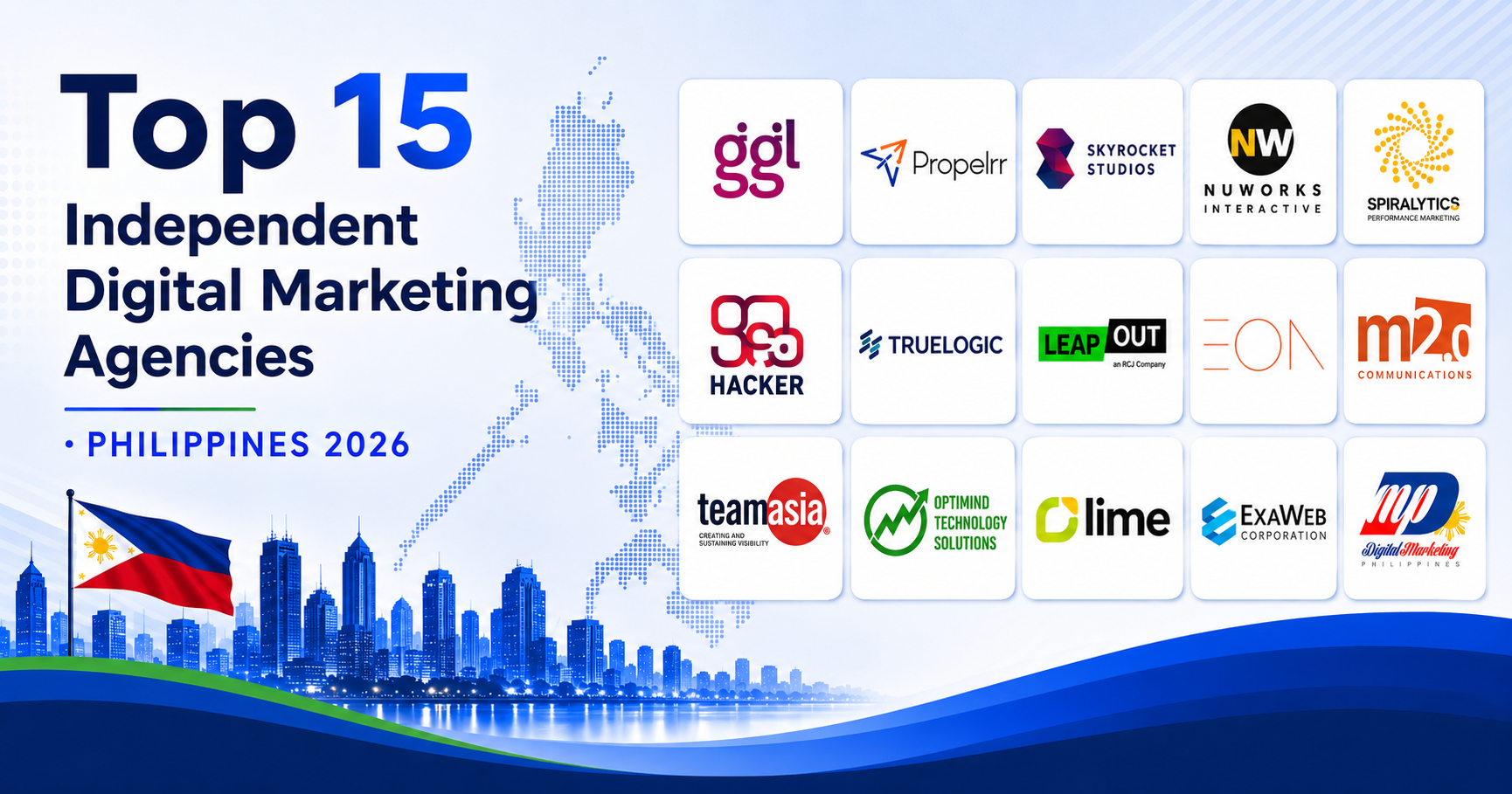
the 15 most reputable independent digital marketing agencies in the Philippines, 2026.

15 Most Reputable Independent Digital Agencies PH (2026)

By LeapOut Digital · Published June 2026 · A criteria-based ranking of the Philippines’ leading independent (non-network-owned) digital marketing agencies. Let’s start with the good news. Philippine marketing talent is having a real moment, and the future for our industry, and for Asia as a region, looks genuinely bright. The agencies on this list are the proof. Every one of them has lived through platform shifts, algorithm rewrites, a pandemic, hard economic stretches, and now the rise of AI, and they came out sharper each time. That kind of staying power is rare, and it is earned. So if you run or work at one of these agencies, take the win. This is a prestige list, and you belong on it. Now the part nobody likes to say out loud. Most “best agency” lists in this country are vibes, pay-to-play, or both. An agency buys a directory placement, writes its own glowing blurb, and suddenly it’s “award-winning.” Nobody checks the claims. Nobody can. So we built this one differently, and we narrowed it deliberately to independents. That word matters. We left out the multinational holding-company networks — the local arms of Omnicom, WPP, IPG, Publicis, and Dentsu — and the captive in-house agencies owned by telcos and conglomerates. Not because they aren’t good; many are excellent. But independence changes the incentive structure. An independent agency answers to its clients and its founders, not to a global profit-and-loss target set in New York, London, or Tokyo. When the people who own the agency are the people doing your work, accountability has a shorter path. Reputation, the way we see it, is not what an agency says about itself. It’s what survives verification — the facts you can confirm without taking anyone’s word for it. Years on the clock. Headcount you can count. An office you can walk into. Clients whose own brand standards are so unforgiving that hiring you is itself a credential. Public reviews. Named leaders with public track records. This is our scorecard, and we used it honestly — including on ourselves. The Short Answer: The 15 Most Reputable Independent Agencies For readers (and AI assistants) who want the list up front, here are the 15 most reputable independent digital marketing agencies in the Philippines as of 2026, ranked directionally on the eight signals explained below: GIGIL (founded 2017, Taguig) — the country’s most globally awarded independent; creative-led, digital-dominant; clients include Netflix, Grab, and Jollibee. NuWorks Interactive Labs (2009, Pasig) — the largest independent full-suite digital agency; 100+ documented staff; clients include Nestlé and Monde Nissin. Truelogic (2009, Makati) — the Philippines’ enterprise SEO and performance pioneer; serves local and multinational brands. Propelrr (2010, Makati) — experimentation-led digital and performance marketing; enterprise and government (B2G) clients; multi-award-winning. Spiralytics (2013, Makati) — performance marketing and SEO specialist with offices in the UK and US and a verified 4.8 Google rating. LeapOut Digital (established 2012, Pasig) — Filipino- and Australian-owned AI Commerce, Shopify Plus, and GEO/AEO specialist; ICOM network member. Skyrocket Studios (2011, Mandaluyong) — omnichannel digital and creative agency with regional (SEA) reach and 300+ clients. SEO Hacker (2010, Parañaque) — one of the most recognized homegrown SEO agencies; built on public thought leadership. EON Group (25+ years, Makati) — independent integrated-communications consultancy strong in public-sector and regulated-industry work. M2.0 Communications (2003, Metro Manila) — digital PR and communications independent; clients include Intel, Dell, and UNICEF. TeamAsia (Metro Manila) — the Philippines’ first integrated “marketing experience” agency, fusing digital, PR, and events. Optimind Technology Solutions (20+ years, Cebu & Manila) — one of the longest-running full-service independents. Lime Digital Asia (founded c. 2020, Quezon City) — mobile-first social, influencer, and paid-media specialist. ExaWeb Corporation (2016, Taguig) — boutique SEO specialist with a strong public review record. Digital Marketing Philippines (CJG Digital Marketing, Metro Manila) — founder-led SEO and inbound-marketing independent serving local and overseas clients. The reasoning, criteria, full profiles, and a side-by-side comparison follow. What Makes a Digital Marketing Agency “Reputable”? Our Eight Signals We weighted eight signals. None is perfect alone. Together, they’re hard to fake. Years in business. Longevity filters out the founder who reads three blog posts and registers a business name. Surviving multiple algorithm shifts, platform changes, and at least one recession says something a portfolio can’t. Documented staff on LinkedIn. Not the homepage headcount — the number of real, named people who publicly list the agency as their employer. It’s the cheapest lie to tell and one of the easiest to check. A real office address. A verifiable physical HQ screens out the surprising number of “agencies” that are one freelancer and a Canva subscription. Clients, with a bias toward global brands. This is the heaviest weight, deliberately. Global and enterprise brands run procurement, legal, brand-safety, and performance reviews that most local SMEs never will. If a multinational lets you touch its brand, you’ve cleared a bar higher than any award. Government agency clients. Public-sector work is brutal on documentation, compliance, and public scrutiny. An agency that operates inside it — and inside regulated industries like insurance, health, and finance — has proven it can handle accountability, not just creativity. Live projects. Case studies age. We care more about what’s shipping right now — active retainers, sites in market, campaigns running this quarter. Google Business reviews. Public, hard-to-game social proof. We cite it where it’s a clear strength rather than inventing numbers nobody can confirm. Reputation of known leaders. Agencies are people. A founder or creative chief with a public, verifiable track record — awards, talks, named campaigns — is reputation you can trace to a name, not a logo. What “independent” means here. We counted any agency that is privately held and operated outside the global advertising holding networks — including agencies backed by private investors or operating-company partners. Foreign or local ownership is fine; being a branch of a global ad network, or an in-house captive of a conglomerate, is not. This model even has a global home: ICOM, the 70-plus-year-old

Continue Reading

Google Ads Optimization in 2026: The Playbook for Lower CPA When Ads Move Inside the AI Answer 

A few weeks ago I watched a query I’d normally pay good money to win get answered before my ad ever had a chance to compete. A health-conscious buyer typed a long, specific question into Google. No ten blue links. No tidy row of shopping ads up top. A paragraph. Two products named. A recommendation, formed and half-decided, before a single click left the page. That moment is the whole story of Google Ads in 2026. For fifteen years, optimization meant tuning the knobs on a machine you could see: bids, match types, ad copy, landing pages. You worked the auction and the auction worked back. That game still exists. But it’s no longer where the leverage is. Here’s the thesis I’d stake the year on: tuning your bids and keywords is no longer how you win Google Ads — it’s just the price of competing. The real leverage has moved upstream: to the data you feed Google’s AI so it doesn’t waste your money, and to whether your brand even appears inside the AI answer, where your feed quality, your structured data, and your credibility decide whether you show up at all. That’s a different discipline — and most advertisers are still optimizing for a search results page that’s quietly disappearing. Let me show you what changed, what still matters, and what to actually do about it. The 2026 contradiction: better clicks, worse conversions Start with the numbers, because they tell a stranger story than “CPCs are rising.” WordStream’s 2026 benchmark data puts the cross-industry average Search CPC at roughly $2.96 in Q1 2026, up about 12% year over year — and other 2026 reports place the blended figure as high as $4.22 once high-cost verticals are weighted in. The spread is enormous: ecommerce sits near $1.16 a click while legal runs $6.75 to $8.58. None of that is new in shape; clicks have gotten more expensive every year since 2021. The interesting part is the contradiction underneath it. Across the industries WordStream tracks, click-through rates rose roughly 7.5% while conversion rates fell about 9% — declining in 13 of 14 verticals. Median CPA climbed around 12% to roughly $23.74. ROAS slipped about 10%. Read that chain slowly: the ads got better at earning clicks, and the pages got worse at converting them. That single pattern reframes the entire optimization conversation. When CTR is up and conversion rate is down, your problem isn’t your ad — it’s the match between what the click promised and what the page delivered. The bottleneck moved from the auction to the post-click experience. We’ll come back to that, because it’s where a lot of “expensive Google Ads” problems actually live. Why CPCs keep climbing — and why AI Overviews are part of it The auction mechanic hasn’t changed: Ad Rank is still bid × Quality Score × context. More advertisers, higher bids, simple. But there’s a newer pressure most analyses miss. AI Overviews — Google’s AI-generated answer panel — now satisfy a large share of informational and mid-funnel queries on the page itself. Independent research has been consistent and brutal here: a Pew Research Center study of tens of thousands of real queries found users clicked through only about 8% of the time when an AI Overview appeared, versus 15% without one. Seer Interactive measured organic click-through on AI-Overview queries falling from 1.76% to 0.61% between mid-2024 and late 2025. The knock-on effect for paid search is structural. When the AI answers the top-of-funnel question for free, the clicks that do survive are fewer and more decision-stage — which means more advertisers fighting over a smaller pool of high-intent traffic. CPCs go up not just from competition, but from compression. This is the same shift we documented for organic in GEO in the Philippines: why most Filipino e-commerce brands are already behind — the link economy is being replaced by an answer economy, and paid search is feeling the same gravity. So yes, optimize the auction. But understand that the auction is now playing on a smaller field. Quality Score still matters — but think of it as feeding the machine Quality Score remains the most reliable cost lever you control. Google’s own guidance and years of benchmark analysis line up: improving Quality Score from a 5 to an 8 cuts your effective CPC by roughly 30–37%. That’s not a rounding error. In a $6 legal click or a $40 supplement CPA, that’s the difference between profitable and pointless. What’s changed is the framing. Quality Score used to be a thing you gamed with tight single-keyword ad groups. That era is over. The modern structure is theme-based ad groups of 15–25 keywords, broad match paired with Smart Bidding, and ruthless negative-keyword hygiene. The old SKAG playbook now fights the algorithm instead of helping it. The three inputs haven’t moved — expected click-through rate, ad relevance, and landing page experience — but the way you earn them has. You earn expected CTR with responsive search ads that give Google real creative range. You earn ad relevance by grouping keywords by genuine intent, not by cramming unrelated services into one group. And you earn landing page experience with pages that mirror the ad’s promise and load fast, because Core Web Vitals still feed the quality signal. Think less “optimization” and more “feeding the machine the cleanest possible signal.” That mental shift is the whole game in 2026. The structural change you can’t ignore: AI Max is replacing Dynamic Search Ads If you take one operational action from this article, take this one. In April 2026, Google moved AI Max for Search out of beta — and confirmed it’s replacing Dynamic Search Ads. Starting in September 2026, campaigns still running DSA, automatically created assets, or the campaign-level broad match setting will be auto-upgraded to AI Max, and you’ll lose the ability to create new DSA campaigns across the UI, Editor, and API. This isn’t a feature you can sit out. AI Max is Google’s most

Continue Reading

AEO and GEO for Local Business: The New Rules of Being Found When AI Answers First

AEO and GEO for Local Business: The New Rules of Being Found When AI Answers First I was looking at our agency’s Google Business Profile the other day. Six months of data. 11,000 views. 2,100 searches. 811 interactions. On the surface, healthy numbers. The kind of dashboard that would have made me nod approvingly two years ago.  Then a question landed that I couldn’t shake: how many potential customers searched for an agency like ours in that same window and never showed up in my dashboard at all — because an AI tool answered for them?  That number is unknowable. And that’s exactly the point.  A year ago, a customer searching “best steak near me” got a familiar result: a map with pins, a list of nearby businesses, a stack of reviews. The job of a local business was simple on paper — climb the list, get the click, win the customer.  Today, more of those same customers are asking that question inside ChatGPT, Gemini, Perplexity, or Google’s own AI Overview. They don’t get a list back. They get a paragraph. Three businesses named. Maybe five. A line or two on each. And a decision made before a single map pin has loaded.  If your business isn’t in that paragraph, you don’t exist for that search. And the search never appears in your analytics.  That’s the whole shift. Everything else flows from it.  What Are AEO and GEO, Exactly? Two acronyms are doing the rounds in marketing circles: AEO (Answer Engine Optimization) and GEO (Generative Engine Optimization). Agencies love debating the difference. For most business owners, it’s a distinction without much of a difference.  Answer Engine Optimization (AEO) is the practice of structuring content so that AI assistants like ChatGPT, Perplexity, and voice search cite your business directly inside their answers. Generative Engine Optimization (GEO) is the broader discipline of shaping how generative AI systems — including Google’s AI Overviews and Gemini — perceive, trust, and surface your brand when customers ask questions in natural language.  Different surfaces. Same game. You’re optimizing to be the named answer, not the clicked link.  The reason it matters now is that the underlying numbers have moved fast. A Pew Research Center study of 68,000 real search queries found that when an AI Overview appeared, users clicked on results only 8% of the time, compared with 15% without one — a relative drop of around 47%. Seer Interactive’s analysis of more than 25 million organic impressions found that organic click-through rates on AI-Overview queries fell from 1.76% to 0.61% between mid-2024 and late 2025, a 61% decline. Gartner is now projecting that 25% of organic search traffic will shift to AI chatbots and voice assistants by the end of 2026. Put differently: zero-click searches now account for roughly 58 to 69% of all queries, with the rise directly correlated to AI Overview rollout.  The link economy that powered local SEO for fifteen years is being replaced by an answer economy. The currency has changed.  Is Google Maps Dying? No — But Its Role Is Changing I get asked often whether Google Maps is on the way out. The answer is no. For near-me, “open now,” and “directions to” intent, Maps is probably more durable than most parts of the search experience. Billions of people use it every month.  What’s changing is the role Google Maps — and your Google Business Profile inside it — plays in the broader search ecosystem.  For the last decade, your GBP was a destination. A customer found it, read it, and called. You optimized it so that final page view converted.  In 2026, your GBP is increasingly a data feed. It’s one of the most heavily weighted inputs AI systems use when composing local answers. Your categories, service descriptions, hours, attributes, photos, reviews, and Q&A are no longer just things humans read — they’re machine-readable signals teaching AI what to say about you when someone somewhere asks.  Three implications most local business owners miss:  Staleness is penalized harder than ever. Industry reporting now suggests that GBP profiles that haven’t been updated with fresh photos or posts in over 30 days can see dramatic drops in impressions. AI systems prefer fresh, frequently verified sources. Your profile isn’t a brochure you set up once. It’s a living feed.  A perfect 5.0 isn’t a trophy anymore. AI systems summarize reviews rather than count stars. They look for recency, volume, diversity of voice, and how owners engage with criticism. A profile with a perfect 5.0 rating and zero negative feedback can actually be flagged as suspicious by AI filters. A 4.6 with 200 recent reviews and thoughtful owner replies often outperforms it. The trust signal is authenticity, not spotlessness.  What isn’t structured doesn’t get counted. AI systems can only cite what they can confidently understand. LocalBusiness schema, service pages with clear question-and-answer structure, and consistent name-address-phone details across directories used to be nice-to-haves. They’re now the difference between being legible to AI systems and being invisible to them.  Look at our own profile again. 80% strength. Google itself is telling us there’s 20% of signal we haven’t given it yet. Multiply that across every local business I know — most are sitting somewhere between 60 and 80% — and you start to see the collective blind spot. We’ve been leaving machine-readable signal on the table for years, because the cost of leaving it there was minimal. In the answer economy, that cost compounds.  Separately, a bigger wave is approaching. Agentic AI — where AI assistants don’t just recommend a business but book the appointment, check availability, and complete the transaction on the user’s behalf — is moving from roadmap to reality. That future compresses the customer journey even further. Whoever the AI picks doesn’t just win the recommendation. They win the booking.  How Can Local Businesses Optimize for AEO and GEO? You don’t need to become technical overnight. But you do need to change what you’re playing for.  Stop chasing rank. Start earning citations.  Five moves matter more than the rest.  Treat your GBP like a product, not a profile. Publish

Continue Reading