Gear Up For These Digital Marketing Trends in 2024

Gear Up For These Digital Marketing Trends in 2024

As customer expectations and digital capabilities shift and evolve at breakneck speeds, companies targeting Filipino netizens are faced with significant challenges. The development in search engines, social media, and other related technologies offer myriad opportunities and challenges that often overwhelm businesses, especially their marketing activities. Knowing and understanding trends in the coming year equip companies with the needed information to prepare for the coming year. 

Environment for Enhanced Digital Experience

The year 2024 is an interesting and exciting time for Pinoy consumers. 

  • We have just freed ourselves from the COVID-19 pandemic. As the government scrapped the restrictions it had enforced during the height of the pandemic, we are now in a new normal where we go back to our old ways pre-pandemic while getting accustomed to fully utilizing (and relying on) online platforms and services for practically every activity. 
  • In a blink of an eye, Gen Zeds (aged 18-26) are gradually establishing their foothold in the Philippine workforce, giving them considerable purchasing power and influence.  
  • The use of artificial intelligence (AI) and machine learning is starting to mature at a point that it has already penetrated into, and is now an integral part of the applications we use.

Living under this environment calls for radical changes, particularly in the way we use and engage with digital platforms. True enough, search engines and social media channels are starting to address these challenges. Because of this development, we predict these trends to take place in 2024:

Focus on Gen Z Customers

Gen Zeds and young millennials will remain engaged in social media platforms. As such, they are the ones who will most likely view your ads and content. With their growing influence, experts recommend businesses to focus on digital marketing efforts on the activities and preferences of this demographic like: 

  • Smartphones play a significant role in their daily lives. 
  • As digital natives, they make their purchases seamlessly by navigating the digital world in various platforms, such as social media, online games, and e-stores. 
  • They love consuming bite-sized videos, interactive experiences, and personalized recommendations. 
  • They champion ethical practices and causes that resonate with their values. 

A significant fraction of them are now entry-level employees (and entrepreneurs) who have financial capacity to purchase online. Knowing more of their traits and their buying motivations are vital to your digital marketing success in 2024. 

AI Marketing Automation

More and more people are getting more acquainted with the power of AI. Savvy marketers consider the presence of AI as a blessing. Integrating AI into their workflow would supercharge marketing efficiency and quality. 

In 2024, companies are seen to use AI for:

Hyper-Personalization

AI can crack the code on individual preferences and desires. By sifting data from different sources, it can generate: 

  • Recommendations that predict your customer’s next purchase, 
  • Chatbots that respond to your unique queries with human-like nuance, 
  • Personalized ad creatives that speak directly to your target audience while triggering their pain points.
 

LeapOut CEO, Marvin Ortiz, believes that 2024 will usher in more personalized and targeted digital advertising, with the help of more advanced versions of programmatic advertising platforms.

Content Creation 

You now have an assistant content creator that can generate compelling articles, blog posts, and copies. It can also craft catchy headlines and design visually stunning graphics – all while ensuring brand consistency and SEO optimization. 

Predictive Targeting

AI can optimize your campaigns by analyzing mountains of data, predict consumer behavior, and identify the most profitable channels and audiences. 

Empathetic Conversations on Chatbots

AI is ushering in a new era of empathetic, engaging virtual assistants in chatbots. In 2024, AI personas can mirror and respond to the emotions of your customers. 

Richer Search Engine Experience

Search engines will further harness AI’s capabilities to give enhanced experiences. As of this posting, Google is testing its Search Generative Experience (SGE), which the tech giant might release officially within 2024. Google SGE is powered by generative AI. 

Google’s SGE also hosts advanced features like Shopping Graph, the AI-powered, data set of local and overseas products and sellers updated real-time. 

Social Media Shopping 2.0

Social media will remain as the primary communication and entertainment channel of Gen Zeds. Marketers are concentrating on targeting the youth through this medium, particularly on TikTok. 

Seeing this, Marvin foresees enhanced social media shopping experience with the help of the latest technologies like AI in powering:

  • Enhanced live video selling with real-time interaction and exclusive offers 
  • Expanded use of short videos and reels following the success of TikTok
  • Marketers will capitalize on content submitted 
  • Integration of augmented reality (AR) and virtual reality (VR) experiences for immersive shopping experiences. 
  • Integration of social currency like badges and rewards and gamified elements like points and virtual shopping sprees. 
  • Micro-monetization and subscription-based purchases.
 

Streamlined Digital Marketing and Ecommerce Experiences 

In 2024, Marvin expected continuous growth in e-commerce and digital marketing. Social media and e-commerce platforms are seen to generate more seamless multi-channel experiences to consumers. Consumers can expect a consistent journey across websites, apps, social media, physical stores, and even emerging platforms like the metaverse.

Here are some ways to streamline your digital marketing and e-commerce interconnectivity across various channels:

Intensified Omnichannel Marketing

With the help of technology, you can break down data silos and gather insights from all channels onto a single platform. This provides a ubiquitous presence of your company, allowing for cross-channel promotions and personalized experiences for your customers across the board.

Optimizing Mobile As Primary Touchpoint

To make cross-channel marketing happen, companies need to optimize their presence on the primary device—smartphones. Having a mobile-first design, offering mobile payment options like Apple Pay or Google Pay, and adopting personalized mobile marketing will boost brand presence on mobile devices.

Enhanced Voice Search and AI-Powered Assistants

Siri, Alexa, and Google Assistant have been serving us as our companions. It’s time for companies to leverage these voice assistants to provide product information, customer service, or even personalized shopping experiences for customers.

Boom in Interactive Technologies

Expect a more enhanced use of augmented reality (AR) and virtual reality (VR). With the help of generative AI, companies could showcase products in real-world environments through AR filters or apps like virtual trials of furniture, clothing or home appliances before purchase. Businesses could also offer immersive virtual experiences like store tours, product demonstrations, or even interactive games to boost customers engagement and brand recall.

Bridging the Gap Between Online and Offline Experiences

Marvin also predicts the rise of online to offline experiences through social media “showrooming.” This practice uses social media platforms to showcase your physical store environment, host live events, and offer exclusive in-store promotions.  Besides product delivery, businesses also allow customers to order online and pick up their purchases in store for a convenient and flexible shopping experience.

Inclusion of Games in the Marketing Mix

Most Gen Zeds are active in playing mobile games and esports. Marvin also sees this trend to accelerate further this year. Because of this, marketers will tap this medium through in-game and digital streaming programmatic advertising.

Sustainability and Purpose-Driven Initiatives

Brands are not only expected to espouse sustainability but also act as catalysts for positive change in the society. In 2024, marketing strategies will increasingly revolve around ethical practices, data integrity, inclusivity, and mental health advocacy, aligning with consumer values.

Companies can articulate their sustainability initiatives by:

  • Emphasizing that the purpose of their business goes beyond profit by identifying the values they root for and resonate with their audience and employees. 
  • Integrating sustainability into their operations by making a commitment to reduce your environmental footprint and to support ethical causes.
  • Showcasing the impact of espousing your values in your business practices and products contribute to a better world.
  • Leveraging sustainability thrust as a marketing strategy by utilizing social media platforms to raise awareness about the chosen cause.

Gear Up for 2024 with LeapOut

Faced with these imminent changes, businesses – big or small – need to consult with digital marketing experts. They can provide guidance to navigate to the exciting but overwhelming changes that are expected to take place in 2024. 

As one of the pioneers in Philippine digital marketing, LeapOut has received multiple awards for running successful campaigns. Headed by Marvin Ortiz, LeapOut can help you strategize and implement solutions in line with the current and future marketing trends. Comprising young but experienced specialists in social media management and creation, web graphics, search engine optimization (SEO), and e-commerce development, we offer quality digital services to businesses, local or overseas. Contact our representatives now to kickstart 2024 digital marketing with a blast!

Picture of Tony Chua
Tony Chua

Tony Chua has been in the content writing profession for about a decade, specializing in writing SEO articles, blog posts, and social media copies for various small and medium enterprises and e-commerce sites. Before this, he also authored and edited news, press releases, features, scripts, and editorials for newspapers, magazines, and websites.

Tony is a Web Content Specialist for LeapOut Digital, who has worked for Beko, DMCI, Manulife, and US-based Clark Pawners and Jewelers. Aside from writing, he has experience in desktop publishing, graphic arts, web development, and video editing.
RECENT BLOGS

Ranking #1 on Google No Longer Means Customers Can Find You

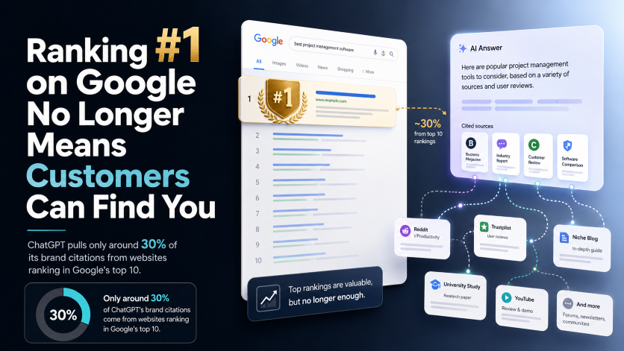
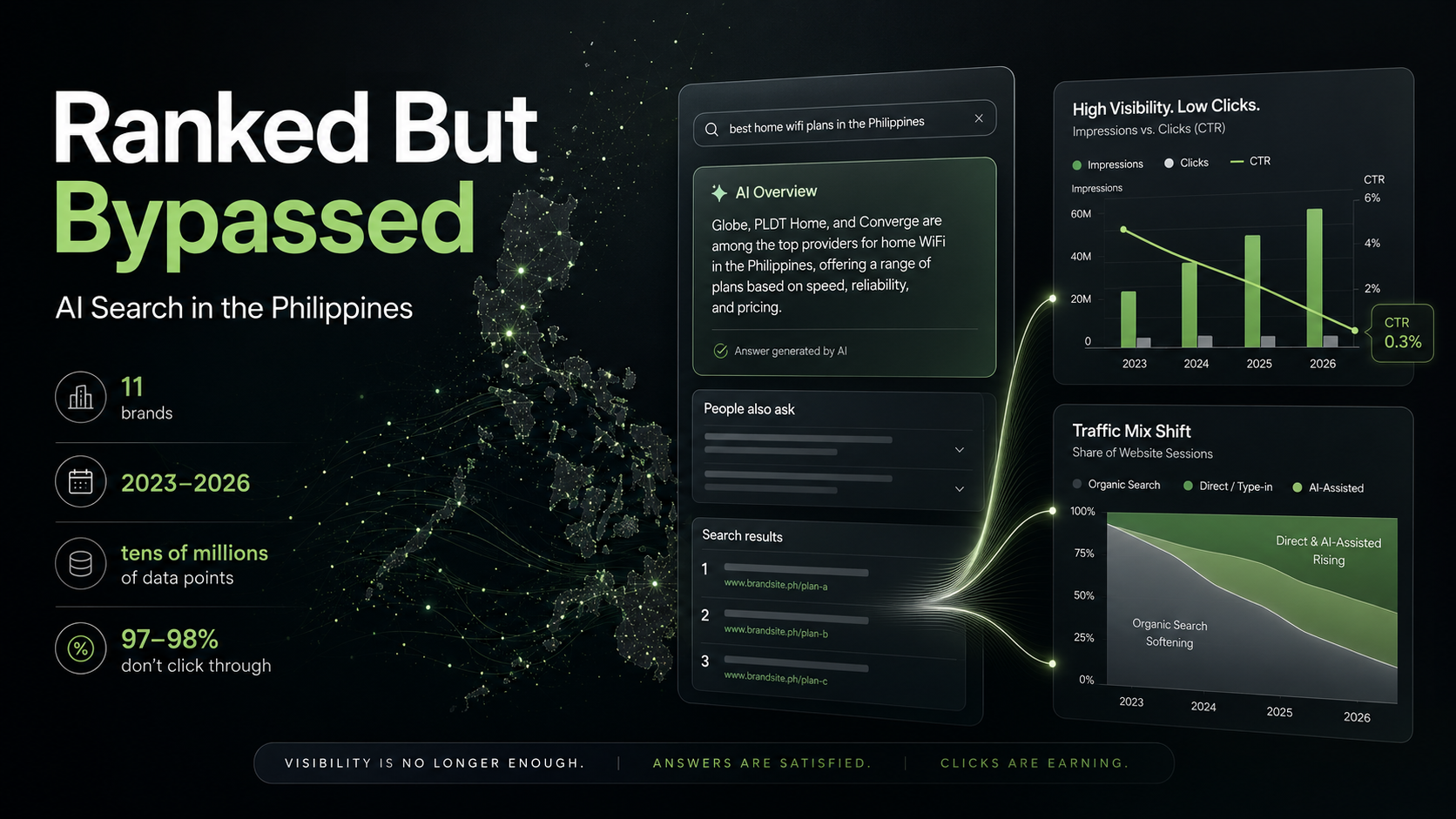
ChatGPT pulls only around 30% of its brand citations from websites ranking in Google’s top 10. Read that again if your company still considers SEO “done” once it reaches page one. For more than twenty years, search visibility had one scoreboard. You ranked or you didn’t. Agencies built retainers around keyword positions, marketing teams built budgets around organic traffic, and everyone agreed on what winning looked like: page one, preferably position one. That scoreboard didn’t get an update. It fragmented. Your business can rank well on Google and still be absent when a customer asks ChatGPT, Gemini, or Perplexity for a recommendation. You can be visible in search and invisible in the conversation. The quick answer Ranking first on Google is still valuable — but it no longer guarantees visibility across AI-powered search. Google Search, Google AI Overviews, Google AI Mode, ChatGPT, Gemini, and Perplexity each use different systems to retrieve, evaluate, and present information. A strong Google ranking influences some of them. It controls none of them. Businesses now need to answer three separate questions: Does Google rank us? Do people still click and visit us? Do AI platforms mention, cite, or recommend us? If your reporting only answers the first question, you’re working from an incomplete scoreboard. The number marketers should sit with Benchmark data published by AI-visibility platform CiteLens, and reported by MarketScale, found that Google AI Mode and Perplexity draw roughly 90% of their brand citations from websites in Google’s conventional top-10 results. Your existing SEO still buys you a seat at those tables.   ChatGPT draws only around 30% from that same pool.   This is one platform’s benchmark, not a universal law for every query, country, and industry. But the commercial implication is hard to ignore: the most-used AI assistant in the world is sourcing roughly 70% of its answers from somewhere your rank tracker doesn’t look. A brand can rank first, generate millions of impressions, and look successful in a traditional SEO report — while being excluded from the answer its next customer actually receives.   Google ranking and AI recommendation are related. They are not the same thing. What our own data shows: ranked, but bypassed LeapOut Digital’s 2026 study, Ranked But Bypassed, examined anonymised first-party Google Analytics 4 and Google Search Console data from 11 brands across the Philippines, Australia, North America, and South Africa — three and a half years of data, from January 2023 to June 15, 2026. Seven of the businesses were Philippine brands across six industry categories. Four brands had Google Search Console data available, representing a combined 59 million Google search impressions over 12 months. Here’s what that data showed. The rankings held. There was no collapse. These brands kept appearing on the first or second page of Google for the searches that matter to them — two Philippine brands held average positions around 8.6 and 9.1, and one generated roughly 35 million Google impressions in a single year. The clicks didn’t follow. Click-through rates across the four brands ranged from just 1.6% to 2.3%. Those 59 million impressions produced fewer than 1.3 million website visits. In practical terms: roughly 97 to 98 out of every 100 people who saw these brands in Google Search never visited their websites. To be clear about what the study does and doesn’t claim — it does not prove AI caused the entire gap. AI Overviews, featured snippets, People Also Ask boxes, query intent, and brand awareness all influence click-through rates. What the data establishes is a pattern businesses can no longer ignore: this isn’t an invisibility problem. It’s a conversion-of-visibility problem. The brand shows up; the searcher goes somewhere else — or gets their answer without going anywhere at all. AI-referred traffic is already showing up in Philippine analytics One more finding worth flagging. The “AI Assistant” acquisition channel appeared for the first time in the 2026 data of six brands in the study — five of them Philippine brands. Volumes were small, between 1 and 89 users per brand in the first half of 2026.   Small, but significant. It confirms that users are already arriving at Philippine brand websites through ChatGPT, Gemini, Perplexity, and Copilot. AI-assisted discovery isn’t something to prepare for someday — it’s already measurable in local analytics. And every major digital channel in history started as a rounding error before it became a budget line. Search didn’t disappear. It splintered. Most marketing teams still run a mental model of “Google Search, with AI added on top.” The reality is a dozen distinct answer surfaces: traditional Google Search, AI Overviews, AI Mode, ChatGPT, Gemini, Perplexity, Claude, Copilot, plus industry-specific assistants and social and ecommerce search. Each has its own retrieval systems, ranking signals, citation logic, and source preferences.   Your Google position influences some of them. It is not a master key to all of them.   This matters especially in the Philippines, where many companies are still strengthening traditional SEO foundations while customer behaviour is already moving toward conversational discovery. People aren’t just typing short keywords anymore — they’re asking complete commercial questions:   “What’s the best Shopify agency in the Philippines?” “Which digital marketing agencies in Manila work with Australian companies?” “Which agency can help a Philippine brand become visible in ChatGPT?” “Which Philippine agency offers global-quality execution at a competitive cost?”   The business named in the AI-generated answer may not be the business ranking first on Google. And when your brand is absent, the platform doesn’t leave the answer blank. It recommends someone else. What is AI search visibility? AI search visibility measures how frequently and prominently a brand appears in AI-generated answers. That includes being directly recommended, included in a shortlist, cited as a source, referenced in comparisons, or having your research and experts quoted to support an answer — and, just as importantly, whether your competitors appear when you don’t.   The discipline goes by several names — Answer Engine Optimisation (AEO), Generative Engine Optimisation (GEO), AI Search

Continue Reading
Headless Shopify development in the Philippines showcasing enterprise eCommerce solutions, custom integrations, and scalable storefronts by LeapOut Digital

Enterprise & Headless Shopify Builds in the Philippines | LeapOut 

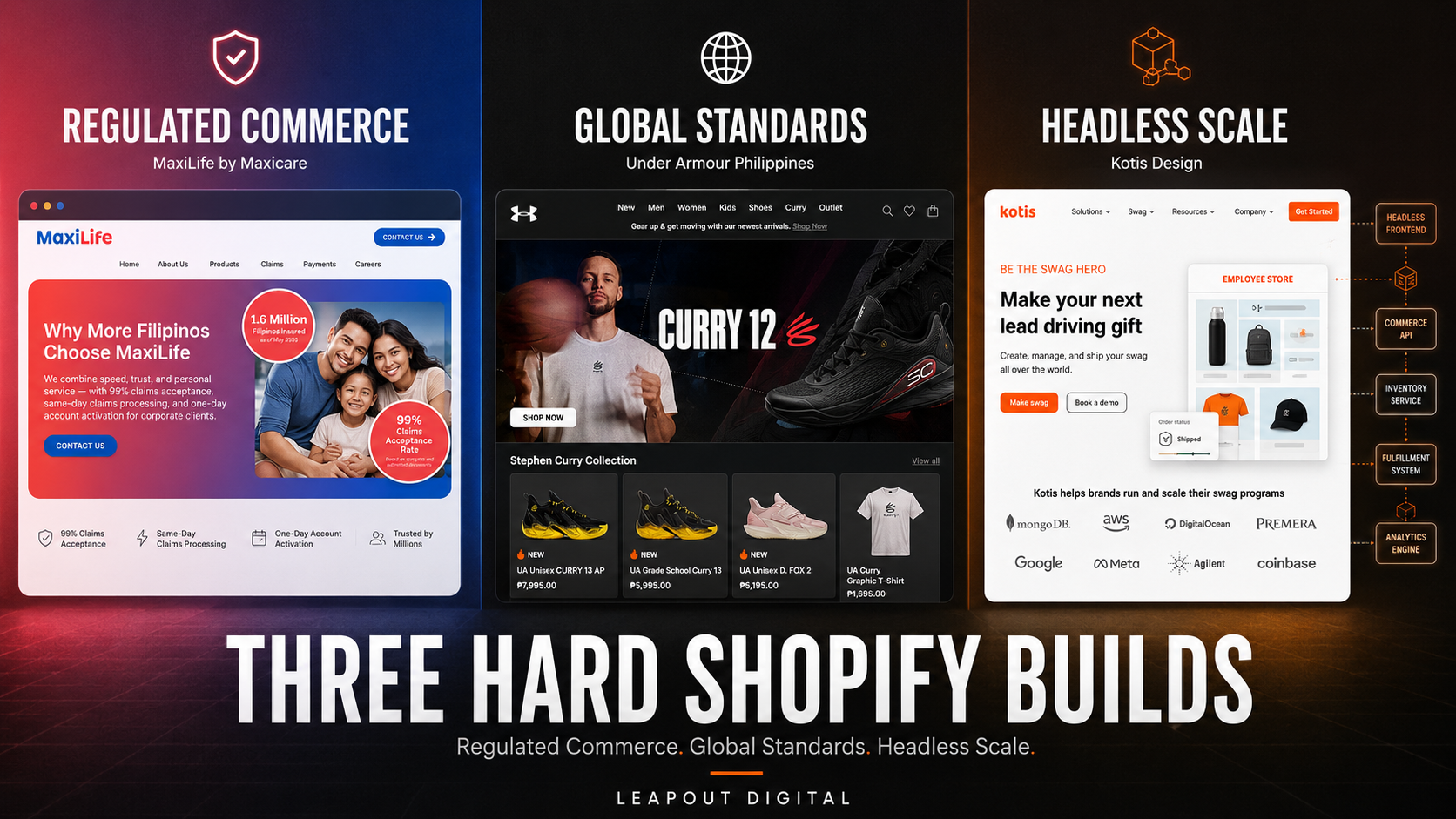
Inside LeapOut’s Hardest Shopify Plus Builds: Regulated Commerce, Enterprise Scale, and Going Headless By Marvin Ortiz, Co-Founder and Managing Partner, LeapOut Digital  The short version: Most agencies show you their prettiest work. We’d rather be judged by our hardest. This is a deep look at three Shopify and Shopify Plus builds that each solved one of the three hardest problems in enterprise ecommerce — selling a regulated product (MaxiLife by Maxicare), executing a global brand’s standards at scale (Under Armour Philippines), and extending Shopify Plus past its native limits into a headless build (Kotis Design, USA). We chose these three because difficulty is the one thing a portfolio can’t fake. If you want to know whether a team can actually build, look at what it does when the easy path runs out.   A portfolio full of beautiful storefronts proves almost nothing. Anyone with a good designer can produce a clean store on a forgiving brief. What separates a real engineering partner from a theme shop is what happens when the brief isn’t forgiving — when a regulator is involved, when a global brand sets a standard you can’t bend, or when the platform itself says “no.”  So instead of showing you everything we’ve built, I want to go deep on three. Not our prettiest work — our hardest. Each one represents a different way an ecommerce build can become genuinely difficult, and together they’re the closest thing we have to an honest answer to the question every serious client is really asking: can you handle the part that’s hard?  Here they are. Build One — MaxiLife by Maxicare: Selling a Regulated Product Online The problem most agencies won’t take. MaxiLife by Maxicare is a regulated, healthcare-adjacent insurance product from one of the country’s largest health-maintenance organizations — sold, for the first time, through ecommerce. That single fact changes everything about the build.  Why it was hard. Selling a regulated financial-and-health product isn’t like selling apparel. The build has to satisfy disclosure, compliance, and documentation requirements that a normal store never encounters — and it has to do that without turning the purchase into a punishing legal form. The entire challenge is a contradiction: make something heavily regulated feel light and human to the person buying it. Get the compliance wrong and you can’t launch. Get the experience wrong and no one buys. You have to win both.  What we did. We extended Shopify Plus with deep technical customization to meet the regulatory requirements while protecting the buying experience — building the compliance into the platform rather than bolting it on top, so the rules were satisfied structurally instead of being patched in. Precision wasn’t a preference here; it was the entire job.  What it proves. When we tell a prospect “we handle regulated commerce,” this is the build we point to — and it’s why brands in insurance, health, and finance take our calls. Regulated ecommerce is a specialist capability most agencies quietly avoid, and the avoidance is the opportunity.  “Your professionalism, dedication, and excellent service have been greatly appreciated… It’s been a pleasure collaborating with your team, and I truly value the strong relationship we’ve built. I will certainly recommend your services moving forward.” — Carlo Rodelas, MaxiLife, Digital Channels Manager Build Two — Under Armour Philippines: Executing a Global Standard, Flawlessly The problem you don’t hear discussed. Under Armour Philippines was one of the most demanding Shopify environments we’ve handled — and the difficulty was a specific, underrated kind: building to a standard we didn’t set.  Why it was hard. When you work with a global brand, the design language, the brand controls, and the performance expectations are all defined elsewhere, and they are non-negotiable. Your job isn’t to invent — it’s to execute someone else’s standard, locally, at the exact quality they require, every single time, while making the catalog, pricing, and promotional logic work for the Philippine market. A lot of agencies are good at being creative. Far fewer are good at being faithful — at delivering precisely what a global brand demands without drift or compromise. Shopify Plus gave us the flexibility; the scale demanded governance, because flexibility without structure creates risk at exactly the moment a global brand is watching.  What we did. Deep front-end customization aligned to global brand standards, disciplined performance engineering, and careful stakeholder alignment across local and global teams — the unglamorous governance work that keeps a high-traffic enterprise store fast, on-brand, and predictable.  What it proves. Being trusted by a global brand to touch its storefront is a credential in itself. Global and enterprise brands run procurement, legal, brand-safety, and performance reviews most local businesses never will. Clearing that bar is harder than winning any award — and it’s a bar we’ve cleared repeatedly. Based on Page speed Insights Report from Jun 14, 2026, 7:18:31 PM  Build-quality scorecard (Google Lighthouse): SEO 100 · Accessibility 95 · Best Practices 92 · Performance 79. A perfect SEO score and near-perfect accessibility are the marks of a build engineered to be found and usable, not just to look good — exactly the disciplined, measurable execution a global brand requires. Build Three — Kotis Design (USA): When the Platform Says No The problem at the technical frontier. Kotis Design is a US-based B2B company — a PPAI 100 firm, one of the largest distributors in the American promotional-products industry — serving major corporate clients with bespoke swag and merchandise programs. Their requirements exceeded what Shopify does natively. The platform, in effect, said no.  Why it was hard. Kotis needed heavy, per-client customization — bespoke corporate stores, redemption sites, and ordering flows tailored to each enterprise client. Shopify’s standard theme-and-app architecture doesn’t bend that far. A weaker partner says “Shopify can’t do that.” We treated it as the brief.  What we did. We built custom functionality to support complex product personalization, and as Kotis’s ambition for their platform grew, the work evolved toward a headless architecture — decoupling the storefront from Shopify’s native layer to deliver experiences and client-specific functionality the standard stack can’t, while keeping Shopify as the commerce engine underneath. It’s not a finished project; it’s a living platform we build against in regular sprints, and have for two years.  What it proves. Two things, and both

Continue Reading